CBSE vs IGCSE
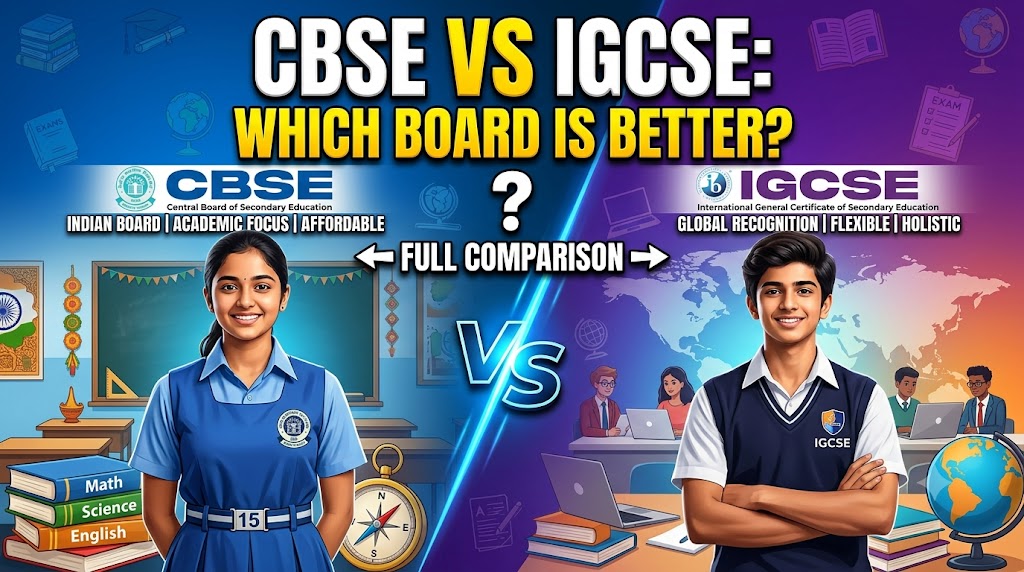
Choosing the right school curriculum can affect a student’s learning style, subject choices, examinations, and future education options. In this CBSE vs IGCSE comparison, we look at the major differences between CBSE and Cambridge IGCSE so parents and students can understand which option may suit their needs.
CBSE is an Indian school board, while Cambridge IGCSE is an internationally recognised qualification generally taken by students around the 14–16 age range. Cambridge IGCSE offers a flexible subject-based curriculum, while CBSE follows a structured curriculum designed for schools affiliated with the board. (CBSE Academic)
Quick Comparison: CBSE vs IGCSE
| Feature | CBSE | Cambridge IGCSE |
|---|---|---|
| Education system | Indian school board | International qualification |
| Main orientation | Indian education system | International education |
| Typical stage | Secondary and senior secondary schooling | Usually ages 14–16 |
| Curriculum | Structured CBSE curriculum | Flexible subject-based curriculum |
| Subject choice | Broad range of subjects | 70+ subjects available |
| Learning approach | Competency-based and experiential learning | Enquiry, problem-solving and application |
| Assessment | Examinations plus applicable internal assessment | Written, oral, coursework or practical depending on subject |
| International recognition | Widely used in India and recognised internationally | Widely recognised internationally |
| Indian higher education | Strongly established pathway | Accepted in India subject to equivalence and institution requirements |
| Best suited for | Students following the Indian education pathway | Students seeking international curriculum flexibility |
CBSE vs IGCSE: Curriculum
CBSE’s current curriculum is aligned with the National Curriculum Framework for School Education and focuses on competency-based education, experiential learning, flexibility and holistic development. (CBSE Academic)
Cambridge IGCSE is designed as an international curriculum. Schools can select and combine subjects according to their programme, and Cambridge states that the curriculum is designed to support learners with different abilities and educational backgrounds. (Cambridge International)
In simple terms: CBSE follows a more standardised Indian school-board structure, while IGCSE gives schools more flexibility in building their subject programme.
CBSE vs IGCSE: Syllabus
CBSE provides prescribed curriculum frameworks and subject curricula for affiliated schools. Its current secondary curriculum includes areas such as languages, mathematics, sciences, humanities, skill subjects, general studies and health and physical education. (CBSE Academic)
Cambridge IGCSE is organised around individual subjects. Cambridge currently offers more than 70 IGCSE subjects, including more than 30 languages, allowing schools to create different combinations. (Cambridge International)
Therefore, students who prefer a familiar Indian curriculum structure may find CBSE easier to follow, while students who want wider international subject flexibility may find IGCSE attractive.
Learning Approach
CBSE’s curriculum places emphasis on competency-based learning, hands-on experience, application of knowledge and real-life problem-solving. (CBSE Academic)
Cambridge IGCSE encourages enquiry, creative thinking, problem-solving and applying knowledge to familiar and new situations. (Cambridge International Help)
This means neither system should simply be described as “easy” or “difficult.” The better choice depends on how the student learns.
- CBSE may suit students who prefer a structured Indian curriculum.
- IGCSE may suit students who enjoy enquiry, application and a more flexible subject structure.
Subjects and Academic Choice
CBSE offers a broad selection of academic and skill-related subjects through its curriculum. The exact subjects available can depend on the school and applicable curriculum structure. (CBSE Academic)
Cambridge IGCSE provides more than 70 subject options, and schools can offer different combinations of subjects. (Cambridge International)
So, if subject variety and international curriculum options are important, IGCSE has an advantage in flexibility.
Examination and Assessment
CBSE assessment depends on the class and subject and can include board examinations and internal assessment components according to the applicable curriculum.
Cambridge IGCSE assessment takes place at the end of the course and can include written, oral, coursework and practical assessment depending on the subject. (Cambridge International)
This makes the assessment structure different rather than simply better or worse.
Better choice:
- For a student comfortable with the Indian examination structure, CBSE may be more familiar.
- For a student who benefits from different assessment methods, IGCSE may provide more variety, depending on the subjects selected.
Global Recognition
Cambridge IGCSE has strong international recognition. Cambridge states that IGCSE is widely recognised by higher education institutions and employers around the world. (Cambridge International Help)
CBSE is also an established Indian board with a large network of affiliated schools and a curriculum designed for the Indian education system. Its qualifications can support students pursuing education in India and abroad, subject to the requirements of the institution or country.
Better for international mobility: IGCSE generally has the clearer international orientation.
CBSE vs IGCSE for Higher Education in India
CBSE provides a direct pathway through the Indian school education system.
Cambridge IGCSE is also accepted in India. Cambridge states that Cambridge IGCSE is accepted as equivalent to Grade 10 in India under the stated equivalence criteria. However, higher-education institutions can have their own admission and subject requirements. (Cambridge International)
Therefore, choosing IGCSE does not automatically prevent a student from studying in India.
For competitive or specialised courses, students should check the latest eligibility and subject requirements of the relevant examination, university or institution before choosing subjects.
CBSE vs IGCSE for Studying Abroad
IGCSE has been designed specifically for international use and is widely recognised by universities and educational institutions around the world. (Cambridge International Help)
CBSE students can also apply to universities outside India. However, individual universities and countries may have specific admission, subject and qualification requirements.
Better suited to an international education pathway: IGCSE.
However, the final decision should also consider the qualification taken after IGCSE, such as Cambridge International AS & A Level, because IGCSE is normally the secondary-level qualification rather than the complete university-entry pathway.
School Transfer
CBSE can be convenient for students who may move between CBSE-affiliated schools in India because they remain within the same board system.
IGCSE can be useful when moving between schools that offer Cambridge programmes. However, the exact subjects and curriculum offered can differ from school to school.
Before changing schools, parents should compare the subjects, grade level and curriculum offered by the new school rather than choosing only on the basis of the board name.
Cost of Education
There is no single fixed fee for either CBSE or IGCSE.
School fees depend heavily on the school, city, facilities, teaching model and other services. IGCSE is commonly offered by private and international-style schools, so the total cost can be higher at some schools, but this is not a universal rule.
Parents should compare the actual annual fee, admission charges, books, transportation, activities and other school expenses before making a decision.
Which Is Better for Your Child?
There is no universal winner in the CBSE vs IGCSE comparison. The better choice depends on the student’s future plans, learning style, school options and budget.
Choose CBSE if:
- You mainly expect the student to continue within the Indian education system.
- You prefer a structured Indian curriculum.
- You want the familiarity of the CBSE system.
- You may move between CBSE schools in India.
- The selected CBSE school offers the subjects and facilities your child needs.
Consider IGCSE if:
- You prefer an internationally oriented curriculum.
- International education or overseas study is an important possibility.
- Your child enjoys enquiry, problem-solving and application-based learning.
- You want a wider choice of subjects.
- Your selected school has a strong Cambridge programme.
Final Verdict: CBSE vs IGCSE
CBSE is a strong choice for students who want a structured pathway within the Indian education system.
IGCSE can be a strong choice for students who want an internationally oriented curriculum, greater subject flexibility and a qualification with broad international recognition.
So, CBSE vs IGCSE does not have one universal winner. For an India-focused education pathway, CBSE may be the more straightforward choice. For students planning an international academic pathway, IGCSE may offer greater flexibility and international orientation.
Most importantly, parents should compare the actual school, teachers, subjects, fees and future academic requirements rather than choosing only on the reputation of the curriculum.
Related Parkhu Comparisons
- CBSE vs State Board: Which Board Is Better?
- ICSE vs State Board: Which Board Is Better?
- CBSE vs IB: Which Board Is Better?
Disclaimer
Education boards, curricula, admission requirements, examination rules, subject combinations and school fees can change over time. The information in this comparison is intended for general guidance. Parents and students should verify the latest curriculum, eligibility, admission and examination requirements with the respective board, Cambridge International, school, university or official examination authority before making an important education decision.