Wireless Charger vs Wired Charger
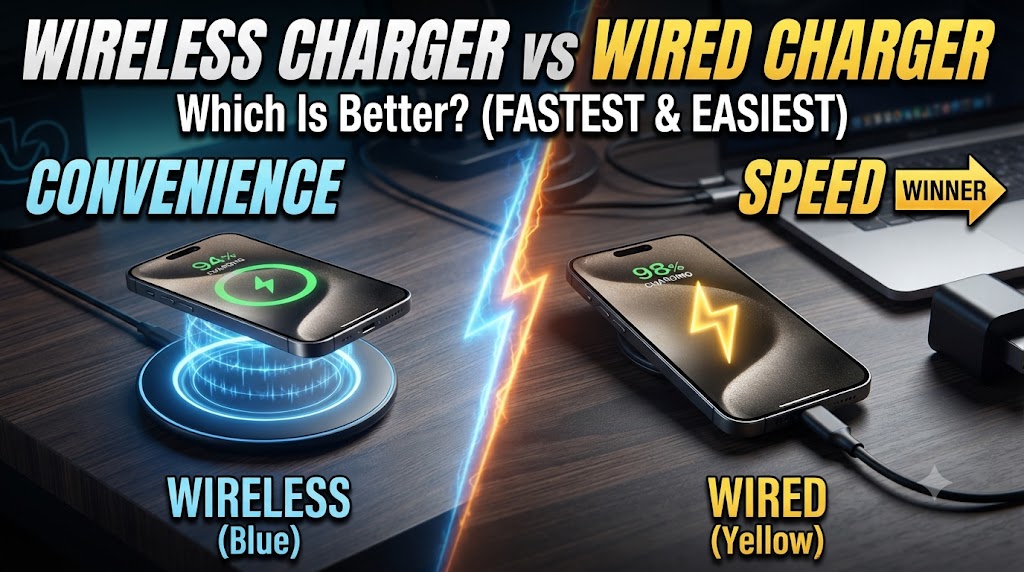
Wireless chargers and wired chargers are two common ways to charge smartphones, earbuds, smartwatches, and other compatible devices. A wired charger transfers power through a cable, while a wireless charger transfers power without a direct cable connection to the device. Both methods can provide reliable charging, but they differ in speed, efficiency, convenience, heat generation, compatibility, and everyday usability. This Wireless Charger vs Wired Charger comparison explains the main differences so you can choose the charging method that better suits your needs.
The better option depends on what you value most. Wired charging is generally better when charging speed, efficiency, and flexibility are priorities. Wireless charging can be more convenient because you can place a compatible device on a charging pad without repeatedly connecting a cable. However, wireless charging requires compatible hardware and proper alignment, while wired charging works through a suitable charging port and cable.
Quick Comparison Table
| Feature | Wireless Charger | Wired Charger |
|---|---|---|
| Charging Method | Wireless power transfer | Cable-based power transfer |
| Charging Speed | Usually slower, depending on technology | Generally faster |
| Charging Efficiency | Generally lower | Generally higher |
| Convenience | Very convenient | Requires cable connection |
| Heat | Can generate more heat | Usually produces less heat |
| Cable Required | Charger still needs a power cable | Yes |
| Compatibility | Requires wireless charging support | Requires compatible charging port/cable |
| Use While Charging | Less convenient | Easier |
| Port Wear | Less use of charging port | Charging port is used |
| Portability | Convenient for a desk or bedside | Usually more flexible for travel |
| Best For | Convenience and easy daily charging | Speed, efficiency, and flexibility |
Wireless Charger vs Wired Charger: Main Difference
The main difference is how electricity reaches the device.
A wired charger sends electrical power directly through a cable connected to the device. The charger, cable, and device work together to deliver the required power.
A wireless charger transfers power through electromagnetic induction between the charging pad and a compatible device. The device normally needs to be positioned correctly on the charging surface.
What Does This Mean for You?
If you want to connect your phone and leave it charging while using it normally, wired charging is usually more practical.
If you want to simply place your phone on a charging pad whenever you are not using it, wireless charging offers greater convenience.
Charging Speed
Charging speed is one of the biggest differences between wired and wireless charging.
Wired charging can support high power levels, especially when the phone, charger, and cable support compatible fast-charging standards. Wireless charging can also offer fast charging, but the maximum speed depends heavily on the device and wireless charging technology.
In general, wired charging has an advantage in charging speed.
Winner: Wired Charger
If your priority is getting your device charged as quickly as possible, a compatible wired charger is usually the better choice.
Charging Efficiency
Wired charging generally transfers power more efficiently because electricity travels directly through the cable.
Wireless charging involves transferring energy between coils, which can result in additional energy loss. Alignment between the device and charging pad can also affect charging performance.
Modern wireless charging systems are designed to manage power and temperature, but wired charging generally remains more efficient.
Winner: Wired Charger
For users who prioritize efficient power delivery, wired charging is usually the better option.
Convenience
Wireless charging is highly convenient for everyday use.
Instead of plugging a cable into your phone, you can simply place the device on the charging pad. This can be especially useful on a desk, bedside table, or other fixed location.
Wired charging requires you to connect and disconnect the cable, but it provides more flexibility while using the device.
Winner: Wireless Charger
Wireless charging has the advantage when convenience is more important than maximum speed.
Heat Generation
Wireless charging can generate more heat because of the energy-transfer process and possible power losses. Heat can also increase if the device is poorly aligned, covered, or used heavily while charging.
Wired charging can also produce heat, especially during fast charging, but direct power transfer is generally more efficient.
Modern phones and chargers include temperature and power management features, so the actual heat level depends on the specific device and charging system.
Winner: Depends
Neither method is automatically free from heat. However, wired charging generally has an efficiency advantage, while modern wireless systems are designed to manage charging temperature.
Compatibility
Wired charging is generally more widely usable because many devices can be charged through a compatible physical charging port and cable.
Wireless charging requires the device itself to support a compatible wireless charging standard. A phone without wireless charging support cannot normally be charged simply by placing it on a wireless charging pad.
Winner: Wired Charger
Wired charging is generally more flexible across different types of devices and charging situations.
Using Your Device While Charging
A wired connection can make it easier to continue using a phone while it is charging. You can hold the phone and keep the cable connected, although the cable can sometimes be inconvenient.
Wireless charging can make continuous handheld use less convenient because the device normally needs to remain near or on the charging pad.
Winner: Wired Charger
For people who frequently use their phone while charging, wired charging is usually more practical.
Port Wear and Convenience
Wireless charging reduces the need to repeatedly connect a charging cable to the device. This can be convenient for people who charge their phone several times throughout the day.
With wired charging, the charging port and cable connector are used regularly. However, a good-quality cable and careful handling can help reduce unnecessary wear.
Winner: Wireless Charger
Wireless charging has an advantage if reducing frequent cable connections is important to you.
Portability
A wired charger can be very practical when travelling because one charger and a compatible cable can serve many charging situations.
A wireless charging pad can also be portable, but it normally still requires a power cable and power adapter. Some wireless charging accessories are designed specifically for travel and can reduce cable clutter.
Winner: Depends
For maximum flexibility, wired charging is usually better. For convenient charging at a fixed location, wireless charging can be more comfortable.
Cost
The price of a charging setup depends on the charger, power rating, cable, brand, and charging technology.
Basic wired charging equipment can be inexpensive. Wireless charging pads can cost more because they require additional charging hardware.
However, the price difference varies widely between products.
Winner: Wired Charger
For a simple and economical charging setup, wired charging generally offers more affordable options.
Which Is Better for Overnight Charging?
Both wireless and wired charging can be suitable for overnight charging when you use compatible, reliable charging equipment.
Wireless charging can be particularly convenient beside the bed because you can simply place the phone on the charging pad.
Wired charging can be preferable if you want faster charging or greater charging efficiency.
Winner: Wireless for Convenience
For bedside convenience, wireless charging has an advantage. For efficiency and flexibility, wired charging remains a strong option.
Which Is Better for Travel?
A wired charger is usually more versatile for travel because you can carry a suitable cable and use it with compatible devices.
Wireless charging can reduce the need to repeatedly connect cables, but you still generally need to carry the charging pad and its power connection.
Winner: Wired Charger
For travel flexibility, wired charging is generally the better choice.
Which Is Better for Fast Charging?
If fast charging is your main priority, wired charging is generally the safer choice because it supports a wide range of high-power charging technologies.
Some wireless chargers also support fast charging, but the actual charging speed depends on the device, charger, charging standard, alignment, temperature, and other factors.
Winner: Wired Charger
For maximum charging speed, a compatible wired fast charger is generally the better option.
Which One Should You Buy?
Choose a wireless charger if:
- You value convenience.
- You mostly charge your device at a desk or bedside.
- Your device supports wireless charging.
- You want to reduce frequent cable connections.
- You prefer placing the phone on a charging pad.
Choose a wired charger if:
- You want faster charging.
- You care about charging efficiency.
- You frequently use your device while charging.
- You travel frequently.
- You want maximum compatibility and flexibility.
Wireless Charger vs Wired Charger: Which Is Better?
There is no single winner for every user.
Wired charging is better for speed, efficiency, flexibility, and travel. Wireless charging is better for convenience and simple everyday charging.
If you want one primary charging method, a wired charger is generally the more versatile choice. If convenience is your top priority, adding a wireless charger for your desk or bedside can be a useful option.
Final Verdict
The Wireless Charger vs Wired Charger comparison shows that both charging methods have clear advantages.
Choose wired charging for faster and more efficient charging. Choose wireless charging for convenience and easy placement. For many users, keeping a reliable wired charger as the primary option and using a wireless charger as a secondary convenience charger can provide the best of both approaches.
Disclaimer
Charging speed, power output, compatibility, heat generation, and charging efficiency can vary depending on the device, charger, cable, charging standard, software, and manufacturer. Always use compatible and reliable charging accessories. Specifications and prices may change over time.