ChatGPT vs Perplexity
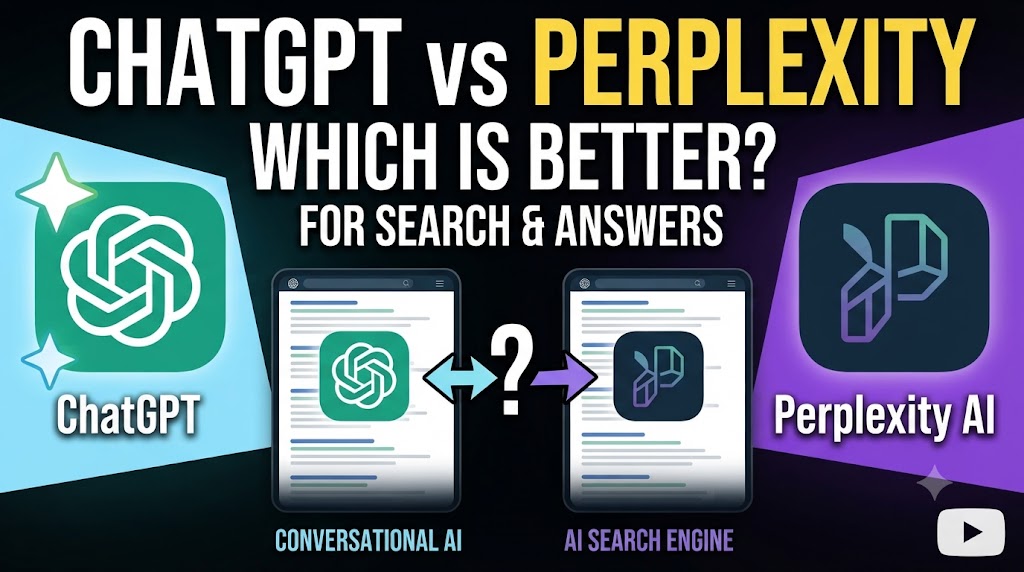
When you need information from the internet, both ChatGPT and Perplexity can provide AI-generated answers instead of making you browse through many search results yourself. However, they are designed with slightly different strengths. ChatGPT combines conversational AI with web search, allowing users to ask follow-up questions, analyze information, and continue a discussion in the same conversation. Its web search can provide current information with links to relevant sources. (OpenAI Help Center)
Perplexity is built more directly around AI-powered search and answers. It searches the web in real time, summarizes information from multiple sources, and provides citations and links with its answers. Its search-focused features include standard Search, Pro Search, and Research, with advanced options designed for more detailed research. (Perplexity AI)
Quick Comparison Table
| Feature | ChatGPT | Perplexity |
|---|---|---|
| Main strength | Conversational AI + search | AI-powered search and research |
| Web search | Yes | Yes |
| Source citations | Yes when web search is used | Yes |
| Real-time information | Yes | Yes |
| Follow-up questions | Excellent | Excellent |
| Research capabilities | Search + Deep Research | Search + Pro Search + Research |
| Writing and content creation | Excellent | Good |
| General-purpose AI assistance | Excellent | Good |
| Source-focused research | Very good | Excellent |
| Best for | Answers, reasoning, writing and broader AI tasks | Search, research and source discovery |
ChatGPT vs Perplexity: Search Experience
ChatGPT
ChatGPT can search the web when a question needs current or detailed information. It can also search manually when the user selects the web-search option. Search results can include citations and links to the sources used for the answer. (OpenAI Help Center)
One major advantage is that search is part of a broader conversational system. You can ask a question, receive an answer, and then continue with follow-up questions without starting the research process again.
For example, you could ask about a smartphone, then ask about its camera, compare it with another phone, and finally ask which one would be better for your budget.
Practical meaning: ChatGPT is useful when your search develops into a longer conversation or decision-making process.
Perplexity
Perplexity is designed specifically around AI-powered search. It searches the web in real time and creates a conversational answer based on information gathered from different sources. Its answers include citations and links to original sources. (Perplexity AI)
Perplexity also offers more advanced search modes. Its Pro Search can conduct multiple searches and synthesize information from sources such as websites, articles, academic papers and other online material. (Perplexity AI)
Practical meaning: Perplexity feels closer to a traditional search engine combined with an AI research assistant.
Winner for search-focused experience: Perplexity
ChatGPT vs Perplexity: Answer Quality
Both tools can turn web information into a direct answer rather than simply displaying a list of links.
ChatGPT has an advantage when the question requires explanation, reasoning, rewriting, brainstorming or a longer conversation. Its web search can combine current web information with the conversational and reasoning capabilities of ChatGPT. (OpenAI)
Perplexity focuses more heavily on finding and synthesizing information from online sources. Its system is designed to search, summarize and cite information in a relatively direct format. (Perplexity AI)
However, neither service should be treated as automatically correct. Both companies recommend checking cited sources, particularly when the information is important. (OpenAI Help Center)
Winner for general-purpose answers: ChatGPT
Winner for source-focused answers: Perplexity
ChatGPT vs Perplexity: Citations and Sources
Citations are important when you are researching a topic because they allow you to check where information came from.
ChatGPT can provide citations when web search is used. Users can open the citations and review the sources behind an answer. (OpenAI Help Center)
Perplexity places even greater emphasis on citations as part of its search experience. The company states that its responses include citations and links to original sources. It also provides source labels for some domains, including Government, Academic and Trusted. (Perplexity AI)
This makes Perplexity particularly convenient when your main purpose is to discover and verify online sources.
Winner for source-focused research: Perplexity
ChatGPT vs Perplexity: Deep Research
Both platforms now offer more advanced research capabilities.
ChatGPT has a Deep Research feature designed for complex questions that require multi-step web research, analysis and synthesis. OpenAI describes it as an agentic process that can search, evaluate sources, refine queries and produce a detailed report with citations. (OpenAI)
Perplexity also offers a Research feature. According to Perplexity, its Deep Research process can perform multiple searches, examine many sources and produce a comprehensive report. (Perplexity AI)
The exact availability and limits of these features can depend on the user’s plan and can change over time.
Verdict: Both are strong for deeper research. The better choice depends on whether you prefer ChatGPT’s broader AI workflow or Perplexity’s search-first approach.
ChatGPT vs Perplexity: Follow-Up Questions
ChatGPT is particularly strong when a search becomes a conversation.
You can ask a broad question and then progressively narrow it down. For example:
Question: Which laptop is better for video editing?
Follow-up: What about battery life?
Follow-up: Which one is better for a student?
Follow-up: Compare their value for money.
This conversational workflow is one of ChatGPT’s major strengths.
Perplexity also supports follow-up questions and maintains conversational context while researching. (Perplexity AI)
Winner: ChatGPT
The difference is not that Perplexity cannot handle follow-ups. Rather, ChatGPT’s broader AI capabilities make it particularly useful when research turns into writing, analysis, planning or other tasks.
ChatGPT vs Perplexity: Writing and Content Creation
This is where the two platforms become noticeably different.
ChatGPT is a general-purpose AI assistant that can search the web but can also help with writing, rewriting, brainstorming, explanations, planning, coding and other tasks.
Perplexity can also generate and organize written content, but its core identity remains much more closely connected to AI-powered search and research.
Therefore, if you want to research a topic and then turn that research into an article, email, explanation or other piece of content, ChatGPT can be the more convenient all-in-one option.
Winner for broader content creation: ChatGPT
ChatGPT vs Perplexity: Research for Students and Professionals
For quick research, both tools can be useful.
Perplexity has an advantage when you want to quickly find information and inspect the sources behind an answer. Its search-focused design and citation system make it convenient for source discovery. (Perplexity AI)
ChatGPT becomes particularly useful when research involves several stages. You can search for information, ask for an explanation, compare findings, organize the information and then create a structured document from it.
For example, a professional researching a new technology could use ChatGPT to search for current information, identify differences between products, analyze the findings and turn the results into a report.
Winner: Depends on the task
- Finding and checking sources: Perplexity
- Research plus analysis and writing: ChatGPT
ChatGPT vs Perplexity: Which Is Easier to Use?
Both are relatively simple to use because you can ask questions in natural language.
ChatGPT is particularly comfortable for users who want one AI assistant for many different tasks.
Perplexity is straightforward for users who primarily think of AI as a smarter search tool. Its search-oriented interface makes the purpose of the service immediately clear.
Winner: Tie
The easier option depends on whether you prefer a general AI assistant or a search-first experience.
ChatGPT vs Perplexity: Which Is Better for Current Information?
Both platforms can access current information through web search.
ChatGPT can search the web for up-to-date information and provide source links. (OpenAI Help Center)
Perplexity states that its answers use real-time web information, allowing it to provide current information when users ask questions. (Perplexity AI)
Therefore, neither should be considered limited to old training information when web search is being used.
Winner: Tie
For important or changing information, however, users should still open and verify the cited sources.
ChatGPT vs Perplexity: Which One Should You Choose?
Choose ChatGPT if you want:
- A general-purpose AI assistant
- Conversational answers and follow-up questions
- Web search combined with broader AI capabilities
- Writing and rewriting help
- Reasoning and analysis
- Research followed by content creation
- One tool for many different AI tasks
Choose Perplexity if you want:
- A search-first AI experience
- Quick answers based on current web information
- Easy access to citations and original sources
- Source discovery and verification
- AI-assisted web research
- More focused search and research workflows
Final Verdict
ChatGPT is better for general-purpose answers, conversation, reasoning and content creation, while Perplexity is better for users who primarily want an AI-powered search and research experience with prominent source citations.
If your main goal is finding information and checking sources quickly, Perplexity is the stronger choice.
If you want search plus a broader AI assistant that can continue into analysis, writing and other tasks, ChatGPT is the better overall choice.
So, there is no universal winner. Perplexity wins for search-focused research, while ChatGPT wins as a broader AI assistant.
Disclaimer
AI features, search capabilities, available models, plans, usage limits, citations and other services can change over time. Always check the official websites and current plan details before making a purchase or relying on a feature described in this comparison.