HEPA Filter vs Standard Filter Vacuum Cleaner
Introduction
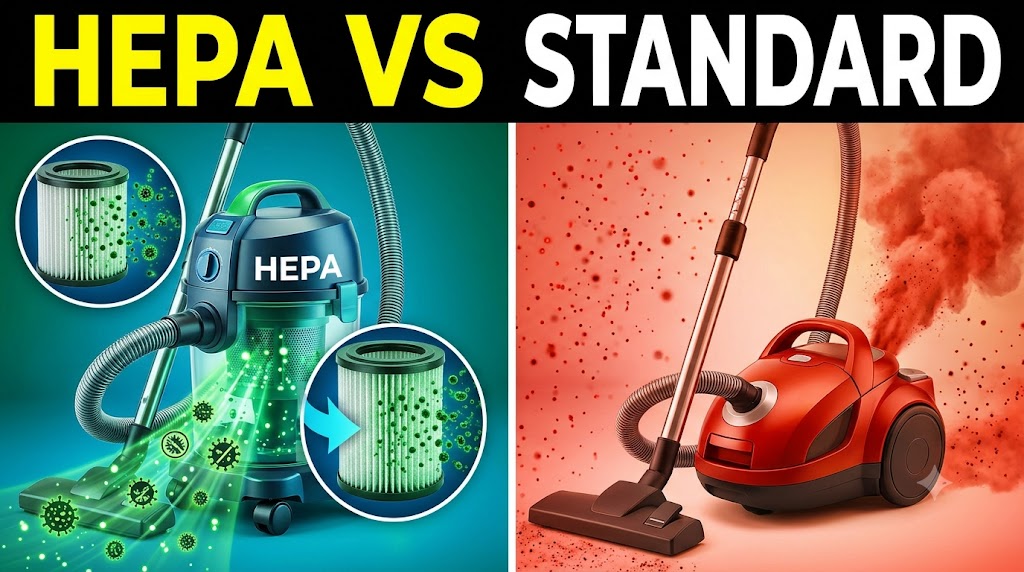
Choosing between a HEPA filter and a standard filter vacuum cleaner depends on your cleaning requirements and the level of filtration you expect. Both types of vacuum cleaners collect dust, dirt, and other particles, but their filtration capabilities can differ significantly. A HEPA filter is designed to capture very small airborne particles under specified test conditions, while standard filters vary in their construction and particle-capturing efficiency. Understanding these differences helps you choose a vacuum cleaner that suits your home and cleaning environment.
Filtration is particularly important when you want to reduce the amount of fine dust released back into indoor air. HEPA filtration can be useful for households concerned about airborne particles, while a standard filter may be sufficient for routine cleaning needs. However, the overall filtration performance also depends on the vacuum cleaner’s sealing, airflow design, and filter maintenance. Before purchasing, check whether the appliance uses a genuine HEPA filter or simply carries a similar-sounding marketing label.
Quick Comparison Table
| Feature | HEPA Filter Vacuum Cleaner | Standard Filter Vacuum Cleaner |
|---|---|---|
| Filtration | High-efficiency particle filtration | Varies by filter type |
| Fine particle capture | Very high under specified test conditions | Depends on filter design |
| Dust removal | Suitable | Suitable |
| Air filtration | Designed for very small airborne particles | Varies by model |
| Allergy-related concerns | May help reduce airborne allergens | Depends on filtration efficiency |
| Maintenance | Requires proper filter care and replacement | Requires filter cleaning or replacement |
| Replacement cost | Can be higher | Often varies by filter type |
| Best for | Users prioritizing high-efficiency filtration | Routine cleaning requirements |
1. Filtration Efficiency
HEPA Filter Vacuum Cleaner
HEPA stands for High-Efficiency Particulate Air. A genuine HEPA filter is commonly specified to capture at least 99.97% of particles measuring 0.3 microns under the relevant test conditions.
This high filtration efficiency makes HEPA filters useful for capturing very small airborne particles, including fine dust and certain allergens.
However, the complete vacuum cleaner must also be designed properly to prevent unfiltered air from escaping around the filter.
Standard Filter Vacuum Cleaner
Standard vacuum cleaner filters are available in different materials and designs. Their ability to capture dust and fine particles depends on their construction and filtration rating.
Some standard filters provide effective everyday filtration, but they may not meet HEPA filtration standards.
Winner: HEPA Filter Vacuum Cleaner. It provides a defined high level of particle filtration when it uses a genuine, properly fitted HEPA filter.
2. Dust and Fine Particle Removal
HEPA Filter Vacuum Cleaner
A HEPA filter can capture very small particles that may otherwise pass through less efficient filtration systems.
It is particularly useful when cleaning areas where fine dust and airborne particles are a concern.
Standard Filter Vacuum Cleaner
A standard filter can capture ordinary household dust, dirt, and debris. However, its ability to retain very fine particles depends on its filtration efficiency.
Lower-efficiency filters may allow some smaller particles to pass through.
Winner: HEPA Filter Vacuum Cleaner. Its high-efficiency filtration provides better capture of fine airborne particles.
3. Indoor Air Quality
HEPA Filter Vacuum Cleaner
A vacuum cleaner with a genuine HEPA filter can help reduce the release of fine particles collected during cleaning.
This can be beneficial for households that want to minimize airborne dust. However, overall performance depends on proper sealing and the appliance’s complete filtration system.
Standard Filter Vacuum Cleaner
A standard filter vacuum cleaner can effectively collect everyday dirt and dust. However, its ability to prevent fine particles from returning to the surrounding air varies between models.
A well-designed standard filtration system may still be suitable for ordinary household cleaning.
Winner: HEPA Filter Vacuum Cleaner. It is generally the better option when high-efficiency particle filtration is a priority.
4. Suitability for Allergy-Sensitive Households
HEPA Filter Vacuum Cleaner
A HEPA filter can capture many small particles, including certain airborne allergens such as pollen and dust-related particles.
This makes it a useful consideration for households concerned about allergens. A sealed vacuum cleaner with genuine HEPA filtration is generally preferable to one with an unverified filter.
Standard Filter Vacuum Cleaner
A standard filter may capture larger dust particles and other common debris, depending on its design.
However, lower-efficiency filters may not retain as many fine airborne particles as genuine HEPA filters.
Winner: HEPA Filter Vacuum Cleaner. Its higher filtration efficiency makes it a stronger option for households prioritizing allergen particle capture.
5. Maintenance and Replacement
HEPA Filter Vacuum Cleaner
HEPA filters require appropriate maintenance to preserve their filtration performance. Some are washable, while others must be replaced.
Cleaning methods depend on the manufacturer’s instructions. Washing a filter that is not washable may damage it.
Standard Filter Vacuum Cleaner
Standard filters also require regular cleaning or replacement. Some models use reusable filters, while others use disposable filter components.
Their maintenance requirements depend on the filter material and appliance design.
Winner: Depends. Both types require proper maintenance. Replacement frequency and cost vary by model.
6. Cost and Value for Money
HEPA Filter Vacuum Cleaner
Vacuum cleaners with genuine HEPA filtration may cost more because of their filtration components and overall design.
Replacement filters can also add to long-term ownership costs. However, the additional filtration may be worthwhile when capturing fine particles is a priority.
Standard Filter Vacuum Cleaner
A standard filter vacuum cleaner may be more affordable, particularly when basic household cleaning is the main requirement.
Replacement filters may also be less expensive, depending on the model.
Winner: Standard Filter Vacuum Cleaner for budget-conscious buyers. However, compare actual purchase and replacement costs before deciding.
7. Which One Is Better for Different Users?
| User or Situation | Recommended Option | Reason |
|---|---|---|
| Household prioritizing fine particle filtration | HEPA Filter Vacuum Cleaner | Captures very small particles efficiently |
| Allergy-sensitive household | HEPA Filter Vacuum Cleaner | Can help capture certain airborne allergens |
| Everyday dust cleaning | Either option | Both can handle routine cleaning |
| Budget-conscious buyer | Standard Filter Vacuum Cleaner | May offer a lower purchase cost |
| Household concerned about indoor dust | HEPA Filter Vacuum Cleaner | Better fine-particle filtration |
| Occasional cleaning requirements | Standard Filter Vacuum Cleaner | May provide sufficient filtration |
| Workshop or dusty environment | Depends | Filter suitability and dust-handling capacity matter |
Final Verdict: HEPA Filter vs Standard Filter Vacuum Cleaner
A HEPA filter vacuum cleaner is the better choice if you prioritize high-efficiency filtration and want to capture very small airborne particles. It can be particularly useful for households concerned about fine dust and allergens.
A standard filter vacuum cleaner is a practical choice for routine cleaning when advanced filtration is not a major requirement. It may also be more affordable, depending on the appliance and replacement filter costs.
Overall winner: HEPA Filter Vacuum Cleaner for filtration performance. However, a genuine HEPA filter alone does not guarantee excellent whole-machine filtration. Check the vacuum cleaner’s sealing, filter certification, maintenance requirements, and replacement availability before buying.
Frequently Asked Questions (FAQs)
1. What is the main difference between a HEPA filter and a standard filter?
A HEPA filter meets a defined high-efficiency particle filtration standard, while standard filters have different filtration capabilities depending on their design and construction.
2. Is a HEPA filter better than a normal vacuum cleaner filter?
Yes, when fine-particle filtration is the priority. A genuine HEPA filter captures very small particles more efficiently than many basic standard filters.
3. Does a HEPA vacuum cleaner help with allergies?
It can help capture airborne allergens such as pollen and certain dust particles. However, it is not a medical treatment and does not eliminate every source of allergens.
4. Can HEPA filters be washed?
Some HEPA filters are washable, but many are not. Always follow the manufacturer’s instructions because incorrect washing can damage the filter.
5. How often should a HEPA filter be replaced?
Replacement frequency depends on the filter design, usage, and manufacturer’s recommendations. Check the user manual for the correct replacement schedule.
6. Is a standard filter vacuum cleaner good for home use?
Yes. A standard filter vacuum cleaner can be suitable for routine household cleaning, depending on its filtration efficiency and overall design.
7. Is every vacuum cleaner advertised as HEPA actually using a genuine HEPA filter?
No. Check the manufacturer’s documentation and filtration specifications to confirm whether the filter meets a recognized HEPA standard.
Disclaimer
Vacuum cleaner filtration efficiency, filter specifications, prices, and replacement requirements vary by brand and model. HEPA performance claims should be checked against the manufacturer’s documentation and applicable testing standards. Always follow the recommended maintenance and replacement instructions.