Juicer vs Blender
Introduction
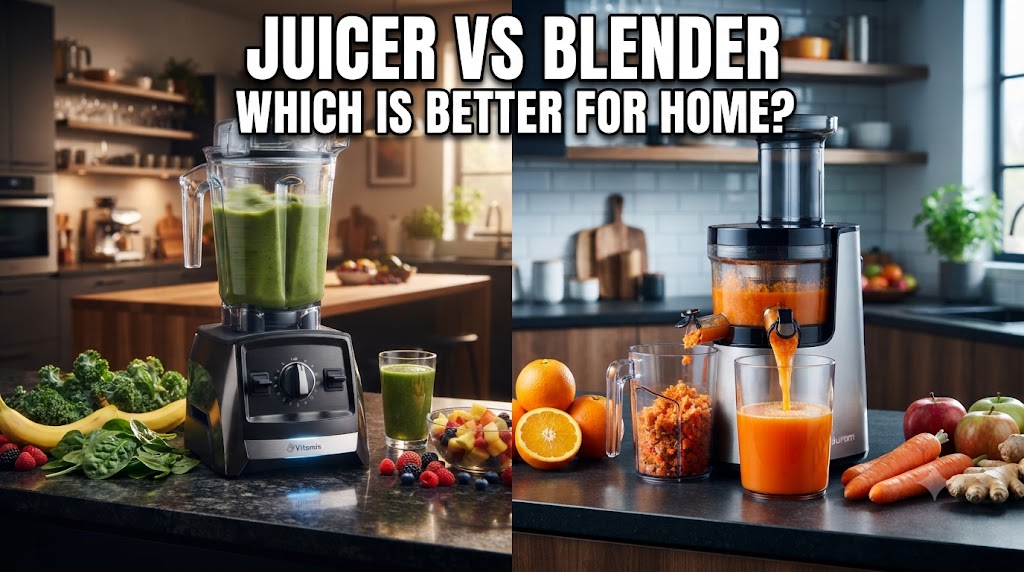
Juicers and blenders are two popular kitchen appliances used to prepare healthy drinks at home. Although both can process fruits and vegetables, they work differently and produce different results. A juicer extracts liquid from ingredients while separating most of the pulp, whereas a blender processes whole ingredients into a thicker mixture. Choosing between them depends on your daily requirements, preferred drink consistency, available kitchen space and cleaning preferences.
Before purchasing either appliance, it is important to understand their differences. A juicer is generally suitable for people who prefer smooth fruit and vegetable juice, while a blender is useful for preparing smoothies, milkshakes, purees, sauces and other recipes. Both appliances can be useful in a home kitchen, but they serve different purposes.
Juicer vs Blender: Quick Comparison Table
| Features | Juicer | Blender |
|---|---|---|
| Main Function | Extracts juice | Blends whole ingredients |
| Pulp | Separates most pulp | Retains fibre and pulp |
| Drink Texture | Usually thin and smooth | Usually thick |
| Fibre Content | Most insoluble fibre is removed | Retains most fibre |
| Smoothies | Not ideal | Excellent |
| Fruit Juice | Excellent | Possible, but thicker |
| Milkshakes | Not suitable for most models | Excellent |
| Vegetable Processing | Suitable for extracting juice | Suitable for blending vegetables |
| Food Preparation | Limited | More versatile |
| Cleaning | Can involve multiple parts | Usually simpler |
| Waste | Produces leftover pulp | Uses whole ingredients |
| Best For | Fresh juice lovers | Everyday kitchen use |
1. Working Principle
Juicer
A juicer extracts liquid from fruits and vegetables through a mechanism that crushes, grinds or presses the ingredients. Depending on the model, it separates the juice from most of the solid pulp.
This makes it suitable for preparing relatively thin drinks from ingredients such as oranges, carrots, apples and other fruits and vegetables.
Blender
A blender uses rotating blades to break down whole ingredients into a mixture. It generally processes the edible pulp along with the liquid instead of separating it.
This makes it suitable for smoothies, milkshakes, fruit mixtures, purees and other preparations.
Winner: Depends. A juicer is better for extracting juice, while a blender is better for blending whole ingredients.
2. Fibre and Nutrition
Juicer
Most traditional juicers separate insoluble fibre from the extracted juice. As a result, the final drink contains less fibre than a smoothie made using whole fruits and vegetables.
However, the nutritional content depends on the ingredients, juicer type and preparation method.
Blender
A blender retains most of the edible fruit and vegetable fibre because it processes the whole ingredients.
This makes blended drinks useful for people who want to include more dietary fibre in their diet.
Winner: Blender for retaining the fibre of whole fruits and vegetables.
3. Juice and Drink Quality
Juicer
A juicer produces a relatively thin and smooth drink with most solid pulp removed. It is suitable for people who prefer traditional fruit and vegetable juice.
The consistency depends on the type of juicer and ingredients used.
Blender
A blender produces thicker drinks because it retains pulp and fibre. The final consistency depends on the amount of liquid added and the ingredients used.
It is particularly useful for making smoothies and thick fruit drinks.
Winner: Depends. Choose a juicer for smooth juice and a blender for thicker drinks.
4. Versatility and Uses
Juicer
A juicer is primarily designed to extract juice. Some models can handle different fruits and vegetables, but their functions are generally more limited than those of blenders.
It is not the ideal appliance for preparing milkshakes, sauces or thick smoothies.
Blender
A blender can perform several kitchen tasks, depending on its design and power. It can prepare:
- Fruit smoothies
- Milkshakes
- Vegetable purees
- Chutneys and sauces
- Protein shakes
- Smooth mixtures for recipes
Some models also support crushing ice and grinding certain ingredients.
Winner: Blender because it offers more preparation options.
5. Ease of Cleaning
Juicer
Juicers often contain several removable components, including a feeding chute, filter, pulp container and juice container.
Cleaning the filter and removing trapped pulp can require additional effort.
Blender
Many blenders have a jar, blade assembly and lid. Their cleaning process is generally simpler, although blade assemblies and jar designs vary between models.
Winner: Blender for everyday cleaning convenience in many household models.
6. Food Waste
Juicer
A juicer separates the juice from most solid pulp. This leftover pulp can create additional food waste unless it is reused in suitable recipes.
Blender
A blender processes the whole edible ingredients, so there is generally less leftover pulp.
However, some ingredients may still need peeling, removing seeds or trimming before blending.
Winner: Blender because it generally uses more of the edible ingredients.
7. Preparation Time
Juicer
A juicer can extract juice quickly, but preparing ingredients and cleaning the different components may take additional time.
Blender
A blender can prepare many drinks within a short time. It also requires less ingredient separation because the whole edible ingredients are generally processed together.
Winner: Depends. Both can prepare drinks quickly, but preparation and cleaning requirements vary.
8. Price and Maintenance
Juicer
Juicer prices vary according to extraction technology, motor capacity, construction and brand. Some models also have specialised filters and additional components that require cleaning and maintenance.
Blender
Blender prices also vary according to motor power, jar material, blade design, capacity and additional functions.
Basic blenders can handle everyday blending tasks, while advanced models offer more capabilities.
Winner: Depends. Compare the features, build quality, warranty and maintenance requirements rather than choosing only by price.
9. Kitchen Space
Juicer
A juicer may require additional storage space because of its separate juice and pulp containers and other components.
Its size depends on the model and extraction mechanism.
Blender
Many household blenders have a compact design, although high-capacity and multifunctional models can also occupy considerable space.
Winner: Blender in many compact household setups.
Advantages and Disadvantages
Juicer
Advantages
- Produces smooth fruit and vegetable juice.
- Separates most solid pulp.
- Suitable for regular juice preparation.
- Useful for processing different fruits and vegetables.
Disadvantages
- Removes most insoluble fibre from the juice.
- Produces leftover pulp.
- Cleaning can involve several components.
- Offers fewer food preparation options.
Blender
Advantages
- Retains most edible fibre.
- Suitable for smoothies and milkshakes.
- Can prepare sauces, purees and chutneys.
- Uses most of the edible ingredients.
- Generally offers greater versatility.
Disadvantages
- Produces thicker drinks.
- Does not separate pulp like a juicer.
- Some ingredients may require additional liquid.
- Blade and jar cleaning is necessary.
Which One Should You Choose?
Choose a Juicer If:
- You regularly drink fresh fruit and vegetable juice.
- You prefer smooth drinks without most of the pulp.
- You do not need an appliance for multiple food preparation tasks.
- You are comfortable with cleaning its separate components.
Choose a Blender If:
- You prefer smoothies and thick fruit drinks.
- You want to retain most of the fibre.
- You regularly prepare milkshakes and protein shakes.
- You need one appliance for several kitchen tasks.
- You want to prepare sauces, purees and chutneys.
Final Verdict: Juicer vs Blender
Both juicers and blenders are useful kitchen appliances, but they serve different purposes.
A juicer is the better choice for people who regularly prefer smooth fruit and vegetable juice with most of the pulp removed. A blender is generally the more versatile option for everyday home use because it can prepare smoothies, milkshakes, sauces, purees and other recipes while retaining most of the edible fibre.
Overall Winner: Blender for general household versatility. However, if your main requirement is extracting smooth juice, a juicer is the more suitable choice.
Frequently Asked Questions (FAQs)
1. Which is better, a juicer or a blender?
A blender is generally better for versatile household use, while a juicer is better for extracting smooth fruit and vegetable juice.
2. Is a blender healthier than a juicer?
A blender retains most of the edible fibre because it processes whole ingredients. A juicer separates most insoluble fibre. Neither appliance automatically makes a drink healthier; ingredients and preparation matter.
3. Can a blender make fruit juice?
Yes. A blender can process fruits with water or other liquids to prepare fruit drinks, but the result is generally thicker than juice extracted using a juicer.
4. Can a juicer make smoothies?
A traditional juicer is not designed to prepare smoothies because it separates most of the pulp from the liquid.
5. Does a blender waste less fruit than a juicer?
Generally, yes. A blender processes most edible parts of the ingredients, whereas a juicer produces leftover pulp.
6. Which appliance is easier to clean?
Many household blenders are easier to clean because they have fewer components. However, cleaning difficulty depends on the particular model.
7. Can I use a blender for vegetables?
Yes. A blender can process vegetables into smoothies, purees and sauces, depending on its motor capacity and blade design.
8. Should I buy both a juicer and a blender?
If you regularly prepare both smooth juices and thick smoothies, owning both can be useful. Otherwise, a blender is generally a more versatile starting option for most households.
Disclaimer
This comparison is based on the general functions and characteristics of household juicers and blenders. Actual performance, features, cleaning requirements, durability and prices may vary depending on the brand and model. Always check the manufacturer’s specifications before purchasing.