Cold Press Juicer vs Centrifugal Juicer
Introduction
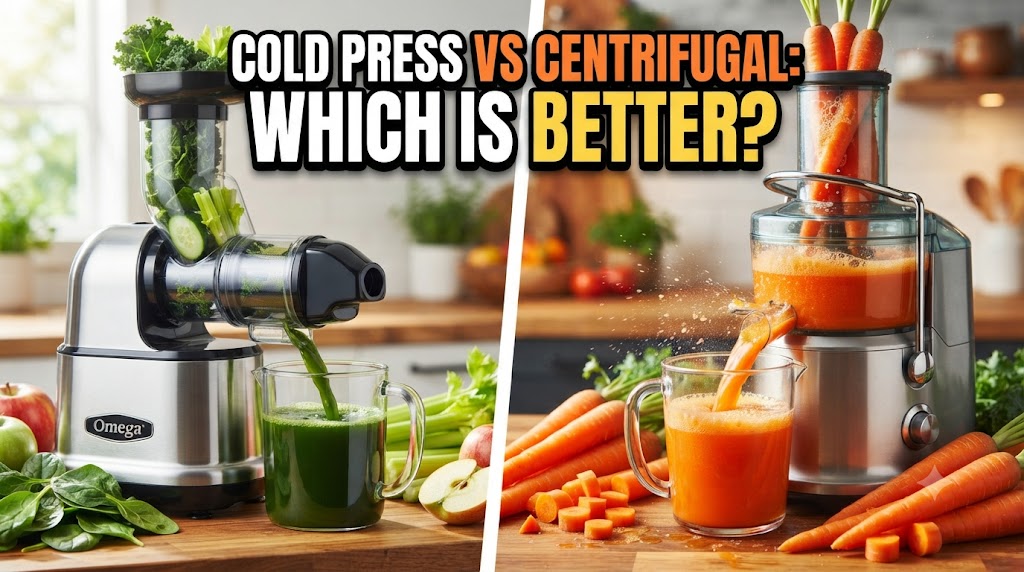
Cold press juicers and centrifugal juicers are two popular appliances for preparing fresh fruit and vegetable juice at home. Both extract juice from ingredients, but they use different methods. A cold press juicer slowly crushes and presses fruits and vegetables to extract liquid, while a centrifugal juicer uses a rapidly rotating blade and centrifugal force to separate juice from pulp. These differences affect extraction speed, juice consistency, noise, cleaning and overall convenience.
Choosing between these juicers depends on your daily requirements, budget and preferred juicing experience. Cold press juicers are generally preferred by people who prioritise slow extraction and want to minimise foam, while centrifugal juicers are suitable for people who want to prepare juice quickly. Understanding their features can help you select the right appliance for your home.
Cold Press Juicer vs Centrifugal Juicer: Quick Comparison Table
| Features | Cold Press Juicer | Centrifugal Juicer |
|---|---|---|
| Working Method | Slow crushing and pressing | High-speed spinning |
| Extraction Speed | Generally slower | Generally faster |
| Juice Quality | Usually less foamy | Can produce more foam |
| Heat Generation | Generally lower | Can generate more heat |
| Oxidation | Generally less during extraction | Generally more exposure to air |
| Juice Separation | Depends on model and ingredients | Depends on model and ingredients |
| Noise | Usually quieter | Usually louder |
| Leafy Greens | Generally better suited | Performance varies |
| Hard Fruits and Vegetables | Suitable | Suitable |
| Cleaning | Can involve more components | Often simpler |
| Price | Generally more expensive | Generally more affordable |
| Best For | Regular, slow juicing | Quick everyday juicing |
1. Working Technology
Cold Press Juicer
A cold press juicer uses a slow-moving auger or pressing mechanism to crush and squeeze fruits and vegetables. It extracts liquid without relying on a high-speed spinning blade.
This process generally produces less foam and limits heat generation during extraction.
Centrifugal Juicer
A centrifugal juicer uses a rapidly rotating cutting blade and mesh filter. The blade breaks down ingredients, and centrifugal force helps separate the juice from the pulp.
This mechanism allows the appliance to process many ingredients quickly.
Winner: Depends. Cold press technology focuses on slow extraction, while centrifugal technology focuses on speed.
2. Juice Quality and Consistency
Cold Press Juicer
Cold press juicers generally produce juice with less foam and a relatively smooth consistency. However, the final texture depends on the ingredients and filtration system.
Centrifugal Juicer
Centrifugal juicers can produce juice quickly, but the high-speed process may introduce more air into the liquid, resulting in additional foam.
Some ingredients may also produce juice with more noticeable separation.
Winner: Cold Press Juicer for people who prefer less foamy juice.
3. Nutrient Retention
Cold Press Juicer
Slow extraction generally reduces heat generation and air exposure during processing. However, the actual nutrient content depends on the ingredients, juicing method and storage time.
Centrifugal Juicer
The high-speed spinning process can generate more heat and expose juice to more air. Some sensitive nutrients may be affected, although the difference depends on the conditions.
Winner: Cold Press Juicer for its lower-heat extraction process, but it does not guarantee that every juice contains more nutrients.
4. Juicing Speed
Cold Press Juicer
Cold press juicers work slowly because their auger crushes and presses ingredients gradually.
Preparing juice may take longer, especially when processing large quantities.
Centrifugal Juicer
Centrifugal juicers use high-speed rotating blades to process fruits and vegetables rapidly.
They are convenient when you need fresh juice in a short time.
Winner: Centrifugal Juicer for faster juice preparation.
5. Leafy Greens and Hard Vegetables
Cold Press Juicer
Cold press juicers are generally effective for extracting juice from leafy vegetables such as spinach, kale and similar ingredients.
Their pressing mechanism is also suitable for many hard vegetables, depending on the model.
Centrifugal Juicer
Centrifugal juicers can handle many hard fruits and vegetables, including apples and carrots. However, leafy greens may not be processed as efficiently in some models.
Winner: Cold Press Juicer for regular leafy-green juicing.
6. Noise Level
Cold Press Juicer
Cold press juicers generally operate at lower speeds and are often quieter than centrifugal models.
This can be useful when preparing juice early in the morning or when you prefer a quieter kitchen.
Centrifugal Juicer
Centrifugal juicers have high-speed motors and rotating components. Their operation can produce noticeable noise.
Winner: Cold Press Juicer for quieter operation in many models.
7. Cleaning and Maintenance
Cold Press Juicer
Cold press juicers may have several components, including an auger, strainer, pulp container and juice container.
Removing fibrous ingredients from the filter can require additional cleaning effort.
Centrifugal Juicer
Many centrifugal juicers have a relatively straightforward design with a cutting disc, mesh filter and separate containers.
However, cleaning the mesh filter properly is important.
Winner: Depends. Cleaning convenience varies by design. Check whether the components are removable and dishwasher-safe before purchasing.
8. Food Waste and Juice Extraction
Cold Press Juicer
Cold press juicers squeeze ingredients to extract juice. Some models leave relatively dry pulp, although extraction efficiency varies.
Centrifugal Juicer
Centrifugal juicers separate juice using high-speed spinning. The remaining pulp may contain some moisture depending on the ingredients and appliance.
Winner: Depends. Compare actual extraction performance rather than assuming every cold press juicer produces less waste.
9. Price and Value for Money
Cold Press Juicer
Cold press juicers are generally more expensive because of their extraction mechanism and design.
They may be worth considering for people who regularly prepare different types of fresh juice.
Centrifugal Juicer
Centrifugal juicers are generally available at more affordable prices.
They can be a practical option for households that want quick juice preparation without spending too much.
Winner: Centrifugal Juicer for buyers prioritising a lower initial purchase price.
10. Storage and Kitchen Space
Cold Press Juicer
Cold press juicers can have larger bodies and multiple detachable components. Their storage requirements depend on the model.
Centrifugal Juicer
Some centrifugal juicers have compact designs, making them easier to store in smaller kitchens.
However, larger models can also require considerable counter space.
Winner: Depends. Check the appliance dimensions before purchasing.
Advantages and Disadvantages
Cold Press Juicer
Advantages
- Generally produces less foamy juice.
- Lower heat generation during extraction.
- Suitable for many leafy vegetables.
- Generally quieter operation.
- Useful for regular juice preparation.
Disadvantages
- Usually more expensive.
- Slower juice extraction.
- Cleaning can take additional effort.
- Some models require smaller ingredient pieces.
Centrifugal Juicer
Advantages
- Faster juice preparation.
- Generally more affordable.
- Convenient for everyday use.
- Suitable for many hard fruits and vegetables.
- Some models have compact designs.
Disadvantages
- Can produce more foam.
- Usually noisier.
- High-speed operation generates more heat.
- May be less effective with certain leafy greens.
Which One Should You Choose?
Choose a Cold Press Juicer If:
- You regularly prepare fresh fruit and vegetable juices.
- You prefer less foamy juice.
- You frequently process leafy vegetables.
- You prefer quieter operation.
- You are comfortable spending more for a slow-extraction appliance.
Choose a Centrifugal Juicer If:
- You want juice quickly.
- You have a limited purchasing budget.
- You mainly process fruits and hard vegetables.
- You prefer convenient juice preparation.
- You do not mind additional foam and operating noise.
Final Verdict: Cold Press Juicer vs Centrifugal Juicer
Both juicers can prepare fresh fruit and vegetable juice, but their working methods make them suitable for different household requirements.
A cold press juicer is a better option for people who prioritise less foamy juice, lower-heat extraction, leafy-green processing and quieter operation. A centrifugal juicer is more suitable for people who want faster juice preparation at a generally lower purchase price.
Overall Winner: Cold Press Juicer for regular juicing and extraction quality preferences. However, a centrifugal juicer offers better convenience for people who prioritise speed and affordability.
Frequently Asked Questions (FAQs)
1. Which is better, a cold press juicer or a centrifugal juicer?
A cold press juicer is generally better for less foamy juice and leafy greens, while a centrifugal juicer is better for faster preparation and affordability.
2. Is cold press juice healthier than centrifugal juice?
Not necessarily. Cold press extraction generally generates less heat and exposes juice to less air during processing, but the nutritional difference depends on ingredients and preparation conditions.
3. Why is a cold press juicer more expensive?
Cold press juicers use a different extraction mechanism and may have more specialised components, which can increase their manufacturing and purchase costs.
4. Can a centrifugal juicer extract juice from carrots?
Yes. Most centrifugal juicers designed for hard fruits and vegetables can process carrots. Follow the manufacturer’s instructions.
5. Is a cold press juicer good for leafy vegetables?
Yes. Cold press juicers are generally better suited to leafy greens because their slow pressing mechanism can extract juice effectively from many fibrous leaves.
6. Which juicer produces less foam?
Cold press juicers generally produce less foam than centrifugal juicers because they operate at lower speeds and introduce less air during extraction.
7. Which juicer is easier to clean?
Cleaning depends on the model. Some centrifugal juicers have simpler designs, while cold press juicers may have additional components that need cleaning.
8. Can I store juice made with either juicer?
Yes. Juice from either appliance can be refrigerated in a clean, airtight container. For better freshness and food safety, consume it as soon as possible and follow appropriate refrigeration practices.
Disclaimer
This comparison is based on the general working methods and features of household cold press and centrifugal juicers. Actual performance, extraction efficiency, noise, cleaning requirements, prices and warranty conditions may vary by brand and model. Nutrient retention also depends on ingredients, preparation and storage conditions. Always check manufacturer specifications before purchasing.