Chest Freezer vs Upright Freezer
Introduction
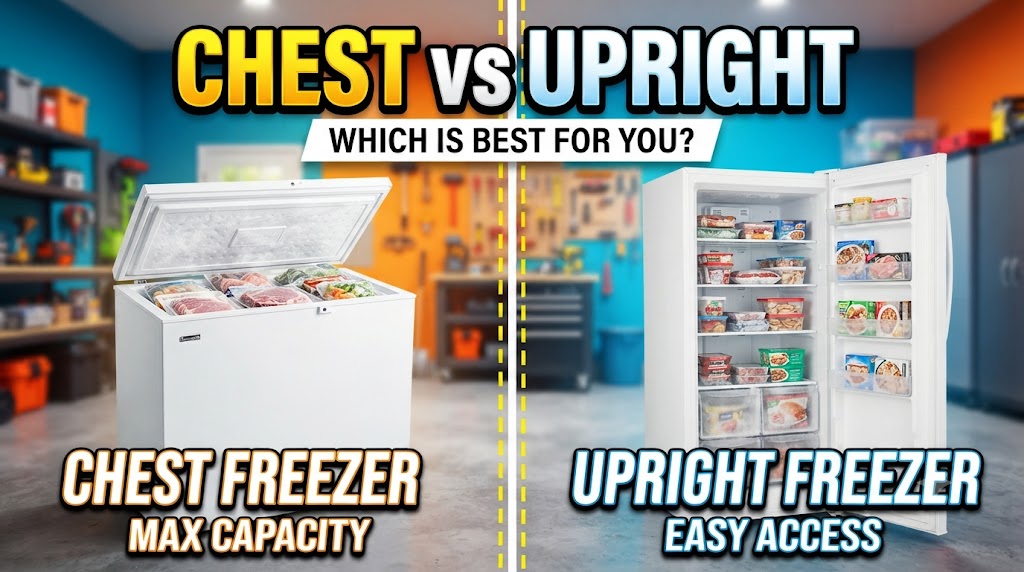
Choosing between a chest freezer and an upright freezer depends on your food storage requirements, available kitchen or utility space, budget and daily usage. Both appliances are designed to keep food frozen for longer periods, helping households store meat, vegetables, frozen meals, ice cream and other items. However, their designs and storage arrangements are different. A chest freezer opens from the top and provides a deep storage compartment, whereas an upright freezer looks similar to a refrigerator and has vertically arranged shelves or drawers.
Chest freezers are commonly preferred for storing large quantities of frozen food because they offer spacious interiors and can maintain cold temperatures effectively. Upright freezers are designed for convenient organization and easier access to individual items. Their vertical arrangement makes it easier to separate different food categories and locate stored products. Understanding their differences in storage capacity, energy consumption, convenience, maintenance and installation can help you select the right freezer for your household.
Quick Comparison Table
| Feature | Chest Freezer | Upright Freezer |
|---|---|---|
| Design | Horizontal, opens from the top | Vertical, opens from the front |
| Storage arrangement | Large open compartment | Shelves and drawers |
| Space requirement | Requires more floor space | Uses less floor space |
| Organization | Less compartmentalized | Easier to organize |
| Energy efficiency | Generally more energy-efficient | May use more energy |
| Cold air retention | Better during lid opening | More cold air can escape |
| Food accessibility | Items at the bottom can be difficult to reach | Easier access to stored items |
| Defrosting | Often manual | Manual or frost-free models |
| Initial cost | Often lower for comparable capacity | Often higher for comparable capacity |
| Best suited for | Bulk food storage | Organized everyday storage |
1. Design and Construction
Chest Freezer
A chest freezer has a horizontal design with a lid that opens from the top. Its interior is generally a large compartment with an open storage area.
Some models include removable baskets to separate frequently used food items. Its simple design makes it suitable for storing large packages, meat and bulk frozen products.
Upright Freezer
An upright freezer has a vertical design with a front-opening door. Its interior usually contains shelves, drawers or compartments for organizing different types of food.
This design resembles a conventional refrigerator and allows users to arrange frozen products in separate sections.
Winner: Depends – Chest freezers are better for bulk storage, while upright freezers offer more organized storage.
2. Storage Capacity
Chest Freezer
Chest freezers are available in different capacities and can accommodate large quantities of frozen food.
Their open interior makes it easier to store bulky items, large food packages and containers that may not fit conveniently on shelves.
However, finding smaller items at the bottom can sometimes be difficult.
Upright Freezer
Upright freezers provide vertical storage with separate shelves and drawers. This arrangement helps users organize different food products without stacking everything in one compartment.
However, shelf dimensions may limit the storage of unusually large packages.
Winner: Chest Freezer – Its open compartment generally makes it more suitable for storing bulky and large quantities of frozen food.
3. Energy Efficiency
Chest Freezer
Chest freezers generally have an energy-efficiency advantage because cold air tends to remain inside when the lid is opened. Cold air is denser than warm air, so less of it escapes through the top opening.
Their insulated construction can also help maintain low temperatures efficiently.
Upright Freezer
Upright freezers have front-opening doors. When the door opens, cold air can flow out more easily and warmer air can enter.
However, modern upright freezers with efficient compressors and good insulation can still offer excellent energy performance.
Winner: Chest Freezer – It generally retains cold air more effectively, although actual energy consumption depends on the model and its energy rating.
4. Food Organization and Accessibility
Chest Freezer
Chest freezers provide a large open storage compartment. Users can place baskets inside to separate different food items.
However, products stored underneath other items may be difficult to locate. You may need to move several packages to reach something at the bottom.
Upright Freezer
Upright freezers usually include multiple shelves and drawers that make food organization easier.
Users can separate meat, vegetables, frozen meals and other products into different sections. This arrangement also makes frequently used items easier to locate.
Winner: Upright Freezer – Its shelves and drawers provide better organization and easier access to individual food items.
5. Space Requirements and Installation
Chest Freezer
A chest freezer requires sufficient floor space because of its horizontal design. You also need enough clearance above the appliance to open its lid comfortably.
It may be suitable for garages, utility rooms, storage areas and larger kitchens.
Upright Freezer
An upright freezer uses vertical space rather than a large horizontal footprint.
Its refrigerator-like design makes it easier to fit into narrow spaces, provided there is enough room for the door to open properly.
Winner: Upright Freezer – Its vertical design generally makes it more suitable for homes with limited floor space.
6. Temperature Retention During Power Cuts
Chest Freezer
Chest freezers generally retain cold temperatures effectively because their insulated construction and top-opening design reduce cold air loss.
When the lid remains closed, a well-insulated and sufficiently filled chest freezer can keep food frozen for an extended period during a power interruption.
Upright Freezer
Upright freezers can also retain cold temperatures during power cuts, depending on insulation, freezer capacity and how full the appliance is.
However, cold air can escape more easily when the front door is opened.
Winner: Chest Freezer – It generally has an advantage in cold air retention during power interruptions when the lid remains closed.
7. Defrosting and Maintenance
Chest Freezer
Many chest freezers use manual defrosting systems. Over time, ice can accumulate on the interior walls, requiring users to remove the stored food and defrost the appliance.
Some models include defrost drainage features that make cleaning easier.
Upright Freezer
Upright freezers are available with both manual-defrost and frost-free technology.
Frost-free models automatically manage frost buildup, reducing the need for manual defrosting. However, they may have additional components and can consume more electricity than comparable manual-defrost models.
Winner: Upright Freezer – Frost-free models offer greater convenience and reduce manual defrosting work.
8. Initial Cost and Long-Term Value
Chest Freezer
Chest freezers are often less expensive than upright freezers with comparable storage capacity.
Their simpler construction can also make some models more affordable to purchase and maintain.
They can provide good value for households that need additional frozen food storage.
Upright Freezer
Upright freezers may cost more because of their vertical design, shelves, drawers and additional features.
Frost-free technology and advanced temperature controls can increase the purchase price further.
However, their organized storage can be valuable for households that access frozen food frequently.
Winner: Chest Freezer – It often offers better value for bulk storage, although actual prices depend on brand, capacity and features.
Advantages and Disadvantages
| Freezer Type | Advantages | Disadvantages |
|---|---|---|
| Chest Freezer | Good cold air retention; suitable for bulk storage; often energy-efficient; generally lower initial cost | Requires more floor space; items can be difficult to locate; manual defrosting is common |
| Upright Freezer | Better organization; easier access; vertical design; frost-free models available | Cold air escapes more easily; may cost more; bulky items may be difficult to arrange |
Which One Should You Choose?
Choose a Chest Freezer if:
- You need to store large quantities of frozen food.
- You regularly purchase meat, vegetables or groceries in bulk.
- You want better cold air retention.
- You have enough floor space.
- You prefer a potentially lower purchase cost.
Choose an Upright Freezer if:
- You prefer organized shelves and drawers.
- You frequently access different frozen food items.
- You have limited floor space.
- You want easier access to stored products.
- You prefer a frost-free model to reduce manual defrosting.
Final Verdict: Chest Freezer vs Upright Freezer
Both chest and upright freezers are useful for household food storage, but their designs serve different purposes.
A chest freezer is generally better for bulk storage, energy efficiency and cold air retention. An upright freezer is more convenient for organizing food, accessing individual items and saving floor space.
Overall Winner: Chest Freezer – It is a strong choice for households that prioritize storage capacity, cold retention and energy efficiency. However, an upright freezer may be the better option for people who prefer organized storage and convenient everyday access.
Frequently Asked Questions (FAQs)
1. Which is better, a chest freezer or an upright freezer?
A chest freezer is generally better for bulk storage and cold air retention. An upright freezer is better for organization, accessibility and smaller floor spaces.
2. Which freezer consumes less electricity?
Chest freezers generally consume less electricity than comparable upright models because they retain cold air more effectively. Actual consumption depends on the model, size and energy rating.
3. Which freezer keeps food frozen longer during a power cut?
Chest freezers generally retain cold temperatures longer when their lids remain closed. Actual performance depends on insulation, temperature, capacity and how frequently the freezer is opened.
4. Is an upright freezer easier to organize?
Yes. Upright freezers usually have separate shelves and drawers, making it easier to arrange and locate different food items.
5. Do chest freezers require manual defrosting?
Many chest freezers require manual defrosting. However, defrosting features vary by model, so check the manufacturer’s specifications.
6. Which freezer is better for storing meat?
A chest freezer is generally suitable for storing large quantities of meat because its open compartment can accommodate bulky packages. An upright freezer is also suitable when better organization is required.
7. Can an upright freezer be used as a refrigerator?
Some convertible models support both refrigerator and freezer modes. However, a standard upright freezer should not be used as a refrigerator unless the manufacturer specifically allows it.
Disclaimer
Freezer storage capacity, energy consumption, temperature retention, defrosting technology and prices vary by model and manufacturer. Always check product specifications, energy ratings and installation requirements before purchasing.