On-Grid vs Off-Grid Solar System
Introduction
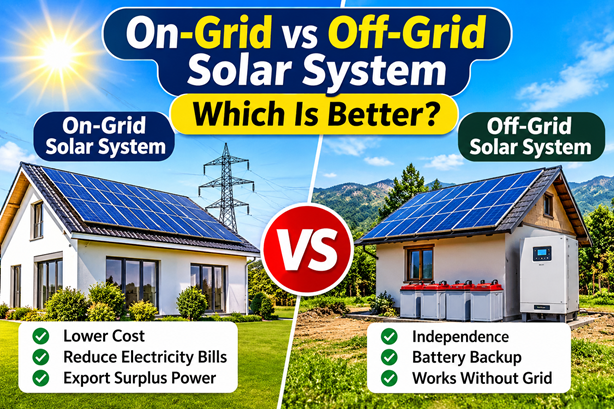
Choosing between an on-grid and an off-grid solar system depends on your electricity requirements, availability of grid power, backup needs and installation budget. Both systems use solar panels to convert sunlight into electricity, but they differ in how they manage and supply electrical energy. An on-grid solar system connects to the electricity grid and can send surplus electricity back to the utility. An off-grid solar system operates independently and uses batteries to store electricity for later use.
On-grid solar systems are commonly suitable for homes and businesses that have a reliable electricity connection and want to reduce their electricity bills. Off-grid systems are useful in remote locations where grid electricity is unavailable or unreliable. They can provide electricity using stored solar energy without depending on the utility grid. Understanding their differences in battery requirements, installation costs, power backup, maintenance and energy management can help you choose the right solar system.
Quick Comparison Table
| Feature | On-Grid Solar System | Off-Grid Solar System |
|---|---|---|
| Grid connection | Connected to electricity grid | Not connected to grid |
| Battery requirement | Usually not required | Required |
| Power backup | No backup during grid failure in standard systems | Yes, through batteries |
| Excess electricity | Can be exported to grid, subject to regulations | Stored in batteries or curtailed |
| Night-time electricity | Draws electricity from grid | Uses stored battery energy |
| Initial cost | Generally lower | Generally higher |
| Installation | Comparatively simple | More complex |
| Maintenance | Generally lower | Higher due to battery maintenance |
| Energy independence | Depends on grid availability | Operates independently |
| Net metering | Available where permitted | Not applicable |
| Best suited for | Homes with reliable grid electricity | Remote locations without reliable grid supply |
1. Working Principle
On-Grid Solar System
An on-grid solar system connects solar panels to an inverter that synchronizes with the electricity grid. Solar panels generate DC electricity, which the inverter converts into AC electricity for household appliances.
The generated electricity is first used by connected loads. If solar production exceeds household consumption, surplus electricity can be exported to the utility grid through an approved metering arrangement.
When solar generation is insufficient, electricity can be drawn from the grid.
Off-Grid Solar System
An off-grid solar system operates independently of the utility electricity grid. Solar panels generate electricity, which is managed by a solar charge controller and stored in batteries.
An inverter converts stored DC electricity into AC electricity for household appliances. The stored energy can be used at night or when sunlight is insufficient.
Winner: Depends – On-grid is better for grid-connected properties, while off-grid is suitable for locations without dependable grid electricity.
2. Battery Backup
On-Grid Solar System
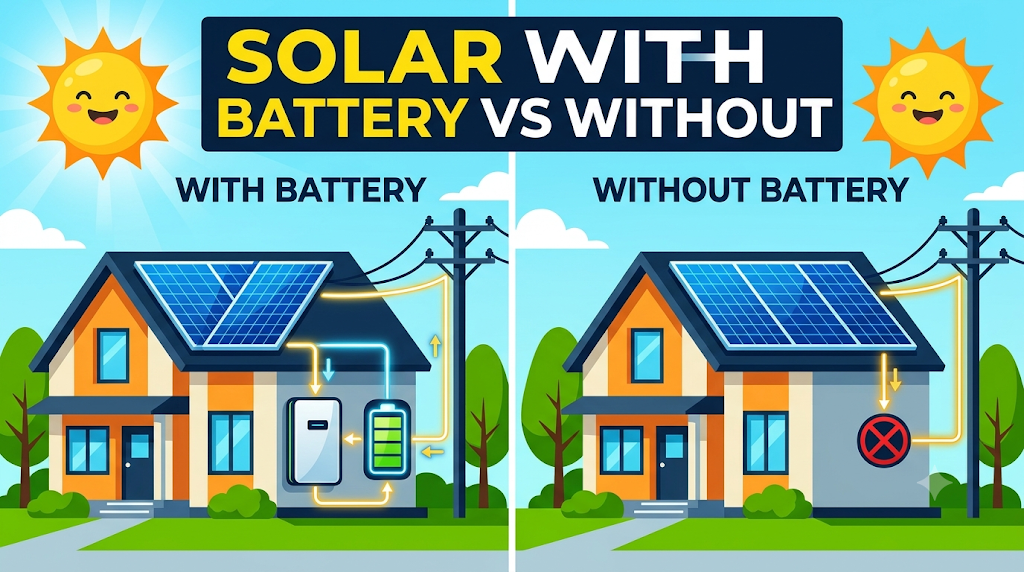
A standard on-grid solar system generally does not include batteries. It uses the utility grid to supply electricity when solar generation is insufficient.
An important limitation is that a standard grid-tied inverter automatically shuts down during a grid power failure for electrical safety. Therefore, solar panels alone do not provide household backup during a power cut.
Battery backup requires an additional compatible backup arrangement.
Off-Grid Solar System
An off-grid solar system includes batteries to store electricity generated by solar panels.
The stored electricity can power lights, fans, refrigerators and other compatible appliances when sunlight is unavailable.
Battery capacity determines how long the system can provide electricity. Proper sizing is important for households with high electricity consumption.
Winner: Off-Grid Solar System – It provides battery-based electricity backup without depending on the utility grid.
3. Initial Installation Cost
On-Grid Solar System
On-grid systems generally have a lower initial installation cost because they usually do not require an expensive battery bank.
Their main components include solar panels, a grid-connected inverter, mounting structures, electrical protection equipment and an approved metering arrangement.
This makes them a practical option for consumers who primarily want to reduce electricity bills.
Off-Grid Solar System
Off-grid systems generally cost more because they require batteries, a suitable inverter and additional charge-control equipment.
Battery capacity must be selected according to daily electricity consumption and the required backup duration. Larger backup requirements can increase the total installation cost.
Winner: On-Grid Solar System – It generally requires less initial investment because batteries are not normally included.
4. Electricity Bill Savings
On-Grid Solar System
An on-grid solar system can reduce electricity bills by supplying solar-generated electricity directly to household appliances.
Surplus electricity may be exported to the grid through net metering or another approved arrangement, depending on local electricity regulations.
The actual savings depend on solar generation, household consumption, tariff structure and applicable export-credit rules.
Off-Grid Solar System
An off-grid solar system reduces dependence on utility electricity because it generates and stores its own electricity.
However, it cannot export surplus electricity to the utility grid because it is not connected to it.
Its financial benefits depend on the cost of the alternative electricity supply, battery investment, replacement costs and maintenance.
Winner: On-Grid Solar System – It is generally more economical for reducing electricity bills in homes with reliable grid connections.
5. Performance During Power Cuts
On-Grid Solar System
A standard on-grid solar system stops supplying electricity when the utility grid fails because its inverter disconnects for safety.
This means that even when sunlight is available, the system cannot normally power household appliances during a grid outage.
A separate compatible backup system is needed if electricity during power cuts is required.
Off-Grid Solar System
An off-grid solar system can continue supplying electricity during power cuts because it operates independently of the utility grid.
Its batteries provide stored electricity when solar panels are not generating enough power.
However, backup duration depends on battery capacity, solar generation and connected appliance consumption.
Winner: Off-Grid Solar System – It is designed to operate independently and provide electricity during grid failures.
6. Energy Efficiency
On-Grid Solar System
On-grid systems use solar electricity directly for household consumption and can export surplus electricity to the grid.
Because they generally do not require battery storage, they avoid the energy losses associated with charging and discharging batteries.
This can make them an efficient arrangement for properties with a suitable grid connection.
Off-Grid Solar System
Off-grid systems often store solar electricity in batteries before using it later.
Energy is lost during battery charging, storage and discharging, and additional conversion losses occur through the inverter.
The overall efficiency depends on battery technology, inverter performance, system design and electricity consumption.
Winner: On-Grid Solar System – It generally avoids battery-related energy losses.
7. Installation and Maintenance
On-Grid Solar System
On-grid systems generally have a simpler installation because they do not normally require battery banks or battery charge controllers.
Maintenance mainly involves cleaning solar panels, checking electrical connections, inspecting the inverter and monitoring system performance.
However, proper grid synchronization, electrical protection and utility approvals are essential.
Off-Grid Solar System
Off-grid systems require additional equipment, including batteries and charge controllers.
Maintenance requirements depend on the battery technology. Some battery types need more attention than others, while lithium batteries generally require less routine maintenance.
Battery condition and system performance should be checked regularly to ensure reliable operation.
Winner: On-Grid Solar System – Its simpler design and lack of a standard battery bank generally reduce maintenance requirements.
8. Suitability for Different Locations
On-Grid Solar System
On-grid systems are suitable for:
- Residential homes with reliable electricity connections.
- Offices and commercial buildings.
- Shops and other business premises.
- Properties where reducing monthly electricity bills is the main objective.
- Locations where approved grid-connected solar arrangements are available.
Off-Grid Solar System
Off-grid systems are suitable for:
- Remote villages without electricity connections.
- Farmhouses and agricultural properties.
- Mountain homes with limited grid access.
- Locations experiencing frequent or prolonged power cuts.
- Properties requiring independent electricity generation.
Winner: Depends – The availability and reliability of grid electricity determine which system is more suitable.
Advantages and Disadvantages
| Solar System | Advantages | Disadvantages |
|---|---|---|
| On-Grid | Lower initial cost; no regular battery replacement; can export surplus electricity; generally lower maintenance | No backup during grid failure in standard systems; depends on grid availability |
| Off-Grid | Independent electricity supply; battery backup; suitable for remote areas; no dependence on utility grid | Higher initial cost; battery replacement expenses; requires careful energy planning |
Which One Should You Choose?
Choose an On-Grid Solar System if:
- Your home has a reliable electricity connection.
- Your main objective is reducing monthly electricity bills.
- You want to avoid battery purchase and replacement costs.
- You want to export surplus electricity where net metering is permitted.
- You do not require solar-powered backup during power cuts.
Choose an Off-Grid Solar System if:
- Your property does not have a reliable electricity connection.
- You experience frequent or prolonged power cuts.
- You need electricity independently of the utility grid.
- You want battery storage for night-time electricity use.
- You have a remote farmhouse, mountain home or agricultural property.
Final Verdict: On-Grid vs Off-Grid Solar System
Both solar systems generate electricity from sunlight, but their purposes are different.
An on-grid solar system is generally a better financial choice for homes and businesses with reliable grid electricity. It has a lower initial investment, avoids battery-related expenses and can reduce electricity bills through self-consumption and approved surplus-export arrangements.
An off-grid solar system is better for properties without reliable grid access or where independent electricity supply is essential. Its batteries provide backup power, but the system requires a higher initial investment and careful capacity planning.
Overall Winner: On-Grid Solar System – It is generally the better choice for grid-connected homes that want to reduce electricity bills with lower installation and maintenance costs. However, an off-grid system is the better option when reliable grid electricity is unavailable.
Frequently Asked Questions (FAQs)
1. Which is better, an on-grid or off-grid solar system?
An on-grid solar system is generally better for reducing electricity bills when grid power is reliable. An off-grid solar system is better when independent electricity and battery backup are required.
2. Does an on-grid solar system work during power cuts?
No. A standard on-grid solar inverter automatically shuts down during a grid failure for electrical safety. A compatible backup arrangement is required to supply electricity during outages.
3. Does an off-grid solar system require batteries?
Yes. An off-grid system generally requires batteries to store electricity for use when solar panels are not generating enough power, particularly at night.
4. Which solar system is cheaper to install?
An on-grid solar system is generally cheaper because it normally does not require a battery bank or additional battery management equipment.
5. Can an on-grid solar system reduce electricity bills?
Yes. It can reduce electricity bills by supplying solar power to household appliances and exporting surplus electricity through an approved net-metering or other permitted arrangement.
6. Can an off-grid solar system run a complete house?
Yes, if the solar panels, batteries and inverter are correctly sized for the household’s daily energy consumption and peak electrical load.
7. Which solar system is better for villages and remote areas?
An off-grid solar system is suitable for villages and remote properties where utility electricity is unavailable or unreliable. An on-grid system can be suitable where a dependable electricity connection exists.
8. Can an on-grid solar system be converted into an off-grid system?
It may be possible to modify an existing installation, but it requires compatible inverters, batteries, protection equipment and suitable electrical configuration. Professional assessment is necessary before conversion.
Disclaimer
Solar system performance, installation costs, battery capacity, electricity savings and maintenance requirements vary according to location, sunlight availability, equipment quality, household consumption and local electricity regulations. Net-metering approvals and government subsidy eligibility also depend on applicable schemes and utility rules. Consult a qualified solar installer and check current DISCOM requirements before purchasing.