Mono PERC vs TOPCon Solar Panels
Introduction
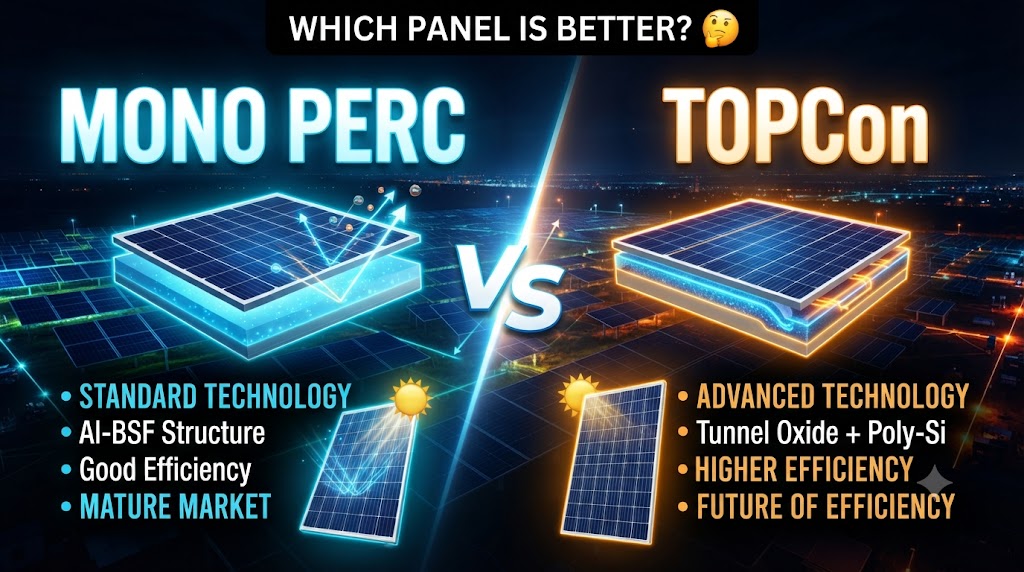
Solar panel technology has improved significantly, giving homeowners and businesses more options for generating electricity from sunlight. Mono PERC and TOPCon are two important solar cell technologies used in modern photovoltaic panels. Both use monocrystalline silicon, but their cell structures and methods of reducing energy losses are different. Mono PERC has been widely used in residential and commercial solar installations, while N-type TOPCon is a newer technology designed to improve efficiency, temperature performance and long-term electricity generation.
Choosing between Mono PERC and TOPCon depends on your available roof space, installation budget, electricity requirements and expected system life. Mono PERC panels are generally more affordable and can provide good performance for budget-conscious installations. TOPCon panels generally offer higher efficiency, lower degradation and better performance in high temperatures. Understanding these differences can help you select a solar panel that offers better value over its operating life.
Quick Comparison Table
| Feature | Mono PERC Solar Panels | TOPCon Solar Panels |
|---|---|---|
| Full Form | Passivated Emitter and Rear Cell | Tunnel Oxide Passivated Contact |
| Silicon Type | Usually P-type | N-type |
| Cell Technology | Rear surface passivation | Ultra-thin tunnel oxide passivated contact |
| Module Efficiency | Generally around 20–21.5% | Generally around 22–23% |
| Temperature Performance | Good | Generally better |
| Temperature Coefficient | Around -0.35%/°C | Around -0.29%/°C |
| Initial Degradation | Generally higher | Generally lower |
| Annual Degradation | Generally higher | Generally lower |
| Low-Light Performance | Good | Generally better |
| Bifacial Performance | Available | Available, often with higher bifaciality |
| Initial Price | Usually lower | Usually higher |
| Best For | Budget-conscious installations | Higher efficiency and long-term performance |
Note: These are indicative technology-level figures, not guaranteed specifications. Actual values vary by manufacturer and panel model.
1. What Are Mono PERC Solar Panels?
Mono PERC stands for Monocrystalline Passivated Emitter and Rear Cell. These panels use monocrystalline silicon cells with an additional passivation layer on the rear side of each cell. This layer helps reduce energy losses and allows some unused light to be reflected back into the silicon cell for better electricity generation.
Mono PERC technology became widely used because it improved the performance of conventional monocrystalline solar cells without requiring an entirely different manufacturing approach. These panels are available in different capacities and are used in residential rooftops, commercial buildings and large solar installations.
Advantages of Mono PERC Solar Panels
- Lower Initial Cost: They are generally more affordable than comparable TOPCon panels.
- Established Technology: Mono PERC has a long history of commercial use and a mature supply chain.
- Good Efficiency: It provides good electricity generation for residential and commercial applications.
- Wide Availability: Different panel capacities and brands are available in many markets.
- Suitable for Budget Projects: It can be a practical choice when the initial installation budget is limited.
- Proven Installation Experience: Many solar installers are familiar with this technology.
Disadvantages of Mono PERC Solar Panels
- Lower Efficiency: Their efficiency is generally lower than comparable modern TOPCon panels.
- Higher Temperature Losses: They generally have a less favourable temperature coefficient.
- Higher Initial Degradation: P-type cells can experience greater light-induced degradation.
- Faster Long-Term Degradation: Typical performance warranties may allow higher annual power loss than TOPCon products.
- Lower Bifaciality: Their bifacial versions generally have a lower rear-side response than comparable TOPCon modules.
2. What Are TOPCon Solar Panels?
TOPCon stands for Tunnel Oxide Passivated Contact. It is an advanced solar cell technology that generally uses N-type silicon. Its structure includes an ultra-thin tunnel oxide layer and a passivated contact that help reduce electron recombination and improve the conversion of sunlight into electricity.
TOPCon panels are designed to provide higher efficiency and better long-term performance than conventional P-type Mono PERC panels. They are increasingly used in residential, commercial and utility-scale solar installations where higher electricity generation and efficient use of available space are important.
Advantages of TOPCon Solar Panels
- Higher Efficiency: They generally convert more sunlight into electricity per unit area.
- Better Temperature Performance: Their temperature coefficient is usually more favourable than Mono PERC.
- Lower Degradation: N-type technology generally offers lower light-induced degradation and better long-term power retention.
- Better Bifacial Performance: TOPCon bifacial modules can generate more electricity from rear-side light.
- Good Low-Light Performance: They can provide favourable performance under diffuse sunlight conditions.
- Better Space Utilisation: Higher efficiency can help generate more electricity from limited rooftop space.
Disadvantages of TOPCon Solar Panels
- Higher Initial Price: They generally cost more than comparable Mono PERC panels.
- Product Differences: Performance and warranty conditions vary between manufacturers.
- Installation Quality Matters: Incorrect system design can reduce the benefits of higher-efficiency modules.
- Technology-Specific Compatibility: Inverters, electrical connections and module specifications must be checked before installation.
- Not Always the Cheapest Option: Their higher purchase price may not provide the best financial return when roof space is abundant and electricity requirements are modest.
3. Mono PERC vs TOPCon Solar Panels: Key Differences
A. Solar Panel Efficiency
Mono PERC panels generally offer module efficiency around 20–21.5%, depending on the model and manufacturer.
TOPCon panels commonly offer around 22–23% module efficiency in many current commercial product ranges. This means they can generate more electricity from a similar installation area when compared under equivalent conditions.
Winner: TOPCon Solar Panels for higher module efficiency.
B. Performance in High Temperatures
Solar panels generally lose some output as their cell temperature increases above the standard testing temperature of 25°C.
Mono PERC panels commonly have a power temperature coefficient around -0.35% per °C. TOPCon panels commonly offer a more favourable value around -0.29% per °C.
This means TOPCon panels generally lose less power as cell temperature rises. This advantage can be useful in hot climates, although actual performance also depends on ventilation, mounting arrangements and the specific module.
Winner: TOPCon Solar Panels for better temperature performance.
C. Initial Purchase Cost
Mono PERC panels are generally more affordable because the technology has an established manufacturing base and supply chain.
TOPCon panels can have a higher purchase price because of their advanced cell structure and manufacturing requirements. However, the price difference varies by brand, capacity, market conditions and product specifications.
Winner: Mono PERC Solar Panels for lower initial purchase cost.
D. Long-Term Degradation
Solar panels gradually lose some electricity-generating capacity over time. This is known as degradation.
Mono PERC panels generally experience higher initial light-induced degradation because they use P-type silicon cells. Their long-term performance also depends on product quality and environmental conditions.
TOPCon panels generally have lower initial degradation and lower annual degradation. This can help them retain more of their original power output over the years.
Winner: TOPCon Solar Panels for generally better long-term power retention.
E. Low-Light Performance
Mono PERC panels can generate electricity during cloudy weather and in diffuse sunlight, although their output decreases when sunlight intensity falls.
TOPCon panels generally offer favourable low-light performance because of their cell design and reduced recombination losses. However, the actual difference depends on the individual panel model and operating conditions.
Winner: TOPCon Solar Panels in typical technology comparisons.
F. Bifacial Electricity Generation
Bifacial solar panels can generate electricity from both their front and rear surfaces. Mono PERC technology is available in bifacial designs, while TOPCon technology is also widely used in bifacial modules.
TOPCon modules generally offer higher bifaciality, meaning their rear side can produce a greater proportion of the front-side rated output under suitable testing conditions.
However, actual additional electricity depends on the amount of reflected light reaching the rear surface, mounting height, ground surface and installation layout.
Winner: TOPCon Solar Panels for generally higher bifaciality.
G. Installation and Compatibility
Mono PERC and TOPCon panels can both be used in residential and commercial solar systems. Both require compatible inverters, mounting structures, wiring and electrical protection equipment.
The installer must check voltage, current, string configuration and inverter input limits before selecting either technology. A TOPCon panel is not automatically compatible with every existing solar installation simply because it is more advanced.
Winner: Tie. Both technologies can be installed in properly designed solar systems.
H. Warranty and Lifespan
Mono PERC panels are available with different product and performance warranties. Some models offer long performance warranties, but the exact conditions depend on the manufacturer.
TOPCon panels also come with product and performance warranties. Many manufacturers offer extended performance warranties because of their lower expected degradation.
A longer warranty does not automatically guarantee better product reliability. Buyers should compare the actual warranty terms, degradation schedule and manufacturer support.
Winner: TOPCon Solar Panels in many current product ranges, but the individual warranty matters more than the technology name alone.
I. Electricity Generation Over Time
Mono PERC panels can provide reliable electricity generation throughout their operating life when properly installed and maintained.
TOPCon panels generally combine higher starting efficiency with lower expected degradation. This can result in more cumulative electricity generation over the system’s lifetime for comparable rated capacity and installation conditions.
The financial benefit depends on the price premium, electricity tariff and actual energy production.
Winner: TOPCon Solar Panels for typical long-term energy generation comparisons.
4. Which Solar Panel Is Better for Different Users?
| User Requirement | Better Choice | Reason |
|---|---|---|
| Limited rooftop space | TOPCon | Higher efficiency |
| Lower initial investment | Mono PERC | Generally lower purchase price |
| Hot climate | TOPCon | Better temperature coefficient |
| Long-term electricity generation | TOPCon | Generally lower degradation |
| Budget-conscious home installation | Mono PERC | More affordable option |
| Commercial solar installation | TOPCon | Higher generation potential per area |
| Bifacial solar installation | TOPCon | Generally higher bifaciality |
| Existing compatible solar system | Depends | Inverter and module compatibility matter |
| Maximum efficiency | TOPCon | Generally higher module efficiency |
5. Which One Should You Choose?
Choose Mono PERC solar panels if your main priority is keeping the initial installation cost low. They remain a practical option for homes and businesses with sufficient rooftop space and a limited budget. Compare the actual module specifications and warranty before purchasing.
Choose TOPCon solar panels if you want higher efficiency, better performance in hot conditions and lower expected long-term degradation. They are particularly suitable when rooftop space is limited or you want to maximise electricity generation from your available installation area.
Before making a purchase, compare the price difference between the two technologies against their expected annual electricity generation. A slightly more expensive panel may offer better long-term value, but the actual financial benefit depends on the complete system cost.
6. Final Verdict: Mono PERC vs TOPCon Solar Panels
Both Mono PERC and TOPCon are useful solar panel technologies, but they offer different levels of performance and pricing.
Overall Winner: TOPCon Solar Panels.
TOPCon generally offers higher efficiency, a better temperature coefficient, lower degradation and stronger bifacial performance. These advantages make it an attractive option for modern residential and commercial solar installations.
However, Mono PERC remains a reasonable choice when the purchase budget is the main concern and sufficient rooftop space is available.
For most new installations, TOPCon is the stronger technical choice. The final decision should still depend on the exact panel model, price per watt, warranty, manufacturer support and expected electricity generation.
Frequently Asked Questions (FAQs)
1. Which is better, Mono PERC or TOPCon solar panels?
TOPCon is generally better for efficiency, temperature performance and long-term power retention. Mono PERC can be better when the initial purchase budget is limited.
2. What does Mono PERC stand for?
Mono PERC stands for Monocrystalline Passivated Emitter and Rear Cell. It is a solar cell technology that uses a rear passivation layer to improve electricity generation.
3. What does TOPCon stand for?
TOPCon stands for Tunnel Oxide Passivated Contact. It uses a thin oxide layer and passivated contact structure to reduce electron recombination in solar cells.
4. Are TOPCon solar panels more efficient than Mono PERC?
Generally, yes. TOPCon panels commonly offer higher module efficiency, although actual efficiency depends on the manufacturer and specific product.
5. Which solar panel is better for Indian weather?
TOPCon is generally a strong option for Indian conditions because it usually has a better temperature coefficient and lower degradation. Proper installation and ventilation are also important.
6. Are Mono PERC solar panels outdated?
Mono PERC is an established technology and is still available in the market. However, many manufacturers are shifting production towards newer technologies such as TOPCon.
7. Do TOPCon solar panels work during cloudy weather?
Yes. They generate electricity under diffuse sunlight, although output is lower than under strong direct sunlight. Their low-light performance can be favourable compared with conventional PERC modules.
8. Do TOPCon panels last longer than Mono PERC panels?
TOPCon panels generally have lower expected degradation, which can help them retain more power over time. Actual lifespan depends on manufacturing quality, installation and environmental conditions.
9. Are TOPCon solar panels worth the extra cost?
They can be worth the additional investment when higher efficiency, limited roof space and long-term electricity generation are important. Compare the total system price and expected energy production before deciding.
10. Can Mono PERC and TOPCon panels be used together?
They may be used in the same overall solar installation only with careful electrical design. Different voltage and current characteristics can create compatibility issues, so separate MPPT inputs or other suitable arrangements may be necessary.
Technical references: Industry comparisons and technical data on module efficiency, temperature coefficients, bifaciality and degradation. nuvamaresearch.com+3
Disclaimer
The information in this comparison is intended for general educational purposes. Mono PERC and TOPCon solar panel efficiency, prices, temperature performance, degradation rates and warranties vary by manufacturer and product model. Actual electricity generation depends on installation conditions, weather, shading and system configuration. Always check the manufacturer’s specifications and warranty details before purchasing solar panels.