PWM vs MPPT Solar Charge Controller
Introduction
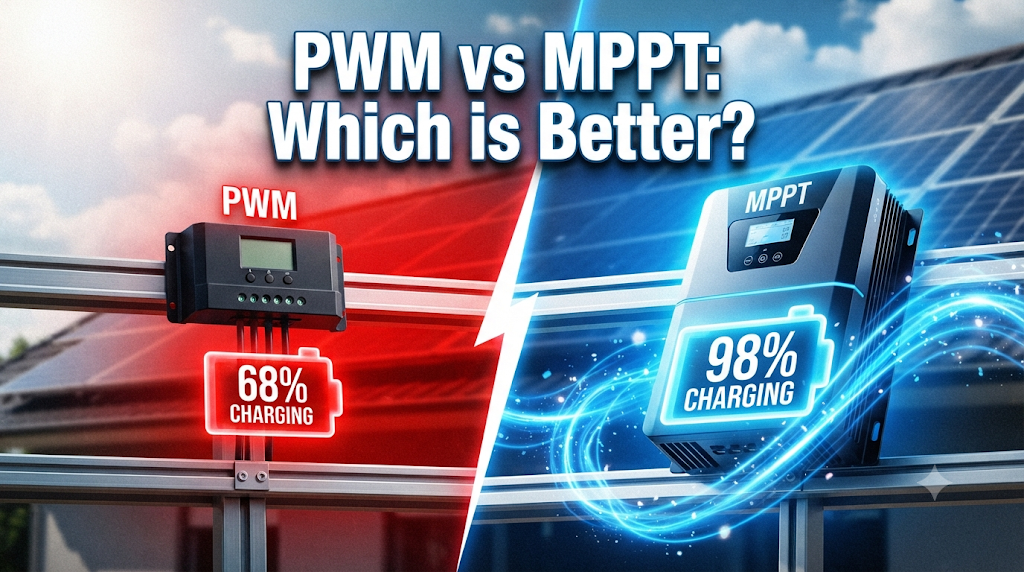
A solar charge controller is an important component of an off-grid solar power system. It regulates the electricity flowing from solar panels to batteries and helps prevent overcharging. Two commonly used types are PWM (Pulse Width Modulation) and MPPT (Maximum Power Point Tracking) solar charge controllers. Both perform battery charging management, but they use different technologies to handle the electricity generated by solar panels. These differences affect charging efficiency, solar panel compatibility, system design and overall performance.
Choosing between a PWM and an MPPT solar charge controller depends on your solar panel capacity, battery voltage, budget and electricity requirements. PWM controllers are generally simpler and more affordable, making them suitable for smaller solar installations. MPPT controllers are more advanced and can extract more usable power from solar panels, particularly when panel voltage is higher than battery voltage. Understanding their differences can help you select the right controller for your solar system.
Quick Comparison Table
| Feature | PWM Controller | MPPT Controller |
|---|---|---|
| Full form | Pulse Width Modulation | Maximum Power Point Tracking |
| Technology | Regulates charging through pulse-width control | Tracks the panel’s maximum power point |
| Charging efficiency | Generally lower | Generally higher |
| Solar energy utilization | Less effective with voltage mismatch | Better power utilization |
| Panel voltage compatibility | Usually requires panel voltage suitable for battery charging | Supports higher panel voltage within rated limits |
| Energy conversion | Primarily regulates panel-to-battery charging | Converts excess voltage into useful charging current |
| Initial cost | Generally lower | Generally higher |
| Cold-weather performance | Limited by voltage matching | Can benefit from higher panel voltage |
| Installation | Generally simple | Requires correct configuration |
| Best suited for | Small, budget solar systems | Larger or higher-performance solar systems |
1. Working Principle
PWM Solar Charge Controller
A PWM solar charge controller regulates the electricity flowing from solar panels to batteries by rapidly switching the connection between them.
As the battery approaches its charging target, the controller adjusts the charging pulses to control the amount of energy supplied.
A PWM controller generally pulls the solar panel operating voltage closer to the battery voltage. As a result, some of the panel’s available power may not be utilized when there is a significant voltage difference.
MPPT Solar Charge Controller
An MPPT solar charge controller continuously tracks the solar panel’s maximum power point.
Solar panels produce their maximum available power at a particular combination of voltage and current. An MPPT controller identifies this operating point and uses DC-to-DC conversion to provide suitable charging voltage and current to the battery.
This allows it to use available solar power more effectively when panel voltage is higher than battery charging voltage.
Winner: MPPT Controller. Its maximum power point tracking technology helps extract more usable energy from solar panels.
2. Charging Efficiency
PWM Solar Charge Controller
PWM controllers can charge batteries effectively when the solar panel voltage is properly matched to the battery system.
However, they generally cannot convert excess panel voltage into additional charging current. This can result in unused available solar power.
MPPT Solar Charge Controller
MPPT controllers convert excess panel voltage into additional battery charging current, within their operating limits.
This helps improve solar energy utilization, particularly when using higher-voltage panels with lower-voltage battery systems.
Actual efficiency depends on the controller model, operating conditions and system configuration.
Winner: MPPT Controller. It generally provides better charging energy utilization than PWM technology.
3. Solar Panel Compatibility
PWM Solar Charge Controller
PWM controllers generally work best with solar panels whose operating voltage is suitable for the battery charging voltage.
For example, a nominal 12V solar panel is commonly paired with a 12V battery system, subject to the actual panel and controller specifications.
Using a much higher-voltage panel with a PWM controller can result in significant power loss or exceed controller limits.
MPPT Solar Charge Controller
MPPT controllers can support solar panels with higher operating voltages than the battery charging voltage.
For example, an MPPT controller may allow suitable higher-voltage solar panel configurations to charge a lower-voltage battery bank.
However, the panel’s open-circuit voltage, input current and total power must remain within the controller’s specified limits.
Winner: MPPT Controller. It offers greater flexibility in solar panel voltage configuration.
4. Performance in Cold Weather
PWM Solar Charge Controller
Solar panel voltage generally increases as temperature decreases.
With a PWM controller, the additional panel voltage is not converted into additional battery charging current in the same way as an MPPT controller.
Therefore, the additional voltage may not provide its full potential charging benefit.
MPPT Solar Charge Controller
MPPT controllers can make better use of available solar panel voltage by converting it into charging current.
Cold weather can increase the available voltage difference between the solar panels and battery charging voltage, which may improve the benefit of MPPT technology.
However, the controller’s maximum input voltage must never be exceeded.
Winner: MPPT Controller. It can utilize the additional available panel voltage more effectively.
5. Initial Purchase Cost
PWM Solar Charge Controller
PWM controllers are generally less expensive because they use simpler charging regulation technology.
They can be a practical option for small solar installations where panel and battery voltages are properly matched.
MPPT Solar Charge Controller
MPPT controllers generally cost more because they use advanced tracking and DC-to-DC conversion technology.
Their higher initial cost may be justified when improved energy utilization reduces the need for additional solar panel capacity.
Winner: PWM Controller. It is generally the more affordable option.
6. Performance in Different Weather Conditions
PWM Solar Charge Controller
PWM controllers can operate effectively in sunny conditions when the solar panel and battery voltage are properly matched.
However, they cannot recover the same amount of unused voltage-related power as MPPT controllers.
MPPT Solar Charge Controller
MPPT controllers can improve energy utilization when sunlight conditions change and the panel operating point moves.
Their ability to track the maximum power point helps them make better use of available solar energy.
However, neither controller can generate additional energy when sufficient sunlight is unavailable.
Winner: MPPT Controller. It generally offers better energy utilization under changing solar operating conditions.
7. Installation and System Design
PWM Solar Charge Controller
PWM controllers generally have a simple installation process.
They are commonly used in smaller systems with suitable solar panel and battery voltage matching.
The installer must still check the controller’s rated current, battery voltage and solar panel specifications.
MPPT Solar Charge Controller
MPPT controllers offer more flexibility in panel configuration, including suitable higher-voltage solar arrays.
However, correct system design is important because the controller must support the solar array’s maximum open-circuit voltage, input current and power rating.
Winner: PWM Controller for simple installations. MPPT is more flexible but requires careful configuration.
8. Solar Energy Savings
PWM Solar Charge Controller
A PWM controller may leave some available solar panel power unused when the panel voltage is significantly higher than the battery charging voltage.
This can limit the amount of energy stored in the battery.
MPPT Solar Charge Controller
An MPPT controller can convert more of the available panel power into useful battery charging energy.
This can be particularly beneficial in larger systems where maximizing daily energy production is important.
Winner: MPPT Controller. It can help increase the amount of usable solar electricity stored in batteries.
9. Battery Charging and Protection
PWM Solar Charge Controller
PWM controllers regulate battery charging and commonly provide charging stages such as bulk, absorption and float, depending on the model.
They can also include protection against overcharging, reverse polarity and other electrical problems.
MPPT Solar Charge Controller
MPPT controllers also manage battery charging and commonly include configurable charging stages.
Many models provide additional monitoring, temperature compensation and configurable battery profiles.
However, available protection features vary by manufacturer and model.
Winner: Tie. Both technologies can provide effective battery charging management and protection when correctly selected.
10. Which Is Better for Home Solar Systems?
PWM Solar Charge Controller
A PWM controller can be suitable for homeowners who:
- Have a small solar installation.
- Want a low-cost charging solution.
- Use solar panels with suitable battery voltage matching.
- Have basic battery charging requirements.
- Do not need maximum solar energy utilization.
MPPT Solar Charge Controller
An MPPT controller can be suitable for homeowners who:
- Have larger solar panel installations.
- Use higher-voltage solar panel configurations.
- Want better solar energy utilization.
- Need flexibility in panel and battery voltage combinations.
- Want to maximize battery charging from available sunlight.
Winner: MPPT Controller. It is generally better for modern home solar systems where energy utilization and system flexibility are important.
Overall Comparison: Which Is Better?
| Comparison Factor | Better Option |
|---|---|
| Charging efficiency | MPPT |
| Maximum power point tracking | MPPT |
| Higher-voltage panel compatibility | MPPT |
| Solar energy utilization | MPPT |
| Cold-weather voltage utilization | MPPT |
| Initial purchase price | PWM |
| Simple installation | PWM |
| Basic small solar systems | PWM |
| Larger solar installations | MPPT |
| Advanced charging technology | MPPT |
Final Verdict
An MPPT solar charge controller is generally better for most modern residential solar installations. It tracks the maximum power point of solar panels and converts available excess voltage into useful battery charging current. This can improve solar energy utilization, particularly in systems using higher-voltage panels.
A PWM solar charge controller is a suitable budget-friendly option for smaller solar systems. It works well when solar panel voltage is properly matched to the battery charging requirements.
If your priority is maximizing available solar energy and improving system flexibility, MPPT is generally the better investment. If you have a small installation and want a simple, affordable solution, PWM may be sufficient.
Frequently Asked Questions (FAQs)
1. What is the main difference between PWM and MPPT solar charge controllers?
PWM controllers regulate charging by switching the connection between solar panels and batteries, while MPPT controllers track the solar panel’s maximum power point and convert available power into suitable battery charging voltage and current.
2. Which is better, PWM or MPPT?
MPPT is generally better because it can utilize more available solar panel power. PWM is more affordable and suitable for smaller systems with properly matched panel and battery voltages.
3. Does an MPPT controller produce more electricity than a PWM controller?
An MPPT controller does not generate electricity. It can extract more usable power from the same solar panels by converting excess panel voltage into charging current.
4. Can an MPPT controller charge a 12V battery using higher-voltage solar panels?
Yes. A suitably rated MPPT controller can use higher-voltage solar panels to charge a 12V battery system, provided the panel voltage, current and power remain within the controller’s specifications.
5. Is an MPPT controller worth the extra cost?
It can be worth the extra cost in larger installations or systems with higher-voltage panels. For very small systems, the additional investment may not provide enough practical benefit.
6. Can I use a PWM controller with a 24V solar panel?
Compatibility depends on the solar panel’s actual operating voltage and the battery system. A standard PWM controller generally requires suitable panel voltage matching. Check the manufacturer’s specifications before connecting the equipment.
7. Does MPPT work better in winter?
MPPT controllers can benefit from increased solar panel voltage in cold weather and convert that voltage into useful charging current. However, actual performance depends on sunlight, panel temperature and controller limits.
8. Which controller is better for a 12V solar battery?
Both can charge a 12V battery when properly configured. An MPPT controller generally provides better energy utilization, while PWM can be suitable for a smaller and more economical setup.
Disclaimer
This article is intended for general educational and comparison purposes. PWM and MPPT controller performance, charging efficiency, compatibility and pricing may vary depending on the manufacturer, model, solar panel specifications, battery chemistry and operating conditions. Always check voltage, current and power limits before installing a solar charge controller. Consult a qualified solar installer for system selection and installation.
COPY
A detailed comparison of PWM and MPPT solar charge controllers, explaining working principles, charging efficiency, solar panel compatibility, battery charging, installation costs and residential solar applications.
WordPress Image Tags
COPY
PWM Solar Charge Controller, MPPT Solar Charge Controller, Solar Charge Controller Comparison, Solar Battery Charging, Solar Technology
Type Next for the final article, Article 17: MPPT vs Hybrid Solar Inverter: What Is the Difference?