Pure Sine Wave vs Modified Sine Wave Inverter
Introduction
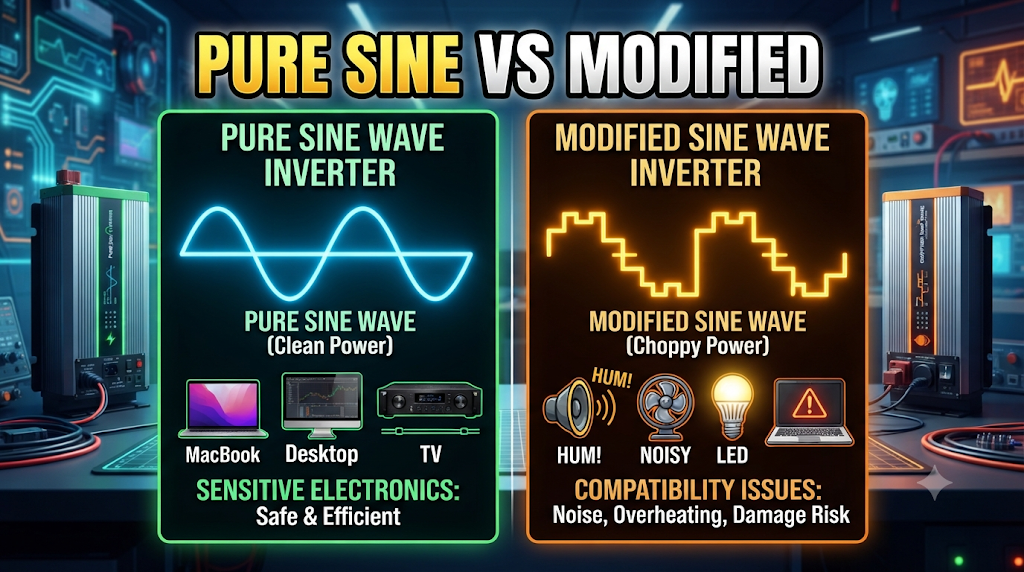
Pure sine wave and modified sine wave inverters are two common types of inverters used to convert DC electricity from batteries into AC electricity for household appliances. Although both perform the same basic function, they produce different types of AC waveforms. A pure sine wave inverter produces a smooth waveform similar to the electricity supplied by the utility grid, while a modified sine wave inverter produces a stepped waveform. This difference can affect appliance compatibility, operating noise, efficiency and overall performance.
Choosing between a pure sine wave and a modified sine wave inverter depends on the appliances you want to operate, your budget and your backup power requirements. Pure sine wave inverters are generally suitable for modern household appliances, sensitive electronics and equipment containing motors. Modified sine wave inverters can be suitable for simpler electrical loads, provided those appliances support this type of power supply. Understanding their differences can help you choose the right inverter for your home.
Quick Comparison Table
| Feature | Pure Sine Wave Inverter | Modified Sine Wave Inverter |
|---|---|---|
| Output waveform | Smooth sine wave | Stepped waveform |
| Power quality | Closer to grid electricity | Less similar to grid electricity |
| Appliance compatibility | Very wide | More limited |
| Sensitive electronics | Generally suitable | Compatibility may vary |
| Motor operation | Generally smoother | May produce additional noise and heat |
| Fan operation | Generally quieter | May produce humming noise |
| Refrigerator compatibility | Generally suitable if correctly rated | Depends on motor and compressor compatibility |
| Energy efficiency | Depends on design and load | Depends on design and load |
| Initial cost | Generally higher | Generally lower |
| Operating noise | Usually lower appliance-related noise | Some appliances may produce more noise |
| Best suited for | Modern homes and sensitive equipment | Compatible basic electrical loads |
1. Output Waveform
Pure Sine Wave Inverter
A pure sine wave inverter produces a smooth, continuously changing AC waveform.
This output closely resembles the electricity supplied by the utility grid. It is suitable for a wide range of household appliances and electronic equipment designed to operate on standard AC electricity.
The smooth waveform helps electrical devices operate according to their intended design.
Modified Sine Wave Inverter
A modified sine wave inverter produces a stepped or modified square-like waveform instead of a smooth sine wave.
It can operate many basic electrical appliances, but its output is not identical to normal grid electricity.
Some electronic devices and motor-based appliances may not work as efficiently with this waveform.
Winner: Pure Sine Wave Inverter. It produces a waveform closer to standard household AC electricity.
2. Appliance Compatibility
Pure Sine Wave Inverter
Pure sine wave inverters are generally compatible with a wide range of household appliances, including:
- LED televisions.
- Computers and laptops with suitable power supplies.
- Refrigerators.
- Ceiling fans.
- Wi-Fi routers.
- Audio equipment.
- Electronic devices and chargers.
However, the inverter must have sufficient capacity and suitable voltage ratings for the connected appliances.
Modified Sine Wave Inverter
Modified sine wave inverters can operate many basic electrical loads, such as certain lights and simple resistive appliances.
However, compatibility can be limited with appliances containing electronic control circuits, motors, transformers and sensitive power supplies.
Always check the appliance manufacturer’s requirements before connecting it.
Winner: Pure Sine Wave Inverter. It offers broader compatibility with modern household appliances.
3. Performance with Fans and Motors
Pure Sine Wave Inverter
Ceiling fans and other motor-based appliances generally operate more smoothly with pure sine wave electricity.
They are less likely to experience additional humming noise or waveform-related heating compared with operation on a modified sine wave supply.
Modified Sine Wave Inverter
Fans and motors may operate with additional humming noise, vibration or heat when connected to a modified sine wave inverter.
Their performance depends on the motor design and the appliance manufacturer’s compatibility requirements.
Winner: Pure Sine Wave Inverter. It is generally better for fans, pumps and other motor-based appliances.
4. Performance with Computers and Electronics
Pure Sine Wave Inverter
Pure sine wave inverters are generally suitable for computers, laptops, televisions and other electronic devices.
They provide an AC waveform closer to the supply these devices are designed to use.
This makes them a practical option for homes with multiple electronic appliances.
Modified Sine Wave Inverter
Some electronic devices may operate on modified sine wave electricity, but others may experience buzzing, overheating, charging problems or malfunction.
Certain power supplies may also be less efficient with modified waveforms.
Winner: Pure Sine Wave Inverter. It is the safer general choice for modern electronic equipment, provided voltage and power ratings are correct.
5. Energy Efficiency
Pure Sine Wave Inverter
Pure sine wave inverters can provide efficient power conversion, depending on their design and operating load.
Their efficiency is particularly important when powering electronic equipment and appliances that require a high-quality AC supply.
Modified Sine Wave Inverter
Modified sine wave inverters may have lower conversion losses in some simple applications, but waveform-related losses in connected appliances can reduce overall system efficiency.
Actual performance depends on inverter design, load type and operating conditions.
Winner: Depends. There is no universal efficiency winner. Compare the manufacturer’s rated efficiency and consider the appliances being operated.
6. Operating Noise
Pure Sine Wave Inverter
Pure sine wave inverters generally allow compatible fans, motors and electronic devices to operate with less waveform-related noise.
The inverter itself may still produce cooling fan noise or transformer noise depending on its design.
Modified Sine Wave Inverter
Some appliances connected to modified sine wave inverters may produce noticeable humming, buzzing or vibration.
This is particularly relevant for motors and transformers.
Winner: Pure Sine Wave Inverter. It generally provides quieter operation for compatible motor-based appliances.
7. Initial Purchase Cost
Pure Sine Wave Inverter
Pure sine wave inverters generally cost more because of their waveform generation technology and electronic design.
The price depends on rated capacity, brand, features, battery voltage and protection functions.
Modified Sine Wave Inverter
Modified sine wave inverters generally have a lower purchase price.
They can be an economical option when the connected appliances are compatible and the backup requirements are limited.
Winner: Modified Sine Wave Inverter. It is generally the more affordable option for basic applications.
8. Heat Generation
Pure Sine Wave Inverter
Pure sine wave electricity generally allows compatible motors and transformers to operate with less waveform-related heating.
The inverter itself can still generate heat during power conversion, particularly under heavy loads.
Modified Sine Wave Inverter
Modified sine wave electricity can cause additional heating in some motors, transformers and other inductive loads.
This can affect operating performance and equipment life if the appliance is not designed for this type of supply.
Winner: Pure Sine Wave Inverter. It is generally preferable for appliances that are sensitive to waveform-related heating.
9. Battery Backup and Runtime
Pure Sine Wave Inverter
A pure sine wave inverter can provide battery backup for household appliances when the battery and inverter are properly sized.
Its backup duration depends on battery capacity, connected load, inverter efficiency and battery condition.
Modified Sine Wave Inverter
A modified sine wave inverter can also provide battery backup.
However, some connected appliances may consume more power or operate less efficiently because of the modified waveform.
Actual runtime depends on the inverter, battery and connected equipment.
Winner: Depends. Battery capacity and connected load have a greater influence on backup duration than waveform type alone.
10. Which Is Better for Indian Homes?
Pure Sine Wave Inverter
A pure sine wave inverter is suitable for households that:
- Use computers and modern electronic appliances.
- Need backup for refrigerators and ceiling fans.
- Want quieter motor operation.
- Have sensitive electronic equipment.
- Want broader appliance compatibility.
Modified Sine Wave Inverter
A modified sine wave inverter may be suitable for households that:
- Need backup for basic compatible electrical loads.
- Have a limited purchase budget.
- Do not need to operate sensitive electronics.
- Have checked appliance compatibility.
- Want an economical backup solution.
Winner: Pure Sine Wave Inverter. It is generally the better choice for modern Indian homes because of its wider appliance compatibility.
Overall Comparison: Which Is Better?
| Comparison Factor | Better Option |
|---|---|
| Output waveform quality | Pure Sine Wave |
| Modern appliance compatibility | Pure Sine Wave |
| Computer and laptop compatibility | Pure Sine Wave |
| Fan and motor operation | Pure Sine Wave |
| Operating noise | Pure Sine Wave |
| Purchase price | Modified Sine Wave |
| Simple compatible electrical loads | Both |
| Overall suitability for modern homes | Pure Sine Wave |
Final Verdict
A pure sine wave inverter is generally the better choice for modern homes. It produces smooth AC electricity and offers broader compatibility with computers, televisions, refrigerators, ceiling fans and other household appliances. It is particularly useful when you want reliable backup for sensitive electronics and motor-based equipment.
A modified sine wave inverter can be a budget-friendly option for basic electrical appliances that are confirmed to be compatible. However, its stepped output waveform may cause additional noise, heat or operating problems in certain appliances.
If you are purchasing a new home inverter, a pure sine wave model is generally worth considering because of its wider compatibility and better overall appliance performance.
Frequently Asked Questions (FAQs)
1. What is the main difference between pure sine wave and modified sine wave inverters?
A pure sine wave inverter produces a smooth AC waveform similar to grid electricity, while a modified sine wave inverter produces a stepped waveform.
2. Which inverter is better for home use?
A pure sine wave inverter is generally better for home use because it supports a wider range of modern electrical and electronic appliances.
3. Can a modified sine wave inverter run a refrigerator?
Some refrigerators may operate on modified sine wave electricity, but compatibility depends on the compressor and control electronics. A pure sine wave inverter is generally the preferred option.
4. Can I run a computer on a modified sine wave inverter?
Some computers may work with modified sine wave inverters, but compatibility is not guaranteed. A pure sine wave inverter is generally recommended for computers and sensitive electronics.
5. Why do fans make noise on modified sine wave inverters?
The stepped waveform can cause additional magnetic and electrical effects in fan motors, resulting in humming or buzzing noise.
6. Is a pure sine wave inverter more expensive?
Yes. Pure sine wave inverters generally cost more than modified sine wave models with comparable capacity.
7. Does a pure sine wave inverter increase battery backup time?
Not necessarily. Backup time mainly depends on battery capacity, connected load and inverter efficiency. Waveform type alone does not determine battery runtime.
8. Can a modified sine wave inverter damage appliances?
Some appliances may experience overheating, noise, inefficient operation or malfunction when supplied with an incompatible modified waveform. Always check manufacturer recommendations.
Disclaimer
This article is intended for general educational and comparison purposes. Inverter performance, efficiency, appliance compatibility, pricing and battery backup may vary depending on the manufacturer, model, electrical load and operating conditions. Always check appliance requirements and consult a qualified electrician before selecting or installing an inverter.