Lithium-Ion vs Lead-Acid Solar Battery
Introduction
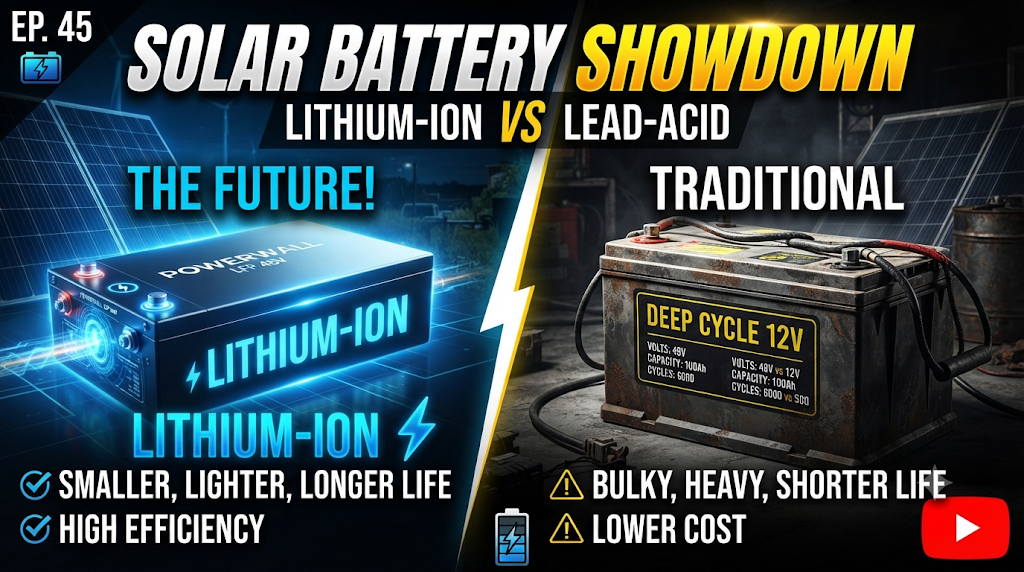
Choosing the right battery is an important decision when installing a solar power system. A solar battery stores electricity generated by solar panels so that you can use it later, especially at night or during a power cut. Two commonly discussed battery technologies are lithium-ion and lead-acid. Both can store electricity for household use, but they differ in battery life, charging efficiency, usable capacity, maintenance, size and initial cost. Understanding these differences can help homeowners select a battery that matches their electricity requirements and long-term budget.
Lithium-ion batteries have become increasingly popular for residential solar energy storage because of their higher usable capacity, longer service life and lower maintenance requirements. Lead-acid batteries, on the other hand, remain an option for homeowners who want a lower initial purchase cost. However, the purchase price is not the only factor to consider. Battery replacement, charging losses and usable electricity also affect the overall cost. In this comparison, we will examine both technologies to understand which one is more suitable for different household solar applications.
Quick Comparison Table
| Feature | Lithium-Ion Battery | Lead-Acid Battery |
|---|---|---|
| Initial Cost | Higher | Lower |
| Battery Lifespan | Generally longer | Generally shorter |
| Cycle Life | Generally higher | Generally lower |
| Usable Capacity | Higher | Lower |
| Charging Speed | Generally faster | Generally slower |
| Charging Efficiency | Higher | Lower |
| Maintenance | Usually minimal | Depends on battery type |
| Size and Weight | Compact and lighter | Larger and heavier |
| Deep Discharge | Handles deeper discharge | Sensitive to deep discharge |
| Replacement Frequency | Usually less frequent | Usually more frequent |
| Solar Compatibility | Requires compatible system | Compatible with many conventional systems |
| Long-Term Value | Generally better | Depends on usage and budget |
1. Battery Lifespan
Battery lifespan determines how long a battery can provide reliable energy storage before its capacity becomes unsuitable for regular use.
Lithium-Ion Battery: Lithium-ion batteries generally have a longer service life than conventional lead-acid batteries. Their lifespan depends on the battery chemistry, temperature, charging conditions, discharge depth and number of cycles. Many residential lithium battery products are designed for around 10–15 years of service.
Lead-Acid Battery: Lead-acid batteries generally have a shorter service life, particularly when they are frequently charged and discharged. Their lifespan also depends on maintenance, temperature and how deeply they are discharged. A typical service-life estimate for lead-acid batteries is around 5–10 years, although individual products can differ.
Winner: Lithium-Ion Battery
Lithium-ion batteries are generally better for homeowners who want a longer-lasting solar energy storage solution.
2. Usable Battery Capacity
Usable capacity refers to the amount of stored electricity that a battery can safely deliver for household use.
Lithium-Ion Battery: Lithium-ion batteries generally support a higher depth of discharge. Depending on the model, approximately 90–100% of rated capacity may be usable. This allows homeowners to access more of the electricity stored in the battery.
Lead-Acid Battery: Conventional lead-acid batteries generally require a shallower discharge to protect their lifespan. Depending on the battery design, approximately 30–60% of rated capacity may be recommended as usable.
For example, a 100 Ah battery does not necessarily provide 100 Ah of practical usable capacity. The recommended discharge limit must be considered when selecting battery capacity.
Winner: Lithium-Ion Battery
Lithium-ion batteries generally provide more usable electricity from the same rated capacity.
3. Charging Speed
Charging speed determines how quickly a battery can store electricity generated by solar panels.
Lithium-Ion Battery: Lithium-ion batteries generally accept higher charging rates when operated within their manufacturer’s specifications. This makes them suitable for solar systems that need to store energy during limited sunlight hours.
Lead-Acid Battery: Lead-acid batteries generally require more careful charging management. Charging current and absorption time must be controlled to avoid incomplete charging, overcharging and battery damage.
Winner: Lithium-Ion Battery
Lithium-ion batteries generally offer better charging performance, provided the inverter and battery management system support the required charging settings.
4. Charging Efficiency
Charging efficiency describes how much of the electricity supplied to a battery can be recovered during discharge. Higher efficiency means less energy is lost during the storage process.
Lithium-Ion Battery: Lithium-ion batteries generally have higher charging and discharging efficiency. This helps homeowners make better use of electricity produced by their solar panels.
Lead-Acid Battery: Lead-acid batteries generally have lower energy efficiency because more electricity is lost during charging and discharging. Actual performance depends on battery condition, charging rate and operating temperature.
Winner: Lithium-Ion Battery
Lithium-ion batteries are generally more efficient for storing and delivering solar electricity.
5. Initial Purchase Cost
The purchase price is an important consideration, especially for homeowners installing a solar system on a limited budget.
Lithium-Ion Battery: Lithium-ion batteries generally have a higher upfront price. The total installation cost may also include a compatible inverter, battery management system and electrical protection equipment.
Lead-Acid Battery: Lead-acid batteries generally have a lower initial purchase cost. This makes them attractive to homeowners who want to reduce their initial investment.
However, the lower purchase price does not automatically mean lower lifetime cost. Battery lifespan, replacement expenses and usable capacity should also be considered.
Winner: Lead-Acid Battery
Lead-acid batteries are generally the better choice when the main priority is reducing the initial purchase cost.
6. Maintenance Requirements
Maintenance affects the convenience, safety and ongoing cost of operating a solar battery.
Lithium-Ion Battery: Most modern residential lithium-ion batteries require minimal routine maintenance. They generally include a Battery Management System (BMS) that monitors important operating conditions and helps protect the battery.
Lead-Acid Battery: Maintenance depends on the type of lead-acid battery. Flooded batteries may require regular electrolyte-level checks and distilled-water top-ups. Sealed AGM and gel batteries generally require less routine maintenance, but they still need proper charging and inspection.
Winner: Lithium-Ion Battery
Lithium-ion batteries generally require less routine maintenance than conventional flooded lead-acid batteries.
7. Size and Weight
Battery size and weight are important when installation space is limited.
Lithium-Ion Battery: Lithium-ion batteries generally offer higher energy density, allowing them to store more electricity in a smaller and lighter package. This can make installation easier in homes where available space is limited.
Lead-Acid Battery: Lead-acid batteries are generally heavier and bulkier for the same nominal energy capacity. Multiple batteries may require additional installation space and suitable structural support.
Winner: Lithium-Ion Battery
Lithium-ion batteries are generally more convenient where compact installation and lower weight are important.
8. Deep Discharge Performance
Depth of discharge refers to the percentage of a battery’s rated capacity that has been used.
Lithium-Ion Battery: Lithium-ion batteries are generally designed to support deeper discharge without the same level of lifespan reduction associated with conventional lead-acid batteries. The actual permitted discharge depends on the battery’s chemistry and manufacturer’s specifications.
Lead-Acid Battery: Lead-acid batteries are more sensitive to deep discharge. Repeatedly discharging them beyond recommended limits can accelerate degradation and reduce their service life.
Winner: Lithium-Ion Battery
Lithium-ion batteries are generally better for households that regularly use stored solar electricity.
9. Safety and Temperature Performance
Safety is an important consideration because batteries store electrical energy and must operate within specified conditions.
Lithium-Ion Battery: Lithium-ion batteries require an appropriate Battery Management System, compatible charging equipment and suitable electrical protection. Different lithium chemistries have different thermal characteristics. For example, LiFePO4 batteries generally offer better thermal stability than NMC batteries.
Lead-Acid Battery: Lead-acid batteries also require proper installation and electrical protection. Flooded lead-acid batteries can release hydrogen during charging and therefore need suitable ventilation. They may also require precautions against electrolyte spills and acid exposure.
Both technologies can be used safely when correctly selected, installed and maintained according to manufacturer instructions.
Winner: Depends
The safer choice depends on battery chemistry, product quality, installation conditions, ventilation and protection systems.
10. Long-Term Value
Long-term value considers the total cost of owning and operating a battery rather than just its purchase price.
Lithium-Ion Battery: Lithium-ion batteries generally offer better long-term value for households that regularly charge and discharge their solar batteries. Their longer service life, higher usable capacity and better efficiency can help offset their higher initial price.
Lead-Acid Battery: Lead-acid batteries can be economical for occasional backup applications or households with limited initial budgets. However, frequent cycling and earlier replacement can increase their lifetime cost.
Winner: Lithium-Ion Battery
Lithium-ion batteries generally provide better long-term value for regular solar energy storage applications.
Advantages and Disadvantages
Lithium-Ion Solar Battery
Advantages:
- Longer typical service life.
- Higher usable battery capacity.
- Better charging and discharging efficiency.
- Faster charging capability.
- Compact size and lower weight.
- Minimal routine maintenance.
- Better suitability for frequent daily cycling.
Disadvantages:
- Higher initial purchase cost.
- Requires compatible charging equipment.
- Battery Management System is essential.
- Performance and safety depend on battery chemistry and operating conditions.
Lead-Acid Solar Battery
Advantages:
- Lower initial purchase cost.
- Widely available in many markets.
- Established battery technology.
- Established recycling infrastructure.
- Suitable for certain backup and lower-budget applications.
Disadvantages:
- Shorter typical service life.
- Lower usable capacity.
- Generally lower charging efficiency.
- Slower charging characteristics.
- Heavier and bulkier design.
- Flooded models require regular maintenance.
- Deep discharge can reduce battery lifespan.
Which Battery Is Better for Different Users?
The better battery depends on your electricity usage, installation budget and backup requirements.
- For daily solar energy storage: Lithium-ion battery is generally the better option.
- For lower initial investment: Lead-acid battery is generally more affordable.
- For longer battery life: Lithium-ion battery is generally preferable.
- For limited installation space: Lithium-ion battery is generally more suitable.
- For minimal maintenance: Lithium-ion battery is generally preferable.
- For occasional backup: Lead-acid battery may be a practical budget option.
- For frequent charging and discharging: Lithium-ion battery is generally the better choice.
Frequently Asked Questions (FAQs)
1. Which is better for solar panels, lithium-ion or lead-acid batteries?
Lithium-ion batteries are generally better for regular solar energy storage because they offer higher usable capacity, better efficiency and a longer service life. Lead-acid batteries may be suitable when the initial budget is the main concern.
2. How long does a lithium-ion solar battery last?
Many residential lithium-ion batteries are designed for approximately 10–15 years of service. Actual lifespan depends on chemistry, temperature, usage, charging conditions and warranty specifications.
3. How long does a lead-acid solar battery last?
Lead-acid solar batteries commonly have an estimated service life of around 5–10 years. Actual lifespan depends on battery type, maintenance, discharge depth and operating conditions.
4. Can I use a lithium-ion battery with a normal solar inverter?
Not every solar inverter is compatible with every lithium-ion battery. You should check battery voltage, charging specifications, communication compatibility and BMS requirements before installation.
5. Is a lithium-ion battery worth the extra cost?
For households using solar battery storage regularly, lithium-ion batteries can justify their higher initial cost through longer service life, higher usable capacity and better efficiency. For occasional backup, a lead-acid battery may be more economical initially.
6. Which battery requires less maintenance?
Most modern lithium-ion batteries require minimal routine maintenance. Flooded lead-acid batteries require more attention, including electrolyte-level checks and distilled-water top-ups.
7. Can lead-acid batteries be used with solar panels?
Yes. Lead-acid batteries can store electricity generated by solar panels. However, the solar charge controller or inverter must support the battery’s voltage and charging requirements.
Conclusion
Lithium-ion and lead-acid batteries both provide energy storage for solar power systems, but they serve different needs. Lead-acid batteries are generally more affordable to purchase and can be suitable for homeowners with limited budgets or occasional backup requirements. Lithium-ion batteries offer higher usable capacity, better charging efficiency, longer service life and lower routine maintenance.
Overall Winner: Lithium-Ion Solar Battery
For most households planning to use solar energy storage regularly, a lithium-ion battery is the better overall investment. However, homeowners should compare the battery’s chemistry, usable capacity, warranty, safety certifications and inverter compatibility before making a purchase. A lead-acid battery can still be a reasonable choice when the upfront budget is the main priority.
Disclaimer
Battery specifications, prices, lifespan, charging efficiency and usable capacity may vary depending on the manufacturer, battery chemistry, model, operating temperature and installation conditions. Always check the manufacturer’s specifications and warranty before purchasing a solar battery. Consult a qualified solar installer or electrician to ensure proper battery and inverter compatibility.