LiFePO4 vs NMC Battery
Introduction
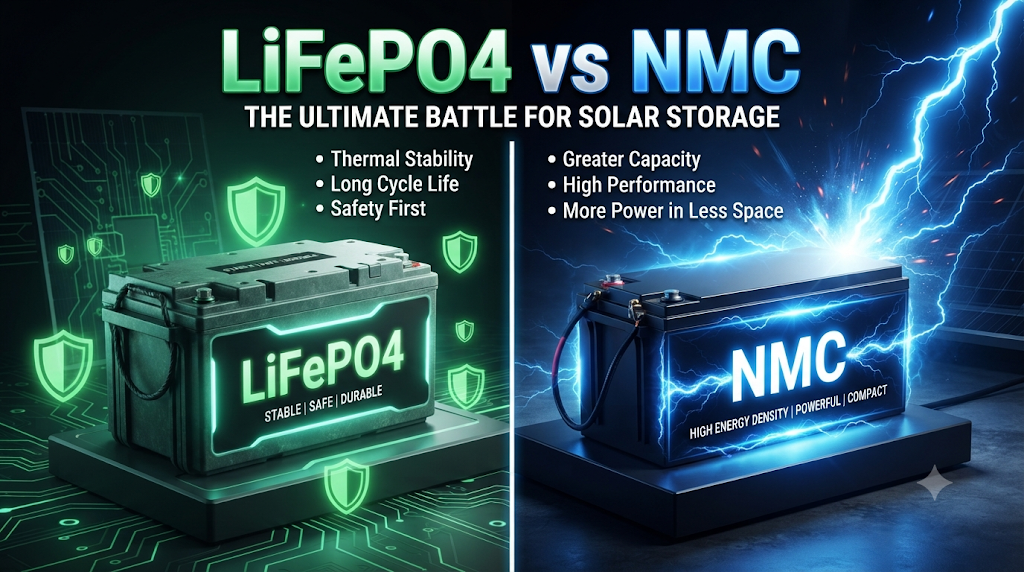
Lithium-ion batteries are widely used in modern solar energy storage systems because they can store electricity generated during the day and supply power when solar panels are not producing enough energy. However, not all lithium-ion batteries use the same chemistry. Two important options are Lithium Iron Phosphate (LiFePO4 or LFP) and Nickel Manganese Cobalt (NMC). Both technologies offer rechargeable energy storage, but they differ in energy density, battery lifespan, thermal stability, charging characteristics, cost and overall suitability for residential solar applications.
LiFePO4 batteries are increasingly preferred for stationary energy storage because of their thermal stability and long cycle life. NMC batteries, meanwhile, offer higher energy density, allowing manufacturers to store more electricity in a smaller and lighter battery. This makes NMC useful where space and weight are important considerations. However, a home solar battery has different requirements from an electric vehicle battery. In this comparison, we will examine both technologies to determine which is the better choice for home solar storage.
Quick Comparison Table
| Feature | LiFePO4 Battery | NMC Battery |
|---|---|---|
| Full Form | Lithium Iron Phosphate | Nickel Manganese Cobalt |
| Energy Density | Lower | Higher |
| Battery Lifespan | Generally longer | Generally shorter |
| Cycle Life | Generally higher | Generally lower |
| Thermal Stability | Higher | Lower |
| Fire Risk | Lower relative thermal risk | Higher relative thermal risk |
| Weight | Generally heavier | Generally lighter |
| Size | Generally larger | Generally more compact |
| Charging Efficiency | High | High |
| Initial Cost | Often competitive | Depends on design and materials |
| Maintenance | Minimal | Minimal |
| Solar Storage Suitability | Excellent | Suitable |
| Best Application | Stationary solar storage | Space-sensitive, high-energy applications |
1. Battery Lifespan
Battery lifespan determines how long a battery can store and deliver electricity before its capacity decreases significantly.
LiFePO4 Battery: LiFePO4 batteries generally have a longer cycle life than conventional NMC batteries under comparable operating conditions. Many commercial products are designed to provide several thousand charge and discharge cycles. Their actual lifespan depends on temperature, charging voltage, depth of discharge and battery management.
NMC Battery: NMC batteries also provide good service life, but their cycle life can be lower than that of LiFePO4 batteries under similar conditions. High temperatures, frequent deep discharging and unsuitable charging conditions can accelerate battery degradation.
Winner: LiFePO4 Battery
LiFePO4 is generally the better choice for homeowners who want long-lasting battery storage with frequent daily charging and discharging.
2. Energy Density
Energy density describes how much electricity a battery can store relative to its weight or volume.
LiFePO4 Battery: LiFePO4 batteries generally have lower energy density. Therefore, they may require more physical space and weight to provide the same nominal storage capacity as an NMC battery.
NMC Battery: NMC batteries have higher energy density, allowing manufacturers to produce smaller and lighter batteries with comparable energy capacity. This is particularly useful in applications where installation space and weight are limited.
Winner: NMC Battery
NMC batteries are better when compact size and lower weight are the main priorities.
3. Safety and Thermal Stability
Battery safety is especially important in residential solar installations because batteries may operate and charge for many hours every day.
LiFePO4 Battery: LiFePO4 chemistry has better thermal stability than NMC chemistry. Its chemical structure is more resistant to oxygen release under thermal abuse conditions, reducing its relative risk of thermal runaway.
NMC Battery: NMC batteries have higher energy density but generally lower thermal stability than LiFePO4 batteries. They require appropriate battery management, temperature monitoring and protective systems to reduce safety risks.
Both battery types can be used safely when properly designed, certified, installed and operated.
Winner: LiFePO4 Battery
LiFePO4 is generally preferable for stationary home solar storage because of its better thermal stability.
4. Charging Efficiency
Charging efficiency determines how effectively a battery stores electricity supplied by solar panels.
LiFePO4 Battery: LiFePO4 batteries generally offer high charging and discharging efficiency. They can store a large proportion of the electricity supplied by a compatible solar charging system.
NMC Battery: NMC batteries also provide high charging efficiency. Their performance depends on cell design, charging rate, temperature and battery management settings.
Both technologies can deliver good efficiency in properly designed solar systems.
Winner: Tie
There is no universal winner because actual efficiency depends on the battery model and complete storage system.
5. Charging Speed
Charging speed determines how quickly a solar battery can store electricity during available sunlight hours.
LiFePO4 Battery: LiFePO4 batteries support good charging performance and can handle regular solar charging cycles. However, the permitted charging rate depends on the cell design, temperature and manufacturer’s specifications.
NMC Battery: NMC batteries can also support relatively fast charging. Some designs offer high charging rates, although charging performance varies considerably between products.
Winner: Depends
The better option depends on the specific battery’s maximum charging current, temperature limits and inverter compatibility.
6. Initial Purchase Cost
The initial purchase cost is important when planning a residential solar installation.
LiFePO4 Battery: LiFePO4 batteries can be cost-effective for stationary storage because they do not require nickel or cobalt in their cathode materials. Their longer cycle life can also improve lifetime value.
NMC Battery: NMC batteries use nickel, manganese and cobalt. Their purchase cost depends on material prices, battery design, manufacturing and market conditions. Higher energy density can provide value when installation space is limited.
Winner: Depends
LiFePO4 is often an attractive option for stationary solar storage, but actual purchase prices must be compared for batteries with similar usable capacity, warranties and safety features.
7. Size and Weight
Battery dimensions and weight affect installation convenience and available storage space.
LiFePO4 Battery: LiFePO4 batteries generally require more space and weight for the same nominal energy capacity because of their lower energy density.
NMC Battery: NMC batteries generally provide more energy in a smaller and lighter package. This can make them suitable for installations where space is restricted.
Winner: NMC Battery
NMC is generally preferable when compact battery dimensions and lower weight are important.
8. Deep Discharge Performance
Depth of discharge refers to the percentage of a battery’s rated capacity that has been used.
LiFePO4 Battery: LiFePO4 batteries are generally designed to support deep discharge and frequent cycling. Many products allow a high percentage of their rated capacity to be used, subject to manufacturer limits.
NMC Battery: NMC batteries can also support deep discharge. However, their recommended operating limits vary by manufacturer, and repeated deep cycling can affect their service life.
Winner: LiFePO4 Battery
LiFePO4 generally offers an advantage for stationary solar systems that regularly use stored electricity.
9. Maintenance Requirements
Maintenance affects the convenience and ongoing operating requirements of a solar battery.
LiFePO4 Battery: Modern LiFePO4 batteries generally require minimal routine maintenance. Their Battery Management System monitors operating conditions and provides protection against issues such as overcharging, excessive discharge and temperature limits.
NMC Battery: NMC batteries also generally require minimal routine maintenance. They use a Battery Management System to monitor voltage, temperature and other important operating conditions.
Both technologies need correct installation, periodic system inspection and appropriate battery protection.
Winner: Tie
Both offer convenient low-maintenance operation when supplied as properly designed battery systems.
10. Long-Term Value for Solar Storage
Long-term value depends on the usable electricity, service life, purchase cost, efficiency and replacement requirements of a battery.
LiFePO4 Battery: LiFePO4 batteries generally provide excellent long-term value for residential solar storage because of their long cycle life, thermal stability and suitability for frequent daily use.
NMC Battery: NMC batteries offer higher energy density and can be valuable when installation space is limited. However, their comparatively lower cycle-life advantage may make them less attractive for some frequently cycled stationary applications.
Winner: LiFePO4 Battery
For most residential solar storage applications, LiFePO4 generally offers a better balance of durability, safety and long-term value.
Advantages and Disadvantages
LiFePO4 Battery
Advantages:
- Generally longer cycle life.
- Better thermal stability.
- Lower relative risk of thermal runaway.
- Excellent suitability for stationary solar storage.
- Good deep-discharge performance.
- Minimal routine maintenance.
- Does not use nickel or cobalt in its cathode.
Disadvantages:
- Lower energy density than NMC.
- Generally heavier for the same energy capacity.
- May require more installation space.
- Requires compatible charging equipment and BMS protection.
NMC Battery
Advantages:
- Higher energy density.
- Smaller and lighter battery design.
- Good charging and discharging performance.
- Suitable for applications with limited space.
- Widely used lithium-ion chemistry.
Disadvantages:
- Lower thermal stability than LiFePO4.
- Generally shorter cycle life under comparable conditions.
- Requires careful temperature and battery management.
- Uses nickel and cobalt in its cathode materials.
- May require more attention to thermal protection.
Which Battery Is Better for Different Users?
The right battery depends on your installation space, energy requirements and priorities.
- For home solar storage: LiFePO4 is generally the better option.
- For longer battery life: LiFePO4 is generally preferable.
- For better thermal stability: LiFePO4 is the better option.
- For compact battery installations: NMC is generally preferable.
- For lower battery weight: NMC is generally better.
- For frequent daily charging and discharging: LiFePO4 is generally preferable.
- For stationary energy storage: LiFePO4 is generally more suitable.
- For applications where energy density is the priority: NMC is generally preferable.
Frequently Asked Questions (FAQs)
1. What is the main difference between LiFePO4 and NMC batteries?
The main difference is their battery chemistry. LiFePO4 uses lithium iron phosphate, while NMC uses nickel, manganese and cobalt. LiFePO4 generally offers better thermal stability and longer cycle life, whereas NMC provides higher energy density.
2. Which battery is safer, LiFePO4 or NMC?
LiFePO4 is generally considered safer because of its better thermal stability and lower susceptibility to thermal runaway. However, both batteries require suitable protection systems and professional installation.
3. Is LiFePO4 better than NMC for solar panels?
LiFePO4 is generally better for residential solar storage because it offers a combination of long cycle life, thermal stability and good usable capacity. NMC can still be suitable when compact size is important.
4. How long does a LiFePO4 solar battery last?
Many commercial LiFePO4 batteries are designed for several thousand charge and discharge cycles. Actual service life depends on product quality, operating temperature, depth of discharge and charging conditions.
5. Why are NMC batteries smaller than LiFePO4 batteries?
NMC batteries generally have higher energy density. This allows them to store more electricity in a given weight or volume, resulting in smaller and lighter battery designs.
6. Do LiFePO4 and NMC batteries need a BMS?
Yes. Both battery technologies require an appropriate Battery Management System to monitor cell voltage, temperature, charging and discharging conditions and other safety parameters.
7. Can LiFePO4 and NMC batteries use the same solar inverter?
Not necessarily. Compatibility depends on battery voltage, charging settings, communication protocols and inverter specifications. Always check the manufacturer’s compatibility information before installation.
Conclusion
LiFePO4 and NMC are two important lithium-ion battery technologies, but their advantages are different. NMC batteries offer higher energy density and a compact design, making them useful where space and weight are important. LiFePO4 batteries provide better thermal stability, generally longer cycle life and excellent suitability for stationary energy storage.
Overall Winner: LiFePO4 Battery
For most homeowners planning to install a solar energy storage system, LiFePO4 is the better overall choice. It offers a strong balance of safety, durability and long-term performance. NMC remains a suitable alternative when compact size and higher energy density are more important than the advantages of longer cycle life.
Disclaimer
Battery performance, lifespan, energy density, charging efficiency and prices may vary depending on the manufacturer, battery model, chemistry, operating temperature and installation conditions. Always check product specifications, safety certifications, warranty terms and inverter compatibility before purchasing a battery. Consult a qualified solar installer or electrician for installation advice.