Tubular Battery vs Flat Plate Battery
Introduction
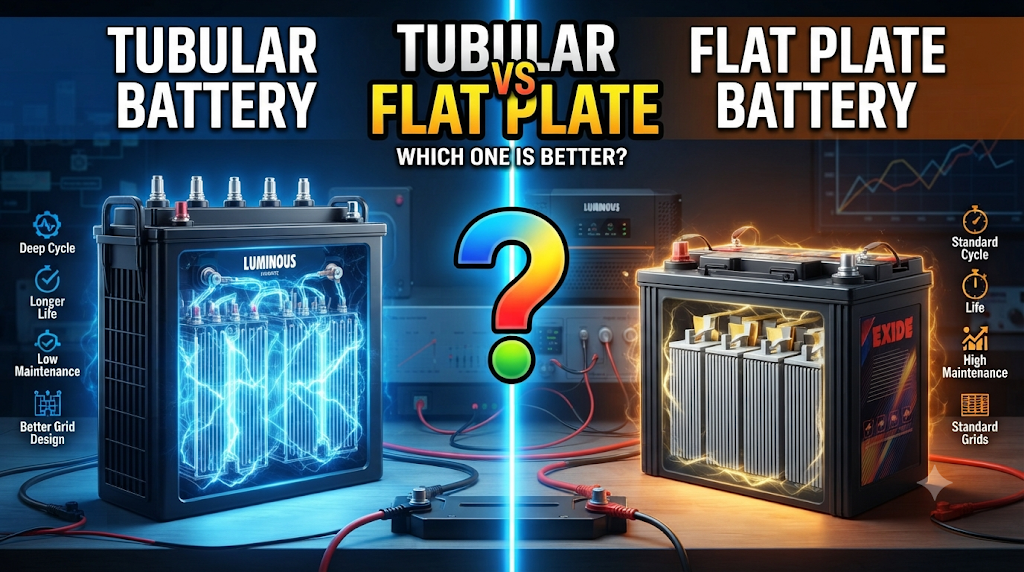
Choosing the right inverter or solar battery is important for maintaining a reliable electricity backup at home. Tubular and flat plate batteries are two common types of lead-acid batteries used in residential inverter systems. Both store electrical energy and provide power when the electricity supply is interrupted. However, they differ in plate construction, deep-discharge performance, battery lifespan, maintenance requirements, charging characteristics and initial purchase cost. Understanding these differences can help homeowners select a battery according to their backup requirements and electricity usage.
Tubular batteries are generally designed for repeated charging and discharging, making them suitable for homes that experience frequent or longer power cuts. Flat plate batteries are generally more affordable and can be suitable for households that need occasional backup for shorter periods. However, not all flat plate batteries have the same construction or performance. Deep-cycle specifications, battery capacity and manufacturer recommendations should also be considered. In this comparison, we will examine both battery types to understand which one offers better performance and value.
Quick Comparison Table
| Feature | Tubular Battery | Flat Plate Battery |
|---|---|---|
| Plate Design | Tubular positive plates | Flat pasted plates |
| Initial Cost | Generally higher | Generally lower |
| Battery Lifespan | Generally longer | Generally shorter |
| Deep Discharge | Better suited | Depends on battery design |
| Cycle Life | Generally higher | Generally lower |
| Charging Speed | Generally slower | Often faster |
| Maintenance | Depends on model | Depends on model |
| Weight | Generally heavier | Generally lighter |
| Installation Space | Usually taller | Usually more compact |
| Long Backup | Better suited | Less suitable for frequent deep cycling |
| Solar Compatibility | Suitable, if solar-rated | Depends on deep-cycle design |
| Best Application | Frequent and longer backup | Occasional and shorter backup |
1. Battery Lifespan
Battery lifespan determines how long a battery can provide reliable backup before its capacity decreases significantly.
Tubular Battery: Tubular batteries generally have a longer service life because their positive plate construction is designed to hold active material more securely during repeated charging and discharging. This makes them suitable for regular cycling and demanding backup applications.
Flat Plate Battery: Flat plate batteries use pasted lead plates. Their service life depends on plate thickness, battery quality and operating conditions. Standard flat plate batteries generally have a shorter lifespan when regularly subjected to deep discharge.
Winner: Tubular Battery
Tubular batteries are generally better for households that need frequent backup and regular battery cycling.
2. Deep Discharge Performance
Deep discharge occurs when a battery supplies a substantial portion of its stored electricity before being recharged.
Tubular Battery: Tubular batteries are designed to handle repeated deep-discharge cycles more effectively. Their positive plate construction helps retain active material during regular charging and discharging.
Flat Plate Battery: Standard flat plate batteries are generally better suited to shallow or moderate discharge applications. Frequent deep discharge can accelerate deterioration and reduce their service life. Special deep-cycle flat plate models may perform better.
Winner: Tubular Battery
Tubular batteries are generally more suitable for homes with long power cuts or regular backup requirements.
3. Initial Purchase Cost
The initial purchase price is an important factor when choosing an inverter battery.
Tubular Battery: Tubular batteries generally cost more because of their construction and suitability for repeated cycling. However, their longer service life can help justify the higher initial investment.
Flat Plate Battery: Flat plate batteries are generally more affordable. They can be a practical choice for households that want basic electricity backup without spending too much initially.
Winner: Flat Plate Battery
Flat plate batteries are generally the better option when the main priority is a lower initial purchase cost.
4. Charging Speed
Charging speed determines how quickly a battery can store electricity after a power cut.
Tubular Battery: Tubular batteries generally take longer to recharge, depending on their capacity, charging current and internal design. Their charging process must follow the manufacturer’s recommended settings.
Flat Plate Battery: Flat plate batteries often recharge faster because of their plate design and construction. However, actual charging speed depends on battery capacity, charging current, temperature and charger specifications.
Winner: Flat Plate Battery
Flat plate batteries often have an advantage when faster recharging is important, although individual models can differ.
5. Maintenance Requirements
Maintenance affects the convenience and ongoing cost of operating an inverter battery.
Tubular Battery: Flooded tubular batteries generally require periodic electrolyte-level checks and distilled-water top-ups. Some modern models are designed with low-maintenance features that reduce the frequency of maintenance.
Flat Plate Battery: Flooded flat plate batteries also require electrolyte checks and water top-ups. Maintenance-free or sealed versions generally require less routine attention.
Winner: Depends
Maintenance requirements depend more on whether the battery is flooded, sealed or maintenance-free than simply whether it uses tubular or flat plate construction.
6. Backup Performance
Backup performance determines how effectively a battery can supply electricity to household appliances during a power cut.
Tubular Battery: Tubular batteries are generally suitable for longer backup requirements because they handle repeated deep cycling better. They are useful for households that need to operate fans, lights, televisions and other compatible appliances for extended periods.
Flat Plate Battery: Flat plate batteries can provide reliable backup for basic household requirements. However, standard models are generally better suited to shorter and less frequent power cuts.
Actual backup time depends on battery capacity, inverter efficiency, appliance load and battery condition.
Winner: Tubular Battery
Tubular batteries generally provide a better solution for frequent and longer backup requirements.
7. Size and Weight
Battery dimensions and weight affect installation space and handling.
Tubular Battery: Tubular batteries generally have a taller construction and may weigh more. Their design can require additional vertical space during installation.
Flat Plate Battery: Flat plate batteries are generally more compact and may be easier to accommodate in homes with limited installation space.
Winner: Flat Plate Battery
Flat plate batteries are generally preferable when installation space and handling convenience are important.
8. Durability and Plate Construction
The internal plate design plays an important role in battery durability.
Tubular Battery: Tubular positive plates contain active material inside porous tubular structures surrounding lead-alloy spines. This construction helps retain the active material during repeated cycling and reduces shedding.
Flat Plate Battery: Flat plate batteries use active material pasted onto a supporting lead-alloy grid. This construction is widely used, but repeated deep cycling can cause active material degradation and shedding.
Winner: Tubular Battery
Tubular plate construction is generally better suited to demanding cyclic applications.
9. Suitability for Solar Systems
Solar batteries need to withstand regular charging and discharging because electricity generated during the day may be stored for use at night.
Tubular Battery: Solar-rated tubular batteries are designed for regular deep-cycle operation. They can be suitable for off-grid and hybrid solar systems when their voltage, capacity and charging requirements match the system.
Flat Plate Battery: Flat plate batteries can also be used in certain solar applications, but standard automotive-style flat plate batteries are not suitable for repeated deep-cycle solar operation. Deep-cycle specifications must be checked before purchasing.
Winner: Tubular Battery
Solar-rated tubular batteries are generally the better choice for traditional lead-acid solar storage.
10. Long-Term Value
Long-term value depends on purchase price, battery lifespan, usable capacity, maintenance and replacement frequency.
Tubular Battery: Tubular batteries generally offer better long-term value for households with frequent power cuts. Their ability to handle repeated deep discharge can reduce the need for frequent replacement.
Flat Plate Battery: Flat plate batteries have a lower initial cost and can be economical when power cuts are occasional and backup requirements are limited. However, frequent deep cycling may increase replacement expenses.
Winner: Tubular Battery
Tubular batteries generally provide better long-term value for regular and demanding backup applications.
Advantages and Disadvantages
Tubular Battery
Advantages:
- Generally longer service life.
- Better deep-discharge performance.
- Suitable for frequent charging and discharging.
- Good choice for longer household backup.
- Strong plate construction.
- Suitable for solar applications when solar-rated.
Disadvantages:
- Higher initial purchase cost.
- Generally heavier and taller.
- May take longer to recharge.
- Flooded models require periodic water maintenance.
- Requires adequate installation space.
Flat Plate Battery
Advantages:
- Lower initial purchase cost.
- Generally compact design.
- Often faster charging.
- Suitable for basic household backup.
- Available in different capacities and designs.
- Practical for occasional power cuts.
Disadvantages:
- Standard models generally have shorter service life.
- Less suitable for frequent deep discharge.
- May require regular water maintenance.
- Not every model is suitable for solar applications.
- Frequent deep cycling can accelerate battery deterioration.
Which Battery Is Better for Different Users?
The right choice depends on your household’s electricity backup requirements and budget.
- For frequent power cuts: Tubular battery is generally better.
- For longer backup duration: Tubular battery is generally preferable.
- For lower initial cost: Flat plate battery is generally better.
- For frequent deep discharge: Tubular battery is the better choice.
- For faster charging: Flat plate battery often has an advantage.
- For limited installation space: Flat plate battery is generally more suitable.
- For regular solar storage: Solar-rated tubular battery is generally preferable.
- For occasional short power cuts: Flat plate battery can be a practical option.
Frequently Asked Questions (FAQs)
1. Which is better, tubular or flat plate battery?
Tubular batteries are generally better for frequent power cuts, longer backup and regular deep discharge. Flat plate batteries are more affordable and suitable for basic backup requirements.
2. How long does a tubular battery last?
The lifespan depends on battery quality, usage, maintenance and operating temperature. Many household tubular batteries are designed to provide approximately 4–6 years of service under suitable operating conditions, although individual products may differ.
3. How long does a flat plate battery last?
Standard household flat plate batteries may provide approximately 2–4 years of service under typical usage conditions. Actual lifespan depends on battery quality, discharge depth and maintenance.
4. Can I use a tubular battery with a normal home inverter?
Yes. A tubular battery can generally be used with a compatible home inverter. However, its voltage, capacity and charging requirements must match the inverter specifications.
5. Is a tubular battery suitable for solar panels?
Yes. Solar-rated tubular batteries are suitable for many lead-acid solar storage applications. They are designed to handle regular charging and discharging.
6. Which battery charges faster, tubular or flat plate?
Flat plate batteries often recharge faster than comparable tubular batteries. However, charging speed depends on the battery model, capacity, charging current and inverter specifications.
7. Does a tubular battery require maintenance?
Flooded tubular batteries generally require periodic electrolyte-level checks and distilled-water top-ups. Sealed and low-maintenance models have different maintenance requirements.
Conclusion
Tubular and flat plate batteries both provide dependable electricity backup, but they are designed for different usage requirements. Flat plate batteries are generally more affordable, compact and suitable for occasional power cuts. Tubular batteries offer better deep-discharge performance, longer service life and greater suitability for frequent backup and solar energy storage.
Overall Winner: Tubular Battery
For most households that experience frequent or longer power cuts, a tubular battery is the better overall investment. It is also generally the preferred choice for traditional lead-acid solar storage. However, if your backup requirements are limited and your budget is tight, a flat plate battery can still be a practical option. Always check the battery’s actual deep-cycle rating and inverter compatibility before purchasing.
Disclaimer
Battery lifespan, charging speed, backup duration, capacity and prices may vary depending on the manufacturer, model, plate construction, usage pattern, operating temperature and maintenance. Solar compatibility also depends on the battery’s charging specifications and system design. Always check manufacturer specifications and consult a qualified electrician or solar installer before purchasing or installing a battery.