Solar Lease vs Buying Solar Panels
Introduction
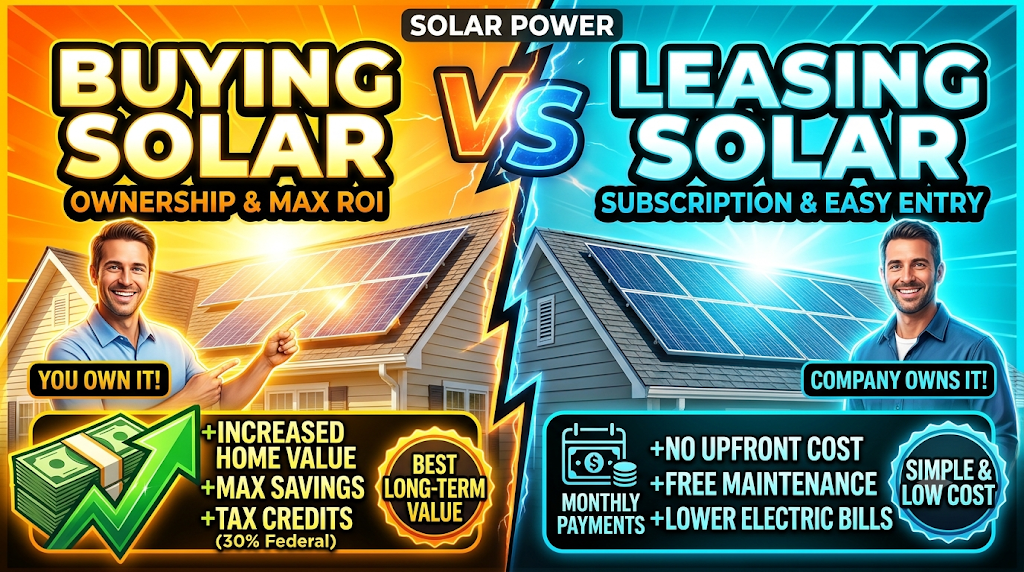
Solar leasing and buying solar panels are two different ways to install and use solar energy at a home or business. Both options allow consumers to benefit from electricity generated by solar panels, but they differ in ownership, upfront investment, monthly payments and maintenance responsibilities. Under a solar lease, a solar company generally owns the equipment and allows the consumer to use the installed system in exchange for regular payments. When buying solar panels, the consumer purchases the equipment and becomes its owner.
Choosing between a solar lease and buying solar panels depends on your financial situation, electricity requirements and long-term plans. Leasing can be attractive for people who want to avoid a large initial investment and prefer the solar provider to handle maintenance. Buying solar panels requires more initial capital or financing, but provides equipment ownership and greater control over the system. Understanding these differences can help you decide which option offers better value for your property.
Quick Comparison Table
| Feature | Solar Lease | Buying Solar Panels |
|---|---|---|
| Ownership | Solar company | Consumer |
| Initial investment | Usually low or zero | Higher |
| Monthly payment | Regular lease payment | No lease payment |
| Maintenance | Generally handled by provider | Owner’s responsibility |
| Equipment control | Limited | Greater control |
| Electricity savings | Depends on lease terms | Depends on solar generation |
| System warranties | Managed according to lease | Manufacturer and installer warranties |
| Government incentives | Generally go to system owner | May be available to eligible owner |
| Contract duration | Usually long-term | No solar lease contract |
| System modification | Requires provider approval | Greater flexibility |
| Selling property | Lease transfer may be required | No lease transfer |
| Long-term ownership | Not automatic | Yes |
| Best suited for | Low upfront investment | Long-term ownership and savings |
1. What Is a Solar Lease?
A solar lease is an arrangement in which a solar company installs and owns a solar panel system on a consumer’s property. Instead of purchasing the panels, the consumer signs a contract and pays a regular amount to use the solar installation.
The leasing company generally handles system monitoring, maintenance and repairs according to the agreement. The consumer receives the benefit of the electricity generated by the solar panels and may reduce the amount of electricity purchased from the utility.
For example, a homeowner may install a rooftop solar system through a leasing company without purchasing the panels. The homeowner makes monthly lease payments while using the electricity produced by the installation.
Main Benefits of Solar Leasing
- Usually requires little or no initial investment.
- Reduces the need to purchase solar equipment.
- Maintenance and repairs are generally handled by the leasing company.
- Provides access to solar electricity without direct system ownership.
- Some agreements include electricity production guarantees.
- Can help preserve personal savings for other expenses.
2. What Does Buying Solar Panels Mean?
Buying solar panels means purchasing the complete solar installation from a solar vendor. The consumer pays for the panels, inverter, mounting structure, wiring and other necessary equipment.
After purchasing and installing the system, the consumer becomes its owner. The generated electricity can be used directly by the property, and eligible surplus electricity can be exported to the grid under the applicable metering arrangement.
The system can be purchased using personal savings or a suitable solar loan.
Main Benefits of Buying Solar Panels
- Complete ownership of the solar equipment.
- Greater control over system operation and configuration.
- No regular lease payments to a solar company.
- Potentially greater long-term financial savings.
- Access to applicable government incentives for eligible consumers.
- More flexibility when modifying or upgrading the installation.
- Greater independence from long-term leasing contracts.
3. Difference in Ownership
Ownership is one of the most important differences between solar leasing and buying solar panels.
Under a solar lease, the leasing company generally owns the complete installation. The consumer can use the electricity generated by the system but does not automatically own the panels, inverter or other equipment.
When buying solar panels, the consumer owns the equipment after purchasing it. This provides greater control over the installation and allows the owner to make decisions about maintenance, upgrades and future use.
Therefore, buying is more suitable for people who want complete ownership, while leasing is suitable for those who prefer using solar equipment without purchasing it.
4. Difference in Initial Investment
Solar leasing generally requires a smaller initial investment because the leasing company finances and installs the system. Some agreements offer installation with no upfront payment.
Buying solar panels requires the consumer to pay the purchase and installation cost. Although solar loans and financing options may reduce the immediate financial burden, the consumer remains responsible for the investment and applicable loan repayments.
This makes leasing attractive for people with limited available capital, while purchasing can suit consumers who have sufficient savings or access to affordable financing.
5. Difference in Monthly Payments
Under a solar lease, consumers generally make regular payments according to the agreement. Some contracts have fixed monthly payments, while others include an annual increase known as an escalator.
Under direct purchasing, there are no lease payments. However, consumers who purchase through a solar loan must make loan repayments until the financing is completed.
It is important to compare the lease payment or loan instalment along with the remaining electricity bill. A low advertised monthly payment does not automatically mean lower total electricity expenses.
6. Difference in Maintenance and Repairs
In a typical solar lease, the leasing company is responsible for maintaining the installation. This may include monitoring, servicing, troubleshooting and repairing covered equipment.
With purchased solar panels, the owner is responsible for arranging maintenance and repairs. Manufacturer warranties and installation warranties can provide protection against certain equipment or workmanship problems.
Consumers should check warranty periods, exclusions, maintenance costs and inverter replacement responsibilities before selecting either option.
7. Difference in Government Subsidies and Incentives
Government subsidies and financial incentives can influence the total cost of a solar installation.
When purchasing solar panels, eligible consumers may qualify for government support under applicable renewable energy schemes. For example, India’s PM Surya Ghar: Muft Bijli Yojana provides financial assistance to eligible residential consumers under its approved guidelines.
Under a third-party solar lease, the leasing company generally owns the system. Therefore, incentives linked specifically to system ownership may not be available directly to the consumer.
However, eligibility depends on the particular government scheme, ownership model and installation requirements. Consumers should verify current rules before signing a lease or purchasing a solar system.
8. Difference in Selling a Property
A solar lease can create additional steps when selling a house or commercial property.
If the property owner sells the building before the lease expires, the agreement may need to be transferred to the new owner. The buyer may have to accept the remaining lease payments and meet the provider’s transfer requirements.
Some contracts may also include early termination or buyout charges.
When buying solar panels, the property owner already owns the equipment. There is no separate lease contract to transfer, although existing loans, warranties and grid connection arrangements should be considered.
9. What Happens When a Solar Lease Ends?
The end-of-contract conditions are important when choosing a solar lease.
Depending on the agreement, the consumer may have options such as:
- Renewing the lease.
- Purchasing the solar system at an agreed price or fair market value.
- Having the leasing company remove the equipment.
- Continuing to use the system under a new arrangement.
The consumer does not automatically become the owner when the lease ends. The exact options, charges and responsibilities should be clearly mentioned in the contract.
When purchasing solar panels, the consumer already owns the installation and can continue using it after the financing period ends, provided the equipment remains operational.
10. Solar Lease vs Buying Solar Panels: Which Is Better?
Solar leasing is generally more suitable for consumers who want solar electricity without spending a large amount on equipment. It can also be useful for people who prefer the leasing company to manage maintenance and repairs.
Buying solar panels is generally better for consumers who can afford the initial investment and want complete ownership. It can provide greater long-term financial benefits because there are no ongoing lease payments to a third-party company.
Overall, buying solar panels is often the better choice for long-term ownership and potential lifetime savings, while solar leasing is more suitable for consumers who want lower upfront costs and less maintenance responsibility.
Before deciding, compare the complete purchase price, lease payments, annual payment increases, maintenance coverage, expected solar generation and contract termination conditions. The best option is the one that provides better financial value under your actual circumstances.
Frequently Asked Questions (FAQs)
1. What is the main difference between solar leasing and buying solar panels?
Under solar leasing, a company owns the solar equipment and charges the consumer for using it. When buying solar panels, the consumer purchases and owns the complete installation.
2. Is it better to lease or buy solar panels?
Buying is generally better for consumers seeking ownership and potential long-term savings. Leasing may be better for people who want lower upfront costs and provider-managed maintenance.
3. Do I own solar panels under a lease?
No. Under a standard solar lease, the leasing company owns the equipment throughout the contract period unless an ownership transfer is specifically agreed upon.
4. Who pays for solar panel maintenance under a lease?
The leasing company generally handles maintenance and covered repairs. The exact responsibilities depend on the lease agreement.
5. Can I buy a leased solar system later?
Some leasing agreements provide an option to purchase the system during or at the end of the contract. The purchase price and conditions should be checked before signing.
6. Can I sell my house if I have leased solar panels?
Yes, but the lease agreement may need to be transferred to the new owner. Alternatively, the contract may require a buyout or another approved arrangement.
7. Can I get a government subsidy when buying solar panels in India?
Eligible residential consumers may receive financial assistance under PM Surya Ghar: Muft Bijli Yojana, subject to current scheme guidelines, approved system requirements and other eligibility conditions.
8. Does buying solar panels eliminate electricity bills completely?
Not necessarily. Solar generation can reduce grid electricity purchases, but fixed charges, taxes and electricity consumed beyond solar production may still result in a bill.
Disclaimer
This article is intended for general informational and educational purposes. Solar lease terms, system ownership, maintenance responsibilities, government subsidies, financing options and electricity billing arrangements may vary by location and service provider. In India, consumers should verify the latest MNRE guidelines, PM Surya Ghar eligibility conditions and local DISCOM regulations before entering into a solar lease or purchasing solar panels. Always review the complete agreement, including payment increases, ownership transfer, warranty coverage and termination conditions, before making a financial commitment.