Fixed-Tilt vs Solar Tracking System
Introduction
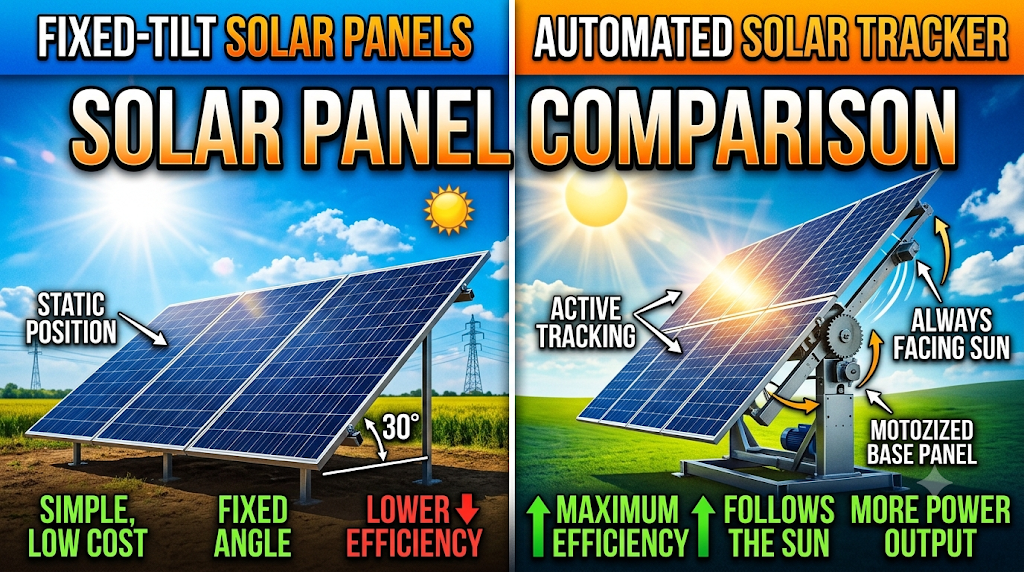
Solar panel mounting systems play an important role in determining how much electricity a solar installation can generate. Two common options are fixed-tilt mounting systems and solar tracking systems. A fixed-tilt system keeps solar panels at a predetermined angle throughout the day, while a tracking system automatically changes the panel position to follow the sun. Both systems are designed to capture sunlight, but they differ in electricity generation, installation costs, maintenance requirements, and suitability for different locations.
Choosing between fixed-tilt and solar tracking systems depends on the installation size, available land, sunlight conditions, budget, and long-term electricity requirements. Tracking systems can capture more direct sunlight during different hours of the day, potentially increasing energy production. However, they also require additional mechanical components and maintenance. Fixed-tilt systems are simpler and generally more affordable. Understanding these differences helps homeowners, businesses, and solar project developers select a suitable mounting solution.
Quick Comparison Table
| Feature | Fixed-Tilt System | Solar Tracking System |
|---|---|---|
| Panel position | Fixed angle | Moves with the sun |
| Sunlight tracking | No | Yes |
| Electricity generation | Standard | Potentially higher |
| Initial cost | Lower | Higher |
| Maintenance | Low | Higher |
| Moving parts | No | Yes |
| Installation | Simpler | More complex |
| Mechanical reliability | Generally higher | Depends on tracker components |
| Land requirements | Often easier to arrange | Depends on tracker design and spacing |
| Rooftop suitability | Excellent | Generally limited |
| Large solar farms | Suitable | Highly suitable |
| Long-term operating costs | Generally lower | Generally higher |
1. What Is a Fixed-Tilt Solar System?
Utility-Scale Solar Projects | Sunistics Group
A fixed-tilt solar system uses mounting structures that hold solar panels at a predetermined angle and direction. Once installed, the panels remain in the same position throughout the day and across different seasons. The tilt angle is selected according to geographical location, sunlight conditions, and project requirements.
These systems do not require motors, sensors, or automatic movement mechanisms. Their simple construction makes installation and maintenance relatively straightforward. Fixed-tilt mounting is commonly used in residential rooftops, commercial buildings, and ground-mounted solar projects where affordability and reliability are important.
Advantages of Fixed-Tilt Systems
- Lower installation cost: They generally require less equipment and simpler mounting structures.
- Low maintenance: No tracking motors or moving mechanical components are needed.
- Simple operation: Panels remain in their installed position without automatic adjustments.
- Good reliability: Fewer mechanical components mean fewer potential mechanical failures.
- Rooftop compatibility: They are suitable for most residential and commercial rooftop installations.
Disadvantages of Fixed-Tilt Systems
- Limited sunlight adjustment: Panels cannot change their position to follow the sun.
- Lower potential energy generation: They may produce less electricity than a suitably designed tracking system.
- Fixed orientation: Their performance depends on the selected installation angle and direction.
2. What Is a Solar Tracking System?
A solar tracking system automatically changes the position of solar panels to follow the sun as it moves across the sky. Its main purpose is to keep the panels better aligned with incoming sunlight for more hours of the day. Depending on the design, the system uses motors, controllers, sensors, and mechanical structures to adjust panel orientation.
Solar tracking systems are commonly considered for large ground-mounted solar farms where additional electricity generation can justify the higher installation and maintenance costs. There are two main types: single-axis and dual-axis tracking systems.
Types of Solar Tracking Systems
Single-Axis Solar Tracker
types de suiveurs solaires et leurs avantages et inconvénients -sunevosolar.com
A single-axis tracker moves solar panels around one axis, generally following the sun’s east-to-west movement. It is widely used in large solar power projects because it offers increased energy production without the complexity of a two-axis mechanism.
Dual-Axis Solar Tracker
Personnalisé Dispositif D’entraînement De Traqueur Solaire Système De Traqueur Solaire à Deux Axes
A dual-axis tracker adjusts panels along two axes. It can follow the sun’s daily movement as well as changes in its position across different seasons. This allows more precise sunlight alignment, but the additional mechanical complexity generally increases installation and maintenance costs.
Advantages of Solar Tracking Systems
- Higher electricity generation: Panels can capture more direct sunlight throughout the day.
- Better morning and evening production: Tracking can improve energy collection outside peak midday hours.
- Improved sunlight alignment: Panels adjust their position instead of remaining at one angle.
- Suitable for large solar farms: They can be beneficial where additional electricity production justifies the investment.
Disadvantages of Solar Tracking Systems
- Higher initial investment: Motors, controllers, and moving structures increase project costs.
- More maintenance: Mechanical components require inspection and servicing.
- Mechanical failure risk: Motors, bearings, and drive mechanisms can develop faults.
- Installation complexity: Tracker systems require more careful engineering and installation.
- Wind considerations: Tracker structures need appropriate wind protection and operating controls.
3. Fixed-Tilt vs Solar Tracking System: Key Differences
Electricity Generation
Solar tracking systems generally have an advantage in electricity generation because they adjust panel positions to follow the sun. The actual improvement depends on location, direct sunlight availability, tracker design, and operating conditions.
Fixed-tilt systems cannot adjust their position during the day. However, a properly designed fixed-tilt installation can still generate substantial electricity without requiring moving components.
Winner: Solar Tracking System for potential electricity generation.
Installation Cost
Fixed-tilt systems generally cost less to install because they use simpler mounting structures and do not require motors, sensors, or tracking controllers.
Solar tracking systems require additional mechanical and electrical equipment, increasing the initial investment. The extra cost may be justified in large projects where increased electricity generation provides sufficient financial returns.
Winner: Fixed-Tilt System for lower installation cost.
Maintenance Requirements
Fixed-tilt systems generally require less maintenance because their mounting structures have no moving parts. Routine inspection, cleaning, and structural checks are still necessary.
Solar tracking systems require additional attention to motors, bearings, controllers, drive mechanisms, and moving structures. Maintenance requirements can increase operating costs over the system’s lifetime.
Winner: Fixed-Tilt System for easier maintenance.
Reliability and Durability
Fixed-tilt systems have a relatively simple design, which reduces the number of mechanical components that could fail. Their long-term performance mainly depends on mounting quality, material durability, and environmental conditions.
Solar tracking systems have additional moving components. Their reliability depends on mechanical design, installation quality, wind protection, regular servicing, and the performance of control systems.
Winner: Fixed-Tilt System for mechanical simplicity.
Rooftop Suitability
Fixed-tilt mounting systems are generally the practical choice for residential and commercial rooftops. They can be installed on suitable roof structures without requiring complex moving mechanisms.
Solar tracking systems are less common on rooftops because they require additional space, structural engineering, wind-load consideration, and maintenance access.
Winner: Fixed-Tilt System for rooftop installations.
Suitability for Large Solar Farms
Both systems can be used in large solar farms. Fixed-tilt installations are attractive when lower costs, simpler operation, or site conditions are priorities.
Tracking systems can be particularly useful for large ground-mounted projects with suitable terrain and strong direct sunlight, where additional energy production can justify the investment.
Winner: Solar Tracking System when higher generation and project economics support the additional cost.
4. Which System Offers Better Long-Term Value?
Long-term value depends on more than electricity generation. Buyers and solar project developers should consider the initial investment, additional electricity produced, maintenance expenses, land requirements, local weather, and expected project lifetime.
A fixed-tilt system may provide better financial value when installation costs and low maintenance are the main priorities. A tracking system may offer better returns when the additional electricity generated produces enough revenue or electricity-bill savings to cover its extra costs.
Therefore, the better investment should be determined through a location-specific technical and financial assessment rather than electricity-generation figures alone.
5. Which System Should You Choose?
Choose a Fixed-Tilt System If:
- You want a more affordable solar installation.
- You are installing solar panels on a residential rooftop.
- You prefer a simple system with fewer mechanical components.
- You want lower routine maintenance requirements.
- Your project has limited space or challenging terrain.
Choose a Solar Tracking System If:
- You are developing a large ground-mounted solar farm.
- Your location receives strong direct sunlight.
- You want to increase electricity generation.
- You have sufficient land and a suitable installation site.
- Your project budget can support additional equipment and maintenance.
Conclusion
Both fixed-tilt and solar tracking systems have their own advantages. Fixed-tilt systems are generally more affordable, simpler to install, and easier to maintain, making them suitable for most residential and commercial rooftop installations. Solar tracking systems can generate more electricity by following the sun, making them attractive for suitable large-scale ground-mounted solar projects.
Overall Winner: Fixed-Tilt System is the better practical choice for most residential and small commercial installations, while Solar Tracking System is a strong option for large solar farms where the additional electricity generation justifies the higher investment.
Frequently Asked Questions (FAQs)
1. Which is better, fixed-tilt or solar tracking?
Fixed-tilt systems are generally better for residential rooftops and budget-conscious projects. Solar tracking systems can be better for large ground-mounted solar farms where increased electricity generation justifies additional costs.
2. How much more electricity can a solar tracking system generate?
The improvement depends on location and tracker design. NREL and other technical references report that single-axis tracking can increase energy production by around 25% or more in suitable conditions, but actual results vary. NREL+1
3. Does a solar tracking system require electricity to operate?
Yes. Motorized tracking systems use electrical power for their motors and control equipment. The consumption is generally considered as part of the overall system energy balance.
4. Are solar tracking systems suitable for residential rooftops?
Generally, no. Fixed-tilt systems are usually more practical because rooftop trackers add structural complexity, cost, and maintenance requirements.
5. Which system requires less maintenance?
Fixed-tilt systems generally require less maintenance because they do not use motors, bearings, or moving tracking mechanisms.
6. What is the difference between single-axis and dual-axis solar tracking?
Single-axis trackers move panels along one axis, generally following the sun from east to west. Dual-axis trackers adjust panel position along two axes to follow both daily and seasonal solar movement.
Disclaimer
The information in this article is provided for general educational and comparison purposes. Actual electricity generation, installation costs, maintenance requirements, and system performance may vary depending on geographical location, sunlight conditions, equipment quality, installation design, and environmental factors. Consult a qualified solar professional before selecting or installing a solar mounting system.