Solar Street Light vs Grid-Powered Street Light
Introduction
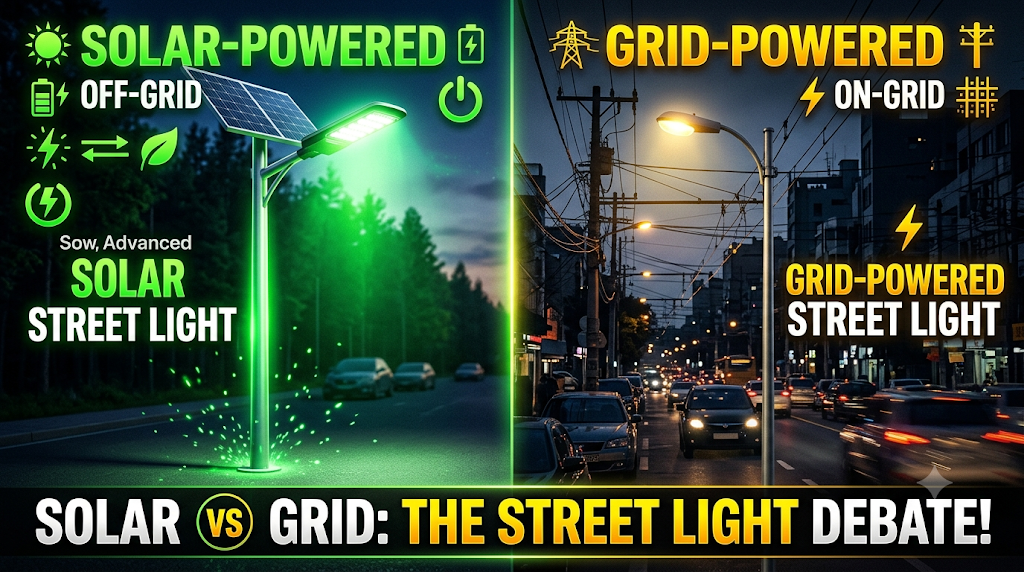
Street lighting is important for road safety, public security and visibility during nighttime. Two commonly used lighting solutions are solar street lights and grid-powered street lights. Both provide outdoor illumination, but they use different energy sources. Solar street lights generate electricity through solar panels and store energy in batteries, while grid-powered street lights receive electricity from the conventional power supply. The choice between these systems depends on installation location, electricity availability, initial budget, maintenance requirements and long-term operating costs.
Solar street lights are increasingly considered for locations where extending electrical connections is difficult or expensive. They can operate independently of the electricity grid when their solar panels and batteries are properly sized. Grid-powered street lights, on the other hand, provide a conventional lighting solution with a continuous electricity connection. They are widely used in urban roads, highways, commercial areas and public spaces. Comparing their installation costs, electricity consumption, reliability and maintenance requirements helps municipalities, businesses and property owners select the right lighting system.
Quick Comparison Table
| Feature | Solar Street Light | Grid-Powered Street Light |
|---|---|---|
| Energy Source | Solar energy | Grid electricity |
| Electricity Bill | No regular grid electricity bill for operation | Regular electricity consumption cost |
| Initial Cost | Generally higher for complete standalone units | Depends on wiring and grid infrastructure |
| Battery Requirement | Usually required | Not normally required |
| Solar Panel | Required | Not required |
| Grid Connection | Not required for standalone models | Required |
| Installation | Can be easier in remote locations | Requires electrical infrastructure |
| Weather Dependency | Depends on sunlight and battery storage | Not directly dependent on sunlight |
| Maintenance | Panels, batteries and lighting components | Electrical connections and lighting components |
| Power Availability | Depends on stored energy and system design | Depends on grid supply |
| Best For | Remote roads and areas without grid access | Urban roads and areas with reliable electricity infrastructure |
1. Working Principle
Solar Street Light
A solar street light uses a solar panel to convert sunlight into electrical energy during the day.
The generated electricity charges a battery, which stores energy for nighttime operation. A controller manages battery charging, discharging and lighting operation.
Many modern solar street lights use LED technology because LEDs provide efficient illumination with relatively low power consumption.
Grid-Powered Street Light
A grid-powered street light receives electricity through an electrical connection from the local power distribution network.
The supplied electricity powers the street light, usually through an LED or another suitable lighting technology.
A timer, photocell or central control system can automatically switch the lights on and off according to lighting requirements.
2. Initial Installation Cost
Solar Street Light
Solar street lights generally require a solar panel, battery, LED fixture, controller and supporting pole or mounting structure.
These additional components can increase the initial purchase price. However, standalone solar lights can avoid the expense of extending grid connections and installing long underground or overhead cables.
Grid-Powered Street Light
Grid-powered street lights require suitable poles, electrical cables, connections, protective equipment and lighting fixtures.
Their initial cost can be relatively economical where electrical infrastructure is already available. However, installing new wiring and extending grid connections can significantly increase project costs.
Winner: Depends. Grid-powered lights can be cheaper where infrastructure already exists, while solar lights can be more economical where grid extension is expensive.
3. Electricity Consumption and Running Cost
Solar Street Light
Solar street lights use energy collected from sunlight and stored in their batteries.
Standalone systems do not normally require electricity from the grid, so they avoid regular grid electricity charges. Their operating costs still include battery replacement and other maintenance expenses over time.
Grid-Powered Street Light
Grid-powered street lights consume electricity from the local distribution network whenever they operate.
Their running costs depend on LED power ratings, operating hours, electricity tariffs and the number of installed lights.
Winner: Solar Street Light for reducing grid electricity consumption and avoiding regular grid electricity bills.
4. Reliability and Power Availability
Solar Street Light
Solar street lights depend on stored battery energy for nighttime operation.
Their reliability depends on solar panel capacity, battery condition, sunlight availability, daily energy consumption and backup capacity.
During extended cloudy or rainy periods, an undersized system may not have enough stored energy to operate throughout the night.
Grid-Powered Street Light
Grid-powered street lights can operate whenever electricity is available from the distribution network.
They are not directly dependent on weather or daily sunlight. However, power cuts, electrical faults and grid failures can interrupt operation.
Winner: Grid-Powered Street Light where the electricity supply is reliable and uninterrupted.
5. Installation Requirements
Solar Street Light
Solar street lights are particularly useful in remote areas where grid electricity is unavailable.
Standalone units generally do not need long electrical cables or connections to the distribution network. However, they require suitable sunlight exposure and properly designed mounting structures.
Grid-Powered Street Light
Grid-powered street lights need electrical infrastructure, including cables, connections, protective devices and suitable power distribution arrangements.
Installation can be more complicated in areas where grid connections are unavailable or require extensive construction work.
Winner: Solar Street Light for remote locations and areas without existing electrical infrastructure.
6. Maintenance Requirements
Solar Street Light
Solar street lights require inspection of solar panels, batteries, controllers, LED fixtures and electrical connections.
Dust accumulation on solar panels can reduce charging performance, while battery capacity can decrease with age and repeated charging cycles.
Grid-Powered Street Light
Grid-powered street lights require inspection of lighting fixtures, wiring, poles, electrical connections and protective equipment.
Since conventional grid-powered systems do not normally use batteries for their primary operation, they avoid routine battery replacement.
Winner: Grid-Powered Street Light for simpler energy-storage maintenance.
7. Environmental Impact
Solar Street Light
Solar street lights use renewable solar energy during operation and can reduce dependence on grid electricity.
Their environmental impact also depends on the manufacturing, transportation, battery replacement and disposal of their components.
Grid-Powered Street Light
Grid-powered street lights depend on the electricity mix supplied by the local grid.
When electricity is generated from fossil fuels, their operation can contribute to greenhouse gas emissions. Their impact can be reduced when the grid uses more renewable electricity.
Winner: Solar Street Light when it replaces electricity generated from fossil fuels and its batteries are properly managed and recycled.
8. Long-Term Operating Cost
Solar Street Light
Solar street lights can reduce long-term electricity expenses, particularly in locations with high grid connection or electricity costs.
However, batteries have a limited service life and may need replacement. The total cost of ownership should include battery replacement, panel cleaning and other maintenance.
Grid-Powered Street Light
Grid-powered street lights have recurring electricity expenses throughout their operating life.
Where the electrical infrastructure is already available, their installation and maintenance costs may be manageable. However, electricity tariffs can influence long-term operating expenses.
Winner: Depends. Solar systems may offer lower lifetime costs in suitable remote installations, while grid-powered systems can be economical where infrastructure is already available and electricity is affordable.
Advantages and Disadvantages
Solar Street Light
Advantages
- Uses renewable solar energy.
- Does not normally require a grid connection.
- No regular grid electricity bill for standalone operation.
- Suitable for remote roads and rural locations.
- Reduces dependence on conventional electricity.
- Can simplify installation where grid wiring is difficult.
Disadvantages
- Higher initial cost in some installations.
- Depends on battery storage.
- Battery replacement may be required.
- Performance can decrease during prolonged cloudy weather.
- Solar panels require periodic cleaning.
- Battery disposal and recycling need proper management.
Grid-Powered Street Light
Advantages
- Provides predictable operation when grid electricity is available.
- Does not normally require battery storage.
- Suitable for established urban electrical infrastructure.
- Not directly dependent on sunlight.
- Can be integrated with central lighting control systems.
- Suitable for large road-lighting networks.
Disadvantages
- Consumes electricity from the grid.
- Creates recurring electricity expenses.
- Requires electrical connections and wiring.
- Grid failures can interrupt lighting.
- Extending electrical infrastructure can be expensive.
- Environmental impact depends on the electricity source.
Which Is Better: Solar Street Light or Grid-Powered Street Light?
Both lighting systems can provide effective outdoor illumination, but their suitability depends on the location and available infrastructure.
A solar street light is generally better for remote roads, rural areas, parks, campuses and locations where extending electrical connections is difficult or expensive. It can operate independently of the grid and reduce recurring electricity expenses, provided its battery and solar panel are properly sized.
A grid-powered street light is generally better for urban roads, highways and developed areas where reliable electrical infrastructure already exists. It provides predictable power availability without depending on battery storage or sunlight.
Final Verdict: Solar Street Light is the better choice for remote locations, reduced grid electricity consumption and independent operation, while Grid-Powered Street Light is generally better for established urban infrastructure and locations with reliable electricity supply.
Frequently Asked Questions (FAQs)
1. What is the main difference between solar and grid-powered street lights?
Solar street lights use solar panels and batteries to generate and store electricity, while grid-powered street lights receive electricity directly from the conventional power network.
2. Do solar street lights work at night?
Yes. Solar street lights use electricity stored in their batteries during the daytime to operate their LED lights at night.
3. Do solar street lights work during rainy weather?
They can operate during rainy weather using stored battery energy. However, prolonged cloudy or rainy conditions can reduce battery charging and affect nighttime operating hours.
4. Which street light is cheaper to operate?
Standalone solar street lights generally have lower grid electricity expenses because they use stored solar energy. However, battery replacement and maintenance must be included when calculating lifetime costs.
5. How long do solar street light batteries last?
Battery life depends on battery chemistry, quality, temperature, charging conditions and usage. The manufacturer’s rated service life should be checked before purchasing.
6. Are solar street lights suitable for highways?
Yes. Solar street lights can be used on highways when their illumination levels, battery capacity, pole design and spacing meet the applicable road-lighting requirements.
7. Which street light is better for villages?
Solar street lights can be a practical option for villages where grid connections are unavailable, unreliable or expensive to extend. Grid-powered lights can also be suitable where reliable electrical infrastructure exists.
Disclaimer
Solar street light prices, brightness, battery capacity, operating hours, electricity costs and maintenance requirements may vary depending on manufacturer, LED power rating, solar panel capacity, battery technology, weather conditions and installation location. Proper lighting design and applicable road safety standards should be considered before installation.