Flat Plate vs Evacuated Tube Solar Water Heater
Introduction
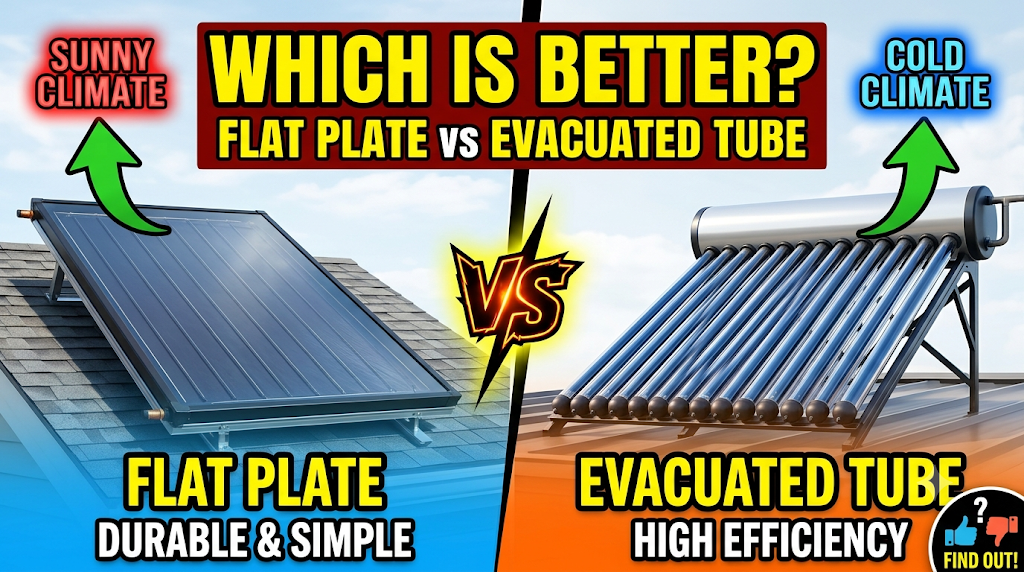
Solar water heaters are available in different technologies, and flat plate collectors and evacuated tube collectors are two commonly used options. Both systems use sunlight to heat water for household, commercial and industrial applications. However, their construction, heat absorption methods, insulation and performance under different weather conditions are different. Flat plate collectors use an absorber plate covered with transparent glazing, while evacuated tube collectors use multiple glass tubes with vacuum insulation to reduce heat loss.
Choosing between these two technologies depends on climate, water-heating requirements, installation space, budget and maintenance expectations. Flat plate collectors are known for their relatively simple and robust construction, while evacuated tube collectors are designed to reduce heat loss and can perform well in colder conditions. Both can provide useful energy savings, but their suitability depends on the actual installation environment. Understanding their differences helps homeowners select an appropriate solar water heating system.
Quick Comparison Table
| Feature | Flat Plate Collector | Evacuated Tube Collector |
|---|---|---|
| Collector Design | Flat absorber plate | Multiple evacuated glass tubes |
| Heat Absorption | Absorber plate | Absorbing surfaces inside tubes |
| Insulation | Insulated collector casing | Vacuum insulation |
| Heat Loss | Generally higher | Generally lower |
| Cold Weather Performance | Can be affected more by heat loss | Generally performs well in cold conditions |
| Construction | Solid and relatively simple | Multiple glass tubes |
| Initial Cost | Often competitive | Varies by design and brand |
| Maintenance | Relatively simple | Individual tubes may need replacement |
| Physical Durability | Robust panel construction | Glass tubes require careful handling |
| Installation | Roof or suitable mounting structure | Roof or suitable mounting structure |
| Best For | Suitable climates and robust installations | Cold climates and applications needing reduced heat loss |
1. Working Principle
Flat Plate Solar Water Heater
A flat plate solar water heater uses a flat absorber plate that captures sunlight and converts it into heat.
The absorber is usually connected to a network of pipes through which water or a heat-transfer fluid circulates. The collected heat is transferred to the water, which is then stored in an insulated tank.
A transparent cover allows sunlight to reach the absorber while helping reduce heat loss.
Evacuated Tube Solar Water Heater
An evacuated tube solar water heater uses multiple glass tubes designed to absorb solar energy.
Each tube contains a vacuum layer between its glass walls. This vacuum reduces heat transfer through conduction and convection, helping retain the collected heat.
The absorbed heat is transferred to water or a heat-transfer fluid, depending on the system design, and then used to heat the storage tank.
2. Heating Efficiency and Heat Retention
Flat Plate Collector
Flat plate collectors absorb sunlight through their coated absorber surfaces. Their insulated casing helps reduce heat loss, but heat can still escape through the glazing and surrounding structure.
Their performance depends on sunlight intensity, ambient temperature and collector design.
Evacuated Tube Collector
Evacuated tube collectors use vacuum insulation to reduce heat loss from the absorber.
This design can help maintain better thermal performance when the surrounding air temperature is low or when there is a significant difference between collector and ambient temperatures.
Winner: Evacuated Tube Collector for reduced heat loss under suitable operating conditions.
3. Performance in Winter
Flat Plate Collector
Flat plate collectors can heat water effectively during sunny winter days. However, their performance may be affected by lower outdoor temperatures because they generally experience more heat loss than evacuated tube collectors.
Evacuated Tube Collector
Evacuated tube collectors have vacuum insulation that helps reduce heat loss in cold weather.
They can be a suitable choice in colder regions where maintaining collector heat is important. Actual performance still depends on sunlight, collector orientation and system design.
Winner: Evacuated Tube Collector for many cold-weather applications.
4. Initial Installation Cost
Flat Plate Collector
Flat plate collectors often offer a competitive purchase price because of their relatively straightforward construction.
Their overall installation cost depends on collector size, storage tank capacity, mounting structure and plumbing requirements.
Evacuated Tube Collector
Evacuated tube collectors are available in different designs and price ranges. Their cost depends on the number and quality of tubes, heat-transfer arrangement and storage capacity.
The complete system cost should be compared rather than judging only the collector price.
Winner: Flat Plate Collector when comparing systems with similar capacity and specifications where it is the less expensive option.
5. Durability and Physical Strength
Flat Plate Collector
Flat plate collectors generally use a rigid absorber plate enclosed within a protective casing. Their construction can provide good physical protection against ordinary outdoor conditions.
However, the glazing and mounting structure still require protection and inspection.
Evacuated Tube Collector
Evacuated tube collectors use individual glass tubes. These tubes can be vulnerable to physical impact, accidental damage and improper handling.
One advantage of their design is that an individual damaged tube can often be replaced without replacing the entire collector, depending on the system design.
Winner: Flat Plate Collector for overall physical robustness in many installations.
6. Maintenance Requirements
Flat Plate Collector
Flat plate collectors generally have a relatively simple structure. Maintenance usually involves checking the glazing, insulation, plumbing connections and collector surface.
Cleaning may be necessary to remove accumulated dust and dirt.
Evacuated Tube Collector
Evacuated tube collectors require inspection of the glass tubes, connections, seals and associated plumbing.
If an individual tube becomes damaged or loses its vacuum, it may need replacement.
Winner: Flat Plate Collector for simpler routine maintenance.
7. Installation and Space Requirements
Flat Plate Collector
Flat plate collectors are installed as complete panel units. They require a suitable mounting structure, appropriate roof space and proper orientation.
Their rectangular shape makes installation planning relatively straightforward.
Evacuated Tube Collector
Evacuated tube collectors use multiple parallel tubes mounted on a supporting frame.
Their arrangement can provide flexibility in certain installations, but adequate spacing, structural support and access for maintenance are still important.
Winner: Depends. Both can be suitable for rooftops when properly designed and installed.
8. Hot Water Availability
Flat Plate Collector
Flat plate collectors heat water during periods of available sunlight. Their insulated storage tanks help retain hot water for later use.
During prolonged cloudy or rainy weather, water temperature may not reach the desired level without backup heating.
Evacuated Tube Collector
Evacuated tube collectors also depend on sunlight, but their vacuum insulation can help reduce heat loss and maintain thermal performance.
They may provide better results under certain cold or low-temperature conditions, although they cannot guarantee hot water during prolonged periods without sunlight.
Winner: Evacuated Tube Collector in conditions where reduced heat loss provides a practical advantage.
Advantages and Disadvantages
Flat Plate Solar Water Heater
Advantages
- Relatively simple construction.
- Robust absorber and casing design.
- Often competitive initial cost.
- Straightforward routine maintenance.
- Suitable for many residential and commercial applications.
- No individual glass absorber tubes.
Disadvantages
- Generally experiences more heat loss than evacuated tube collectors.
- May be less suitable for some very cold conditions.
- Performance depends on sunlight and ambient temperature.
- Glazing and insulation require periodic inspection.
Evacuated Tube Solar Water Heater
Advantages
- Vacuum insulation reduces heat loss.
- Suitable for colder climates.
- Can maintain good thermal performance in lower ambient temperatures.
- Individual tubes may be replaceable.
- Available in different collector configurations.
Disadvantages
- Glass tubes can break due to physical impact.
- Individual tubes require inspection.
- Replacement tubes may be needed after damage.
- Initial cost varies and can be higher for some systems.
- Installation requires suitable mounting and handling.
Which Is Better: Flat Plate or Evacuated Tube Solar Water Heater?
Both technologies can provide effective solar water heating, but their advantages differ according to climate and installation requirements.
A flat plate solar water heater is a practical option for households looking for a relatively simple, robust and easy-to-maintain system. It can be suitable for locations with good sunlight and moderate weather conditions.
An evacuated tube solar water heater can be a better choice in colder regions or applications where reducing heat loss is important. Its vacuum insulation helps retain heat, although its glass tubes need careful handling and inspection.
Final Verdict: Flat Plate Solar Water Heater is a good choice for robust construction and simpler maintenance, while Evacuated Tube Solar Water Heater is generally preferable for colder conditions and reduced heat loss. The final choice should depend on local climate, system quality and total installation cost.
Frequently Asked Questions (FAQs)
1. What is the main difference between flat plate and evacuated tube solar water heaters?
Flat plate systems use a flat absorber plate to collect solar heat, while evacuated tube systems use multiple glass tubes with vacuum insulation to reduce heat loss.
2. Which solar water heater is better in winter?
Evacuated tube collectors generally perform better in colder conditions because their vacuum insulation reduces heat loss. Actual performance depends on sunlight and system design.
3. Which solar water heater is more durable?
Flat plate collectors generally have a more robust physical construction. Evacuated tube collectors use glass tubes that can be damaged by physical impact.
4. Are evacuated tube solar water heaters more efficient?
They can provide better thermal performance under certain conditions, particularly when heat loss is significant. Actual efficiency depends on collector design and operating temperature.
5. Can flat plate solar water heaters work during cloudy weather?
Yes, they can collect some solar energy under cloudy conditions, but heating performance decreases when sunlight is limited. Backup heating may be required.
6. What happens if an evacuated glass tube breaks?
A damaged tube can usually be replaced individually in systems designed for tube replacement. The replacement process should follow the manufacturer’s instructions.
7. Which solar water heater is better for Indian homes?
Both are suitable for Indian homes. Flat plate collectors can be practical in many regions with good sunlight, while evacuated tube collectors can be useful where colder winters and reduced heat loss are important considerations.
Disclaimer
Solar water heater prices, heating performance, collector efficiency and maintenance requirements may vary depending on manufacturer, model, local climate, water quality, installation angle and system capacity. Consult a qualified solar water heating professional before selecting a system.