Article 49 of 50
Grid-Tied Solar with Battery vs Without Battery
Introduction
Grid-tied solar systems allow homes and businesses to generate electricity from solar panels while remaining connected to the utility electricity grid. However, homeowners can choose between a grid-tied solar system with battery storage and one without a battery. Both systems use solar energy to reduce electricity purchases from the grid, but they differ in backup capability, installation cost, energy storage and electricity usage after sunset. Understanding these differences helps homeowners select a solar configuration that matches their electricity consumption, budget and backup requirements.
A grid-tied solar system without a battery generally supplies solar electricity directly to connected loads, while surplus electricity may be exported to the utility grid under applicable net-metering or other billing arrangements. A system with battery storage can store some excess solar electricity for later use, such as during the evening or a grid outage, provided the system is designed for backup operation. The better option depends on electricity tariffs, grid reliability, battery costs, local regulations and household energy requirements.
Quick Comparison Table
| Feature | With Battery | Without Battery |
|---|---|---|
| Initial cost | Higher | Lower |
| Solar energy storage | Yes | No |
| Daytime solar usage | Yes | Yes |
| Night-time solar usage | Stored energy available | Grid electricity |
| Power backup | Possible with suitable design | Generally unavailable |
| Battery maintenance | Required | Not required |
| System complexity | Higher | Lower |
| Grid dependency | Reduced | Higher |
| Energy independence | Greater | Lower |
| Battery replacement cost | Applicable | Not applicable |
| Best suited for | Backup and energy storage | Lower-cost solar savings |
1. Working Method and Electricity Flow
Grid-Tied Solar with Battery
Rooftop Solar Installation Services Mumbai | JK Electrical & Engineers
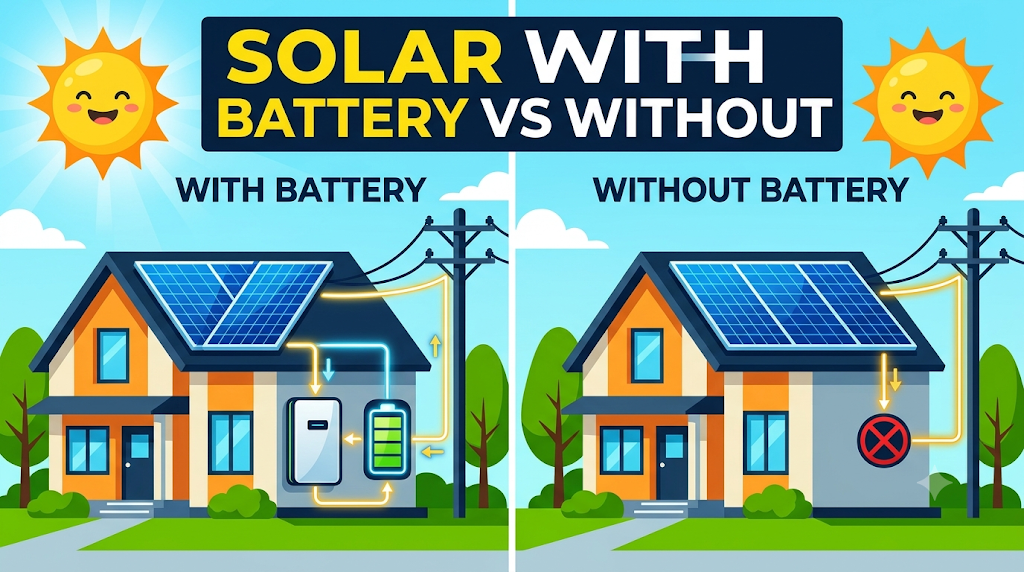
A grid-tied solar system with a battery uses solar panels, a suitable inverter, battery storage and a utility grid connection. During the daytime, solar electricity can supply household appliances and charge the battery when surplus generation is available.
When solar generation decreases, stored battery energy can supply supported household loads. If the battery is insufficient, the system can draw electricity from the utility grid when it is available. The exact operation depends on inverter configuration and system settings.
Grid-Tied Solar Without Battery
Grid-Tie Solar Inverters: Types, Specs & Compliance Guide | Uniz Solar
A grid-tied solar system without a battery sends electricity from solar panels through a grid-compatible inverter to the home’s electrical system. Solar generation is used by connected appliances first, while excess electricity may be exported to the utility grid under the applicable regulations.
When solar generation is insufficient, the home imports electricity from the grid. This arrangement does not store surplus solar electricity for use after sunset.
2. Initial Installation Cost
A grid-tied solar system with a battery costs more because it requires battery storage, compatible inverter equipment and additional electrical protection and installation components. The total cost also depends on battery chemistry, storage capacity and backup requirements.
A grid-tied system without a battery is generally less expensive because it does not require battery storage equipment. This makes it attractive for homeowners who primarily want to reduce their electricity bills.
Winner: Grid-Tied Solar Without Battery. It generally offers a lower initial installation cost.
3. Electricity Backup During Power Cuts
A battery-equipped solar system can provide backup electricity during a grid outage if it has a suitable backup-capable inverter, isolation equipment and correctly configured backup circuits. Some systems support the entire home, while others supply only selected essential appliances.
A conventional grid-tied solar system without battery storage normally shuts down during a power outage because its inverter must stop feeding electricity into the grid for safety reasons. Therefore, solar panels alone do not guarantee household backup.
Winner: Grid-Tied Solar with Battery. It can provide backup when designed and installed for that purpose.
4. Night-Time Electricity Usage
A solar system with a battery can store excess daytime solar electricity and use it after sunset. This can reduce the amount of electricity purchased from the utility grid during evening and night-time hours.
A solar system without a battery cannot store its daytime surplus. After sunset, the home generally depends on grid electricity or a separate backup arrangement.
Winner: Grid-Tied Solar with Battery. It offers greater flexibility for using solar electricity at night.
5. Electricity Bill Savings
Both configurations can reduce electricity bills by generating solar power and lowering electricity imports from the grid.
A system without a battery can be financially attractive where net metering or another favourable export arrangement gives appropriate credit for surplus electricity. A battery system may provide additional savings when stored electricity replaces expensive grid imports, but battery costs and energy-conversion losses must also be considered.
Winner: Depends. Without a battery may provide better financial value when grid-export credits are favourable. Battery storage may be more useful when evening electricity is expensive or export credits are limited.
6. Energy Independence
A grid-tied solar system without a battery remains dependent on the utility grid whenever solar generation is insufficient. It cannot independently use surplus daytime generation after sunset.
A battery-equipped system can store solar electricity and use it when solar generation is low. This reduces dependence on grid imports, although the level of independence depends on battery capacity, solar generation and household consumption.
Winner: Grid-Tied Solar with Battery. It provides greater control over when stored solar electricity is used.
7. Battery Maintenance and Replacement
A grid-tied solar system with a battery requires additional maintenance and monitoring. Battery performance gradually changes with usage, temperature, charging conditions and age. Eventually, replacement may be necessary.
A system without a battery avoids battery-related maintenance and replacement expenses. It still requires normal solar panel, inverter, wiring and electrical-system maintenance.
Winner: Grid-Tied Solar Without Battery. It has fewer components and avoids battery replacement costs.
8. System Efficiency and Energy Losses
A grid-tied system without a battery generally uses solar electricity directly when it is generated. Surplus electricity can be exported to the grid, depending on local arrangements.
A battery-equipped system introduces additional energy-conversion and storage losses during charging and discharging. However, it provides the advantage of shifting solar electricity from daytime production to later consumption.
Winner: Grid-Tied Solar Without Battery. It generally avoids the additional storage-related conversion losses.
9. Installation Space and System Complexity
A battery-equipped solar system requires additional space for battery installation, suitable electrical protection and compatible inverter equipment. Installation must also consider battery temperature, ventilation requirements where applicable and manufacturer safety instructions.
A grid-tied solar system without a battery has a simpler installation arrangement. It generally requires less equipment and space, making it convenient for homes with limited installation areas.
Winner: Grid-Tied Solar Without Battery. It is generally simpler and requires less additional space.
10. Long-Term Reliability
A grid-tied solar system without a battery has fewer major components, which can simplify maintenance and reduce the number of possible equipment failures.
A battery-equipped system contains additional components, but it can provide an important backup function when the grid supply fails. Its long-term performance depends on battery quality, inverter compatibility, installation and maintenance.
Winner: Depends. A battery-free system offers simplicity, while a properly designed battery system provides additional backup capability.
11. Suitability for Indian Homes
In India, the choice between battery and battery-free grid-tied solar depends on electricity supply reliability, local net-metering rules, electricity tariffs and household requirements.
Homes with reliable grid electricity and favourable net-metering arrangements may benefit from a battery-free system. Homes experiencing frequent power cuts may prefer battery storage to operate essential appliances during outages.
Winner: Depends. Choose according to local electricity conditions and your household’s backup requirements.
Overall Advantages and Disadvantages
| With Battery | Without Battery |
|---|---|
| Provides backup with suitable equipment | Lower installation cost |
| Stores excess solar electricity | Simpler installation |
| Supports night-time solar usage | No battery maintenance |
| Reduces grid dependency | Avoids battery replacement |
| Greater energy flexibility | Fewer system components |
| Higher initial investment | No stored solar backup |
| Additional maintenance | Depends more on grid supply |
Which Is Better: Grid-Tied Solar with Battery or Without Battery?
Best choice depends on your needs
A grid-tied solar system with a battery is better for homeowners who experience frequent power cuts, need electricity backup and want to use stored solar energy after sunset.
A grid-tied solar system without a battery is generally better for homeowners who have reliable grid electricity, want lower installation costs and primarily want to reduce their electricity bills.
Final Verdict:
- For power backup: Grid-Tied Solar with Battery.
- For lower installation cost: Grid-Tied Solar Without Battery.
- For night-time solar usage: Grid-Tied Solar with Battery.
- For simpler maintenance: Grid-Tied Solar Without Battery.
- For greater energy independence: Grid-Tied Solar with Battery.
- For basic electricity bill savings: Grid-Tied Solar Without Battery.
There is no universal winner. Compare battery costs, local electricity tariffs, net-metering benefits and backup requirements before selecting a system.
Frequently Asked Questions (FAQs)
1. Can grid-tied solar work without a battery?
Yes. A grid-tied solar system can operate without battery storage. It supplies solar electricity to connected loads and can export surplus electricity to the grid under applicable regulations.
2. Does grid-tied solar without a battery work during power cuts?
Normally, no. Standard grid-tied inverters shut down during grid failures because of anti-islanding safety protection.
3. Can a grid-tied solar battery charge during the daytime?
Yes. A properly configured system can use surplus solar electricity to charge its battery during daylight hours.
4. Is a battery necessary for rooftop solar?
No. A battery is not necessary for a standard grid-tied rooftop solar system. It is an optional component for energy storage and backup.
5. Which solar system is cheaper to install?
A grid-tied solar system without a battery is generally cheaper because it does not require battery storage or associated backup equipment.
6. Can I add a battery to an existing grid-tied solar system?
Yes, in many cases. However, the existing inverter, system configuration and electrical installation must be compatible with battery integration. An AC-coupled or other suitable storage arrangement may be required.
7. How long can a solar battery provide backup?
Backup duration depends on battery capacity, usable stored energy, inverter output and the electricity consumption of connected appliances. Larger batteries can generally provide longer backup when properly sized.
8. Can a battery-equipped grid-tied solar system operate independently during a power cut?
Yes, if it has a suitable backup-capable inverter, isolation protection and properly configured backup circuits. Not every grid-tied battery installation supports this operation.
Disclaimer
This article is for general informational and comparison purposes only. Solar system performance, battery capacity, installation costs, electricity tariffs and net-metering regulations may vary by location and manufacturer. Consult a qualified solar installer and your local electricity distribution company before selecting or installing a solar system.