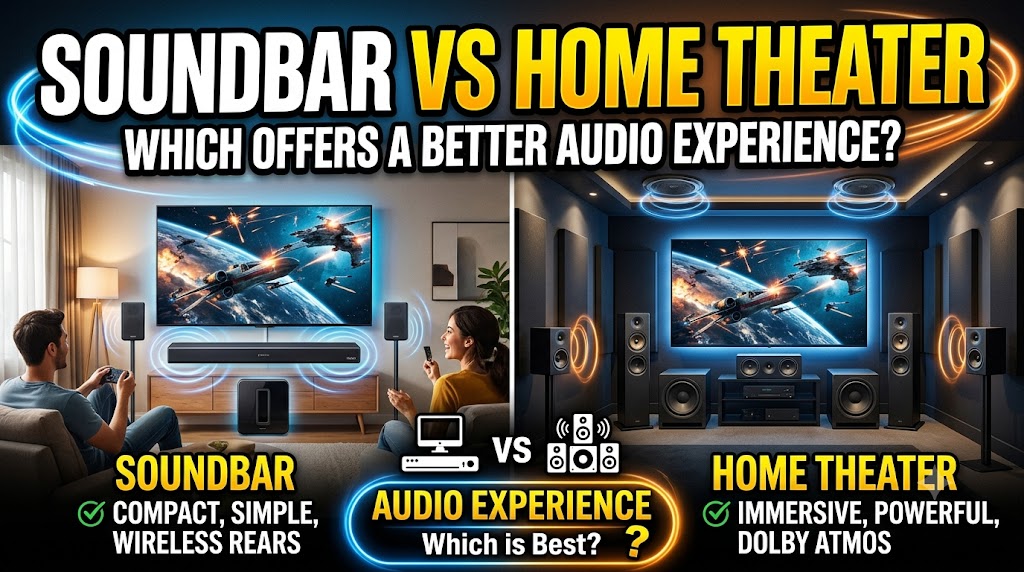
Soundbar vs Home Theater
A soundbar is a compact audio system designed to improve TV sound without requiring several separate speakers around the room. Many modern soundbars include multiple built-in drivers and can support technologies such as Dolby Atmos. Some models can also connect to a separate subwoofer or rear speakers. Because of their simple design, soundbars are popular with people who want better TV audio while keeping installation and space requirements relatively low. Dolby also notes that soundbars can be a practical option for smaller rooms and simpler home theater setups. (Dolby)
A home theater system generally uses multiple separate speakers to create a more traditional surround-sound experience. Depending on the configuration, it can include front speakers, a center speaker, surround speakers, a subwoofer, and sometimes height or ceiling speakers. This physical separation gives sound more opportunities to come from different directions. Dolby’s setup guides include configurations such as 5.1, 7.1, and more advanced Atmos systems. However, a full setup usually requires more space, careful speaker placement, and additional installation work. (Dolby)
Quick Comparison Table
| Feature | Soundbar | Home Theater |
|---|---|---|
| Basic Design | One main bar, often with optional subwoofer/rears | Multiple separate speakers |
| Installation | Easier | More complicated |
| Space Required | Low | Medium to high |
| Surround Sound | Good to excellent depending on model | Excellent with proper setup |
| Soundstage | Wide, but usually limited by physical design | Wider and more naturally separated |
| Bass | Good with subwoofer-equipped models | Excellent with a dedicated subwoofer |
| Dialogue | Generally clear | Excellent with a dedicated center speaker |
| Dolby Atmos | Available on many models | Available with compatible speaker configurations |
| Upgrade Flexibility | Depends on model and ecosystem | Usually higher |
| Room Suitability | Small to medium rooms | Medium to large rooms |
| Convenience | Excellent | Moderate |
| Best For | Simple TV and movie setups | Dedicated home cinema |
| Overall Winner | Best for convenience | Best for maximum immersion |
Soundbar vs Home Theater: Design and Setup
The biggest difference in a soundbar vs home theater comparison is the physical design.
A soundbar puts multiple speakers into a single long enclosure. Depending on the model, it may also include a wireless or wired subwoofer and optional rear speakers. This allows users to achieve a more immersive setup without installing several independent speakers.
A traditional home theater system separates the audio channels among individual speakers. A typical 5.1 configuration, for example, has five main speaker channels plus one subwoofer. Dolby’s guidance identifies separate front, center, surround, and subwoofer positions in a 5.1 setup. (Dolby)
This physical separation can provide better directional information, but it also means that placement matters more.
Winner: Soundbar — for simplicity
Soundbar vs Home Theater: Audio Quality
Audio quality depends heavily on the specific products being compared. A premium soundbar can sound significantly better than inexpensive TV speakers, while a properly configured home theater system can provide a more convincing and physically separated presentation.
Soundbars use several drivers and digital processing to create a wide soundstage. Some premium models also use dedicated rear speakers and upward-firing drivers.
A traditional home theater has a natural advantage because each channel can have its own physical speaker. The front left, center, right, surround, and height channels can be positioned independently.
This gives a well-designed home theater system greater flexibility in reproducing directional effects.
Winner: Home Theater — for maximum audio performance
Surround Sound and Immersion
Surround sound is one of the most important differences between these two systems.
A basic soundbar mainly places its speakers in front of the listener. Advanced models can simulate or reproduce surround effects using side-firing, upward-firing, or rear speakers. Some systems can also use dedicated rear speakers to create a more immersive environment. (Dolby)
A traditional home theater places speakers around the listener. This gives sound effects a more direct physical path from different directions.
For example, an aircraft flying across a movie scene can be represented through different speaker channels as the sound moves around the room.
Dolby states that a multichannel speaker setup can provide a highly immersive Atmos experience, while soundbars provide a more space-efficient alternative. (Dolby)
Winner: Home Theater — for natural surround immersion
Dolby Atmos Support
Dolby Atmos is not exclusive to home theater systems.
Many modern soundbars support Dolby Atmos. Some use upward-firing drivers, while others use virtualization or a combination of technologies to create a sense of height.
Home theater systems can also support Dolby Atmos through compatible speaker configurations. Dolby provides setup guides for systems such as 5.1.2, 5.1.4, 7.1.4, and other configurations. (Dolby)
The important point is that having Dolby Atmos listed on the specifications does not automatically mean two systems will produce the same experience. Speaker placement, room characteristics, hardware, and content all influence the result.
Winner: Home Theater — for maximum Atmos potential
Bass Performance
Bass is another area where the comparison depends on configuration.
A basic soundbar may provide limited low-frequency output because of its compact design. However, many soundbars are sold with dedicated subwoofers, and premium systems can produce powerful bass.
A traditional home theater normally has a dedicated subwoofer. Because the subwoofer is designed specifically for low frequencies, it can provide deeper and more powerful bass than a compact all-in-one bar.
For movie explosions, action scenes, and music with strong low-frequency content, a properly configured home theater has an advantage.
Winner: Home Theater — especially with a dedicated subwoofer
Dialogue Clarity
Clear dialogue is particularly important when watching movies, television shows, and documentaries.
Many soundbars are designed to improve dialogue compared with built-in TV speakers. Some models include dedicated center-channel processing or dialogue enhancement features.
A traditional home theater system can have a physical center speaker dedicated to dialogue. This allows the center channel to be positioned close to the screen while the other speakers handle different audio information.
A well-designed soundbar can still perform very well, but a dedicated center speaker gives a home theater system a structural advantage.
Winner: Home Theater — for dedicated dialogue reproduction
Music Performance
For music, the result is more dependent on the quality and design of the individual system.
A good soundbar can be convenient for casual music listening, especially when it supports wireless streaming and other modern connectivity options. Some premium soundbars can produce a wide stereo presentation and substantial bass.
However, separate speakers can provide greater physical separation between the left and right channels. This can create a more spacious stereo image.
For serious music listening, a properly positioned speaker system can therefore have an advantage.
Winner: Home Theater — for a more flexible speaker-based setup
Room Size
Room size can strongly influence the better choice.
Soundbars are particularly practical in smaller rooms because they occupy relatively little physical space. Dolby specifically describes soundbars as suitable for smaller homes and home theater environments. (Dolby)
A large home theater system can work extremely well in a bigger room because the separate speakers have enough space to create proper separation.
However, installing a large number of speakers in a small room can create placement problems and may not provide the expected benefit.
Winner: Soundbar — for small and medium rooms
Installation and Setup
A soundbar is generally easier to install.
In many cases, you connect the soundbar to the TV, place the subwoofer where appropriate, and complete the setup through the manufacturer’s instructions or app.
Some premium soundbars can also be expanded with compatible rear speakers and subwoofers. For example, manufacturers offer systems where additional speakers can be paired with compatible soundbars. (Sony)
A traditional home theater system requires more planning. The speakers need to be positioned correctly, cables may need to be routed, and an AV receiver or other equipment may be required depending on the system.
Winner: Soundbar — by a clear margin
Space and Cable Management
Soundbars have a major advantage when space is limited.
The main unit sits below or near the TV, while some systems use wireless connections for the subwoofer and rear speakers.
A traditional home theater requires several speaker locations. Depending on the configuration, you may have front speakers, a center speaker, surround speakers, and a subwoofer.
This creates more opportunities for cables and equipment to become visible.
Winner: Soundbar — for a cleaner setup
Connectivity and Features
Modern soundbars can include HDMI ARC or eARC, optical audio, Bluetooth, Wi-Fi, streaming support, voice-control features, and compatibility with different audio formats. The exact features vary significantly between models.
Home theater systems can also offer extensive connectivity, particularly when an AV receiver is involved. An AV receiver can act as the central connection point for multiple audio and video devices.
Therefore, the winner depends on what you want to connect.
For everyday TV use, a soundbar is usually simpler. For a more complex entertainment setup, a receiver-based home theater can provide greater flexibility.
Winner: Tie — it depends on your equipment and requirements
Upgradeability
Home theater systems usually offer greater upgrade flexibility.
With a traditional setup, you can often replace or add individual components. For example, you may upgrade the front speakers, add a better subwoofer, or expand the surround configuration.
Soundbar systems can also be expandable, but upgrades are normally limited to components officially supported by the manufacturer’s ecosystem.
Some premium soundbars can be paired with compatible subwoofers and rear speakers, but compatibility varies by model. (Sony)
Winner: Home Theater — for long-term customization
Ease of Use
If convenience is the priority, soundbars are difficult to beat.
You generally have fewer components to configure and fewer speakers to position. This makes them particularly attractive for people who want better TV audio without building a dedicated cinema room.
A home theater system can also become easy to operate once properly configured, but the initial setup is usually more involved.
Winner: Soundbar — for everyday convenience
Gaming Experience
Both systems can work well for gaming.
A soundbar can provide a significant improvement over built-in TV speakers while keeping the gaming area clean and simple. Premium models can also support surround and spatial audio technologies.
A properly configured home theater can create a larger and more directional sound field. This can make environmental sounds and positional effects more noticeable.
However, gamers should also consider connection type, latency, console compatibility, and the capabilities of the TV or receiver.
Winner: Home Theater — for maximum immersion
Cost and Value
There is no universal winner on price because both categories cover a wide range of products.
Entry-level soundbars can be relatively affordable and require fewer additional components. A complete home theater system may require several speakers, a subwoofer, an AV receiver, cables, and potentially installation.
However, premium soundbars with subwoofers and rear speakers can also become expensive.
The important comparison is therefore not simply the purchase price. Consider the total cost of the complete setup.
Winner: Soundbar — for lower complexity and better value for simple setups
Which Is Better for Movies?
For casual movie watching, a good soundbar is often enough.
It can provide much better sound than typical TV speakers while taking up less space. Premium soundbars can also provide Dolby Atmos and rear-channel support.
For a dedicated movie room, however, a properly configured home theater remains the stronger option. Separate speakers can create a more convincing surround field and provide greater control over speaker placement.
Winner: Home Theater — for dedicated movie watching
Which Is Better for a Living Room?
For a typical living room, the soundbar is usually the more practical choice.
It can fit neatly beneath the TV and does not require multiple speakers around the seating area.
This is especially useful when the room is shared with other activities or when extensive cable installation is undesirable.
A home theater can still be an excellent choice if the room is large enough and the owner is willing to dedicate space to the system.
Winner: Soundbar — for most everyday living rooms
Which Is Better for a Dedicated Home Cinema?
A dedicated home cinema changes the equation.
When space, speaker placement, and installation are not major concerns, a separate speaker system can provide a more immersive experience.
Dolby recommends properly positioned multichannel speakers for the strongest immersive Atmos experience, although soundbars can also provide Atmos in a more compact design. (Dolby)
Winner: Home Theater — for dedicated home cinema
Pros and Cons
Soundbar
Pros
- Compact design
- Easy installation
- Requires less space
- Cleaner appearance
- Good option for TVs and living rooms
- Dolby Atmos available on many models
- Can sometimes be expanded with rear speakers and a subwoofer
Cons
- Physical speaker separation is limited
- Surround performance varies significantly by model
- Upgrade options can be ecosystem-dependent
- Some models cannot match a properly positioned speaker system
Home Theater
Pros
- Excellent surround sound potential
- Better physical channel separation
- Dedicated center speakers can improve dialogue
- Strong bass with a proper subwoofer
- Greater upgrade flexibility
- Excellent for dedicated movie rooms
Cons
- More components
- More complicated installation
- Requires more space
- More cables and equipment
- Speaker placement is important
- Total setup cost can become high
Final Comparison Table
| Category | Winner |
|---|---|
| Design | Soundbar |
| Setup | Soundbar |
| Space Saving | Soundbar |
| Everyday Convenience | Soundbar |
| Small Rooms | Soundbar |
| Audio Quality | Home Theater |
| Surround Sound | Home Theater |
| Dolby Atmos Potential | Home Theater |
| Bass Performance | Home Theater |
| Dialogue | Home Theater |
| Music | Home Theater |
| Gaming Immersion | Home Theater |
| Upgradeability | Home Theater |
| Connectivity | Tie / Depends |
| Dedicated Home Cinema | Home Theater |
| Overall Convenience | Soundbar |
| Overall Immersion | Home Theater |
Final Verdict: Soundbar vs Home Theater
The winner in the soundbar vs home theater comparison depends on what you value most.
Choose a soundbar if you want a simple, compact, and easy-to-install audio solution for your TV. It is particularly suitable for small and medium-sized rooms, everyday television viewing, casual movie watching, and users who do not want several speakers and cables around the room.
Choose a home theater system if your priority is maximum immersion, stronger physical channel separation, powerful bass, and greater control over speaker placement. It is especially suitable for dedicated movie rooms, larger spaces, serious movie enthusiasts, and users who want to upgrade individual components over time.
Overall Winner: Home Theater
Home Theater wins overall for audio performance and immersion.
However, Soundbar wins for convenience, simplicity, space efficiency, and ease of installation. A premium soundbar can also provide an impressive cinematic experience, particularly when combined with a subwoofer and compatible rear speakers.
Therefore, there is no single setup that is best for everyone. If your priority is maximum sound quality and surround immersion, choose Home Theater. If your priority is simple, clean, and convenient TV audio, choose a Soundbar.
Disclaimer
Audio performance varies considerably between individual models, room layouts, speaker placement, source devices, and supported audio formats. This comparison describes the general differences between soundbars and traditional home theater systems rather than guaranteeing the performance of every product. Always check the specifications and compatibility of the specific models you are considering.