CBSE vs IB
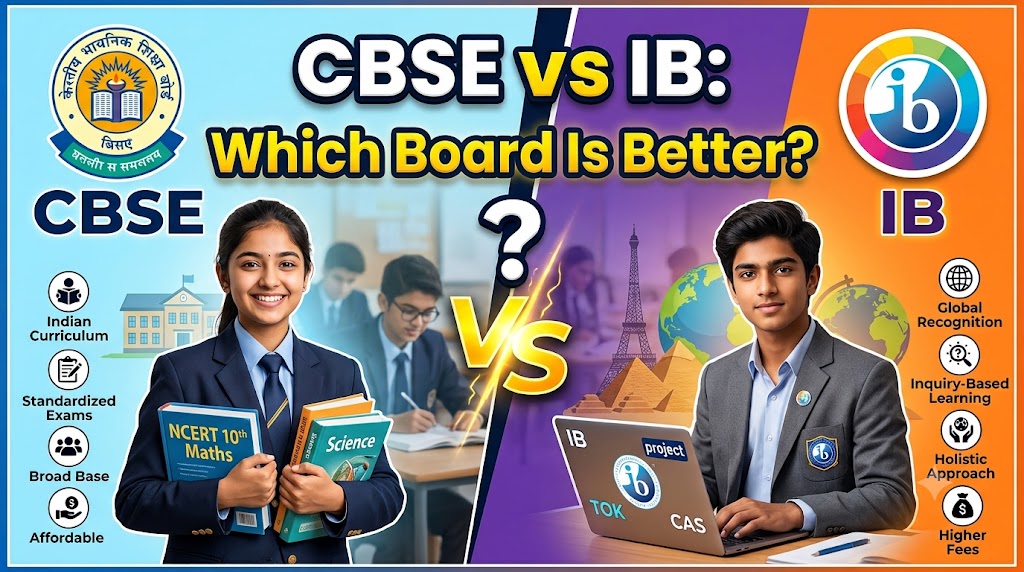
Choosing the right school system is an important decision for students and parents. CBSE vs IB is a common comparison because the two systems have different curriculum structures, teaching approaches, assessment methods, and academic pathways. CBSE follows a national school curriculum in India, while the International Baccalaureate (IB) offers internationally oriented programmes designed for different age groups. CBSE’s current curriculum also emphasises competency-based, experiential, flexible, and holistic learning. (CBSE Academic)
The CBSE vs IB decision depends on the student’s learning style, future plans, preferred academic environment, and the school available to the family. CBSE may suit students who want a nationally structured Indian curriculum, while IB can suit students who prefer inquiry-based and internationally oriented learning. There is no universal winner, so parents should compare the actual school and programme before deciding.
Quick Comparison: CBSE vs IB
| Feature | CBSE | IB |
|---|---|---|
| Full Name | Central Board of Secondary Education | International Baccalaureate |
| Main Focus | Indian national school education | International education |
| Curriculum | Centrally structured CBSE curriculum | IB programme frameworks |
| Learning Approach | Increasing focus on competency and experiential learning | Inquiry-based, conceptual and student-centred |
| Programmes | School education through CBSE classes and subjects | PYP, MYP, DP and CP |
| Assessment | Board and school-based assessment depending on class | Assessment varies by IB programme |
| Global Orientation | Primarily Indian curriculum | Strong international orientation |
| Transfer | Convenient within CBSE schools | Useful for students moving between IB World Schools |
| Best For | Students seeking a structured Indian curriculum | Students seeking an internationally oriented learning experience |
CBSE vs IB: Curriculum
Curriculum is one of the biggest differences in the CBSE vs IB comparison.
CBSE provides a centrally structured school curriculum. For the 2026–27 academic session, CBSE states that its curriculum is aligned with the National Curriculum Framework for School Education and focuses on competency-based education, experiential learning, flexibility, and holistic development. (CBSE Academic)
IB works differently. Instead of one single curriculum for every age, the IB offers four programmes: Primary Years Programme (PYP), Middle Years Programme (MYP), Diploma Programme (DP), and Career-related Programme (CP). These programmes cover students from approximately ages 3 to 19. (International Baccalaureate®)
Practical meaning: CBSE provides a nationally structured Indian curriculum, while IB uses programme frameworks designed around international education.
Winner: Depends on the student’s goals.
CBSE vs IB: Learning Approach
The learning approach is an important difference.
CBSE’s current curriculum framework places emphasis on competency-based education, experiential learning, flexibility, and holistic development. (CBSE Academic)
IB places strong emphasis on inquiry, conceptual understanding, reflection, connections between subjects, and active student participation. For example, the IB Primary Years Programme uses an inquiry-based and transdisciplinary approach. (International Baccalaureate®)
The IB Middle Years Programme also encourages students to connect their studies with the real world and provides a broad and balanced education across eight subject groups. (International Baccalaureate®)
Better for inquiry-focused learning: IB
Better for a structured Indian curriculum: CBSE
CBSE vs IB: Subjects and Academic Structure
CBSE offers a structured range of subjects according to the class and applicable curriculum. Its current curriculum includes academic subjects as well as skill-oriented and interdisciplinary areas. (CBSE Academic)
IB’s subject structure depends on the programme. The Diploma Programme, for example, provides breadth and depth of study and requires students to study at least two languages. It also includes the Theory of Knowledge course as part of the DP structure. (International Baccalaureate®)
Therefore, the subject experience can be quite different between the two systems.
Winner: Depends on the student’s preferred subjects and programme.
CBSE vs IB: Examination and Assessment
CBSE includes formal board examinations at the secondary and senior secondary levels, along with school-based assessment components depending on the class and subject.
IB assessment varies by programme. The IB Diploma Programme is an assessed programme for students aged 16–19, while the Middle Years Programme can include optional external eAssessment in its final year. (International Baccalaureate®)
This makes the assessment experience different from the conventional Indian board examination structure.
Better for a traditional Indian board-examination pathway: CBSE
Better for an international programme-based assessment approach: IB
CBSE vs IB: Global Recognition
International orientation is one of the strongest differences in the CBSE vs IB comparison.
CBSE is an Indian national school board with a large network of affiliated schools in India and abroad.
IB is specifically designed as international education. Its Diploma Programme is intended for students aged 16–19 and is recognised by universities around the world. (International Baccalaureate®)
However, recognition should not be confused with automatic admission. Universities and countries can have their own admission requirements.
Winner for international orientation: IB
CBSE vs IB: School Transfer
School transfer can be an important factor for families that move frequently.
CBSE’s common curriculum framework can make it practical for students transferring between CBSE schools, particularly within India. However, schools can have different admission requirements, subject availability, and academic calendars.
IB can also provide continuity for families moving between IB World Schools because the IB programmes follow common programme frameworks. IB World Schools are schools authorised to offer one or more IB programmes. (International Baccalaureate®)
Winner: Depends on where the family expects to move.
For frequent movement within India, CBSE can be practical. For families moving internationally between suitable IB schools, IB may offer greater programme continuity.
CBSE vs IB: Competitive Exams in India
For students planning to take Indian competitive examinations, curriculum alignment is an important consideration.
CBSE follows an Indian curriculum and can provide a familiar academic framework for students continuing into Indian higher education.
IB students can also pursue Indian higher education and competitive examinations, but they may need to understand the specific eligibility, subject, and examination requirements applicable to their target course.
Therefore, students should compare the current requirements of the specific entrance examination or university rather than assuming that one board automatically guarantees an advantage.
Better for a straightforward Indian academic pathway: CBSE
CBSE vs IB: International University Plans
Students planning to apply to universities outside India may find IB attractive because of its international orientation.
The IB Diploma Programme is designed for students aged 16–19 and is recognised by universities around the world. The programme also aims to provide breadth and depth of knowledge and an internationally minded educational experience. (International Baccalaureate®)
CBSE students can also apply to universities outside India. However, admission requirements vary by country and university.
Better for an internationally oriented school programme: IB
CBSE vs IB: Cost of Education
There is no fixed fee that applies to every CBSE or IB school.
The cost depends on the individual school’s management, location, facilities, teaching resources, activities, transportation, and other services.
IB schools can have higher fees in many cases, but parents should compare the actual schools rather than assuming that every IB school costs more than every CBSE school.
Winner: Depends on the school and location.
CBSE vs IB: Which Is Better for Your Child?
The better choice depends on the student’s academic needs and future plans.
Choose CBSE if:
- You prefer a structured Indian curriculum.
- Your child plans to continue education primarily within India.
- You want easier continuity between CBSE schools in different Indian locations.
- You prefer a familiar Indian school-board structure.
- The CBSE school available to you has strong teachers and facilities.
Consider IB if:
- You prefer inquiry-based and student-centred learning.
- Your child enjoys research, discussion, projects, and conceptual learning.
- You are considering international education pathways.
- Your family may move between countries where suitable IB World Schools are available.
- The available IB school provides the programme that matches your child’s age and goals.
CBSE vs IB: Final Verdict
There is no universal winner in the CBSE vs IB comparison.
CBSE may be better for students who want a structured Indian curriculum and plan to follow an education pathway primarily connected with India.
IB may be better for students who prefer an internationally oriented, inquiry-based learning environment and may consider international education pathways.
The most important point is to compare the actual school, programme, teachers, fees, facilities, curriculum, and future requirements. A strong school that matches the student’s learning style can be more important than choosing a board based only on its reputation.
Related Parkhu Comparisons
Relevant internal links can include:
- CBSE vs State Board
- ICSE vs State Board
- CBSE vs IGCSE
- ICSE vs IGCSE
Disclaimer
Education programmes, curricula, examination patterns, admission requirements, fees, and academic policies may change over time. Always check the latest information from CBSE, IB, the relevant university, and the school before making an education decision.