CBSE vs ICSE for Science
Introduction
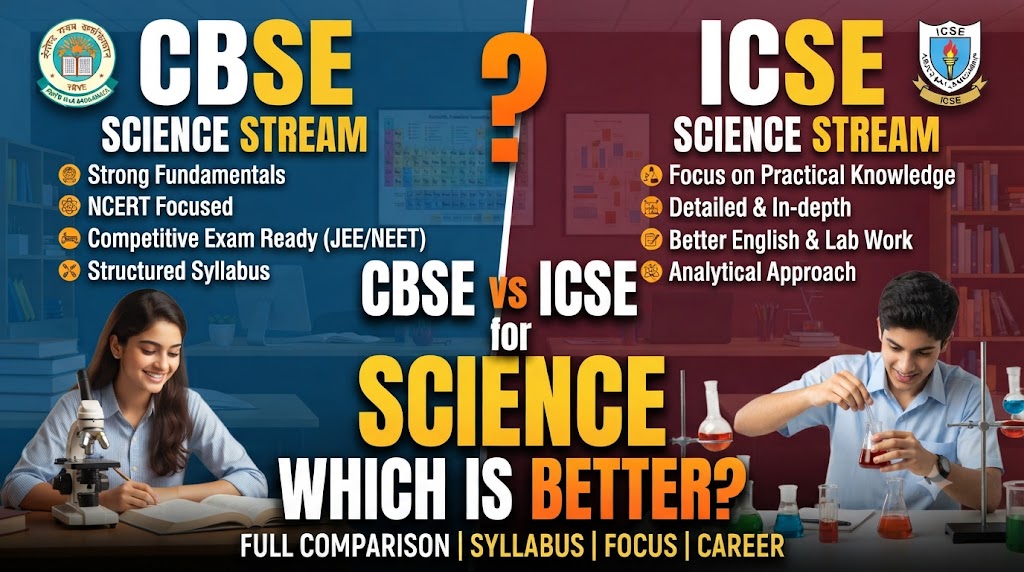
Science helps students understand the physical world through concepts, observation, experimentation, and logical reasoning. For students studying in India, CBSE and ICSE are two important school education systems, and both provide structured Science education. However, they can differ in curriculum coverage, subject structure, practical learning, assessment patterns, and the depth and breadth of topics covered.
CBSE generally provides a focused curriculum with strong emphasis on core concepts, while ICSE can offer broader coverage across different areas of Science at the school level. Both can prepare students for higher studies when supported by good teaching and regular practice. The better choice depends on the student’s interests, learning style, school quality, and future academic plans.
Quick Comparison Table
| Feature | CBSE Science | ICSE Science |
|---|---|---|
| Curriculum | Relatively focused and structured | Generally broader in school-level coverage |
| Core Concepts | Strong emphasis on fundamentals | Strong emphasis with broader topic coverage |
| Physics | Structured conceptual and numerical learning | Detailed conceptual and application-based learning |
| Chemistry | Strong focus on core concepts and applications | Broad coverage with detailed school-level treatment |
| Biology | Structured coverage of biological concepts | Broad coverage with detailed topics |
| Practical Learning | Practical work included as prescribed | Practical work has an important role |
| Textbooks | NCERT is central | Schools may use prescribed/supplementary textbooks |
| Competitive Exams | Convenient foundation for national entrance preparation | Strong foundation but may require additional exam-specific preparation |
| Best For | Students wanting focused preparation and national competitive pathways | Students preferring broader school-level Science coverage |
Curriculum Structure
CBSE Science follows a structured curriculum designed by the Central Board of Secondary Education. The syllabus is organized according to class level and includes relevant areas of Science.
ICSE Science also follows a structured curriculum but can provide broader coverage at the school level. At higher classes, Science is divided into subjects such as Physics, Chemistry, and Biology.
Winner: Depends
Both provide a strong academic framework. The better choice depends on the student’s preferred level of depth and breadth.
Physics
Physics requires students to understand concepts, formulas, numerical problems, and real-world applications.
CBSE Physics provides a structured approach to concepts and numerical problem-solving. Its curriculum can be convenient for students who later prepare for national-level entrance examinations.
ICSE Physics can provide detailed coverage and a variety of conceptual and application-oriented questions. Students may encounter broader school-level treatment of certain topics.
Winner: Depends
Students who enjoy numerical problem-solving and competitive-exam preparation may find CBSE convenient, while students who prefer broader school-level coverage may appreciate ICSE.
Chemistry
Chemistry combines theoretical concepts, equations, calculations, and practical understanding.
CBSE provides structured coverage of fundamental Chemistry concepts. The curriculum and NCERT resources can provide a clear foundation for further studies.
ICSE Chemistry can provide detailed school-level coverage and varied questions. Students may receive extensive exposure to concepts and their applications.
Winner: Depends
Both can provide a strong Chemistry foundation when students understand concepts rather than relying only on memorization.
Biology
Biology involves understanding living organisms, processes, structures, and relationships between different biological systems.
CBSE provides structured Biology content and widely used NCERT resources. This can be particularly useful for students planning further studies in biology-related fields.
ICSE Biology can provide broad and detailed school-level coverage, with attention to concepts, terminology, diagrams, and applications.
Winner: Depends
Students should compare the syllabus and teaching approach for their specific class.
Practical Learning
Practical learning helps students connect scientific concepts with observation and experimentation.
CBSE includes practical activities and laboratory work according to the prescribed curriculum and class level.
ICSE also gives importance to practical work, particularly in the Science subjects at higher levels. Students may have opportunities to perform experiments and record observations as part of their academic work.
Winner: Tie
Both boards provide opportunities for practical learning. The quality of laboratory facilities and how effectively practical classes are conducted depend on the individual school.
Syllabus Breadth
The amount of content students study can affect their workload and preparation strategy.
CBSE generally provides a relatively focused curriculum that emphasizes essential concepts and applications.
ICSE can cover a broader range of school-level Science topics, which may require students to study and revise a larger amount of material.
Winner: Depends
Students who prefer a focused syllabus may find CBSE more manageable, while students who enjoy broader academic coverage may prefer ICSE.
Textbooks and Study Resources
CBSE has a major advantage in the widespread use of NCERT textbooks. These provide a common foundation for many students and are particularly important for CBSE board preparation.
ICSE schools may use textbooks from different publishers that align with the ICSE curriculum. Students may therefore encounter more variation in their learning resources between schools.
Winner: CBSE
CBSE offers a more standardized core textbook framework, which can make preparation easier for many students.
Question Paper Pattern
CBSE Science examinations can include objective, short-answer, long-answer, case-based, and competency-oriented questions depending on the class and current examination pattern.
ICSE Science examinations also test concepts, applications, explanations, calculations, diagrams, and other forms of scientific understanding.
Since examination formats can change, students should use the latest official sample papers and examination guidelines.
Winner: Depends
Students should prepare according to the latest pattern rather than relying on older question papers alone.
Competitive Examinations
Students planning careers in medicine, engineering, and other Science-related fields may eventually need to prepare for national or university-level entrance examinations.
CBSE can provide a convenient foundation for national competitive examinations because its Science curriculum and widely used NCERT resources align closely with concepts commonly required in several entrance examinations.
ICSE students can also perform well in competitive examinations. However, they may need additional preparation specifically aligned with the syllabus and question style of their target examination.
Winner: CBSE
CBSE may offer a more convenient starting point for students targeting major national-level competitive examinations, although dedicated preparation remains important.
Difficulty Level
It is not accurate to say that CBSE Science is always easier or ICSE Science is always harder.
CBSE may feel more manageable to students who prefer a focused syllabus and standardized resources. ICSE may feel more demanding to students who prefer less extensive coverage, while students who enjoy detailed Science may appreciate its broader approach.
The difficulty also depends on the student’s ability, teacher, preparation, and study habits.
Winner: Depends
The board that feels easier varies from student to student.
Which Is Better for Students Interested in Medicine?
Students interested in medicine need a strong foundation in Biology, Chemistry, and Physics and may later prepare for entrance examinations according to the applicable requirements.
CBSE can be convenient because NCERT Science resources are widely used for preparation for major national medical entrance examinations.
ICSE students can also build strong Science fundamentals, but may need to supplement their school studies with examination-specific resources.
Winner: CBSE
For students specifically planning national medical entrance preparation, CBSE can provide a convenient foundation.
Which Is Better for Students Interested in Engineering?
Engineering aspirants generally need strong Physics, Chemistry, and Mathematics foundations.
CBSE’s structured curriculum and widespread NCERT resources can make it convenient to combine school studies with preparation for engineering entrance examinations.
ICSE can also develop strong conceptual knowledge and problem-solving skills. Students may simply need additional preparation tailored to their target examination.
Winner: CBSE
CBSE can be more convenient for students who intend to combine school Science with national engineering entrance preparation.
CBSE vs ICSE for Science: Which Is Better?
CBSE Science may be better for students who want a relatively focused curriculum, standardized NCERT resources, and a convenient foundation for national competitive examinations.
ICSE Science may be better for students who enjoy broader school-level coverage, detailed concepts, and varied academic exposure.
However, the board itself does not determine a student’s success. Good teachers, practical learning, regular revision, problem-solving, and genuine interest in Science are equally important.
Final Verdict
CBSE vs ICSE for Science: Which Is Better?
There is no universal winner.
Choose CBSE if you prefer a focused Science curriculum, widely available NCERT resources, and a convenient pathway toward national competitive-exam preparation.
Choose ICSE if you prefer broader school-level Science coverage and detailed academic learning.
For the best decision, compare the actual school’s Science teachers, laboratories, curriculum, study resources, practical classes, fees, and the student’s future goals rather than choosing only by the board name.
Disclaimer
CBSE and ICSE curricula, syllabi, examination patterns, practical requirements, and assessment policies can change over time. School-level implementation may also vary. Students and parents should verify the latest official information before making an educational decision.