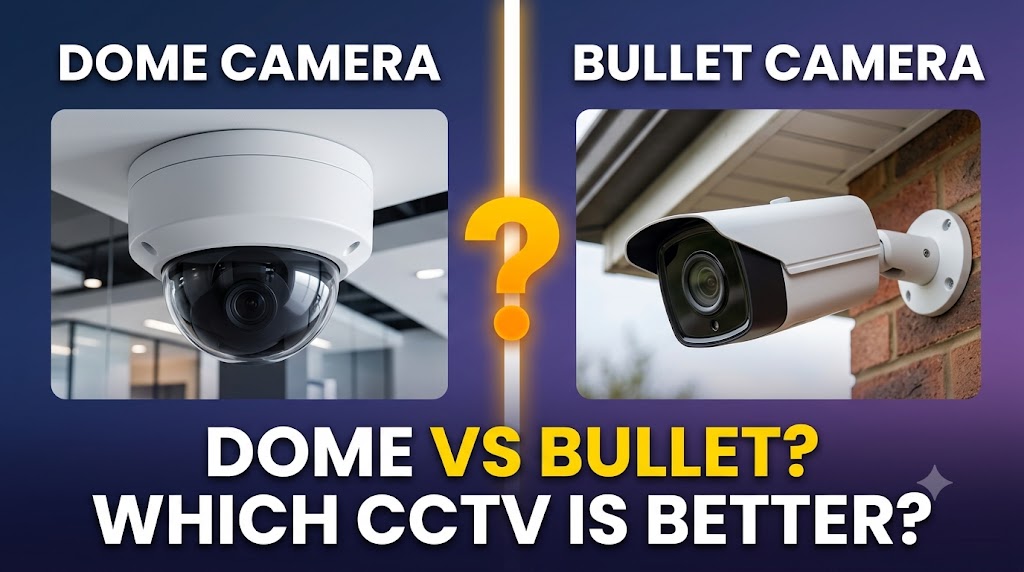
Dome Camera vs Bullet Camera
Dome Camera
A dome camera is a CCTV camera with its lens enclosed inside a rounded dome-shaped housing. It is commonly used on ceilings, walls, corridors, offices, shops and other locations where a relatively compact and less visually exposed camera is preferred. Dome cameras are available in indoor and outdoor versions, and some models include weather and vandal resistance. Modern dome cameras can offer high resolution, infrared night vision, AI detection, WDR, H.265+ compression and other features, depending on the model. Therefore, the shape of the camera alone does not determine its image quality or overall performance.
Bullet Camera
A bullet camera has an elongated cylindrical housing and is commonly mounted on walls, poles, building exteriors and other locations where a more directional viewing arrangement is useful. Bullet cameras are available in different resolutions, lens types and night-vision configurations. Some models use fixed lenses, while others offer varifocal lenses for adjusting the field of view. Outdoor bullet cameras can also have IP-rated protection against dust and water. As with dome cameras, features such as resolution, sensor, lens, IR range and AI detection depend on the exact model rather than the camera shape.
Quick Comparison Table
| Feature | Dome Camera | Bullet Camera |
|---|---|---|
| Design | Rounded/enclosed housing | Long cylindrical housing |
| Typical Installation | Ceiling, wall, indoor areas | Wall, pole, outdoor areas |
| Viewing Direction | Good for discreet/general coverage | Good for directional coverage |
| Indoor Use | Excellent | Good |
| Outdoor Use | Excellent with suitable model | Excellent with suitable model |
| Vandal Resistance | Available on selected models | Available on selected models |
| Night Vision | Available | Available |
| Long IR Options | Available on selected models | Often available on long-range models |
| Varifocal Options | Available | Available |
| AI Features | Available on selected models | Available on selected models |
| Installation | Often compact and neat | Often straightforward for directional viewing |
| Best For | Indoor areas, entrances, general coverage | Outdoor walls, gates, parking and directional monitoring |
| Overall Winner | Depends on location | Depends on location |
Important: Dome and bullet describe the camera’s physical form factor. They do not automatically determine resolution, image quality, AI capabilities or night vision.
1. Camera Design and Appearance
| Dome Camera | Bullet Camera |
|---|---|
| Rounded housing with lens enclosed under a dome | Long, cylindrical housing |
| Usually looks more compact when installed | More visibly directional |
| Suitable where a less prominent appearance is preferred | Suitable where a clearly aimed camera is acceptable |
The physical design is the biggest obvious difference between the two types.
Dome cameras can provide a compact appearance, while bullet cameras make their viewing direction more visually apparent. Manufacturers offer both shapes across different product tiers. Hikvision, for example, lists dome, turret and bullet options across its camera ranges. (Hikvision)
What this means for you: If appearance and a compact installation matter, a dome can be preferable. If you want a clearly directional camera, a bullet can be more suitable.
🏆 Winner: Depends on User’s Needs
2. Indoor Use
| Dome Camera | Bullet Camera |
|---|---|
| Very suitable for ceilings and indoor walls | Can be used indoors but is often more directional |
| Compact appearance | More prominent housing |
| Suitable for offices, shops, corridors and rooms | Suitable for rooms, corridors and entrances |
Dome cameras are particularly practical for indoor environments because their housing can blend more easily with ceilings and walls.
This does not mean bullet cameras cannot be used indoors. The correct choice depends on mounting position and the desired viewing direction.
What this means for you: For a typical indoor room, office or shop, a dome camera is usually the more natural form factor.
🏆 Winner: Dome Camera
3. Outdoor Use
| Dome Camera | Bullet Camera |
|---|---|
| Outdoor dome models are available | Outdoor bullet models are widely available |
| IP-rated weather protection is available on suitable models | IP-rated weather protection is available on suitable models |
| Vandal-resistant versions are available | Vandal-resistant versions are also available |
Both camera types can be used outdoors when the selected model has the appropriate protection rating.
For example, Hikvision currently lists dome cameras with IP67 water/dust resistance and IK10 vandal resistance, while its product ranges also include outdoor bullet cameras. (Hikvision)
What this means for you: Do not assume that every dome or bullet camera is weatherproof. Check the exact model’s IP rating before outdoor installation.
🏆 Winner: Tie
4. Viewing Direction and Coverage
| Dome Camera | Bullet Camera |
|---|---|
| Can provide wide-area coverage depending on lens | Naturally suited to directional coverage |
| Suitable for rooms and areas where the camera is mounted centrally | Useful for focusing on gates, entrances, roads or boundaries |
| Lens options vary by model | Fixed and varifocal lens options are available |
The lens is more important than the housing shape when determining the actual field of view.
For example, Hikvision lists dome cameras with 2.8mm and 4mm lens options, producing different horizontal fields of view. It also offers varifocal dome and bullet cameras. (Hikvision)
What this means for you: If you need to monitor a specific gate or driveway, a directional bullet camera can be convenient. For a room or wider general area, a suitable dome lens may be better.
🏆 Winner: Bullet Camera for Directional Coverage
5. Night Vision
| Dome Camera | Bullet Camera |
|---|---|
| IR night vision available on many models | IR night vision available on many models |
| IR range depends on the model | Long-range IR options are common on selected models |
| Reflection problems can occur if installation is unsuitable | IR performance depends on lens, illumination and surroundings |
Both camera types can provide strong night surveillance.
Hikvision’s product information shows dome cameras with EXIR/IR illumination and bullet cameras with long-range IR options. (Hikvision)
Dahua also offers both dome and bullet cameras with infrared and advanced low-light technologies. Its HDCVI range includes 4K IR bullet and dome cameras with 120dB WDR and long-distance IR on selected models. (Dahua Technology)
What this means for you: Do not choose bullet simply because you think it automatically has better night vision. Compare the exact IR distance and low-light specifications.
🏆 Winner: Depends on the Model
6. Varifocal Lens
| Dome Camera | Bullet Camera |
|---|---|
| Varifocal dome cameras are available | Varifocal bullet cameras are widely available |
| Useful when the viewing angle needs adjustment | Useful for adjusting a directional view |
| Motorized options exist on selected models | Motorized options exist on selected models |
A varifocal lens allows the focal length and field of view to be adjusted within the camera’s supported range.
Hikvision currently lists both varifocal dome and bullet cameras, including models with motorized varifocal lenses. (Hikvision)
What this means for you: If you are unsure about the exact viewing angle during installation, a varifocal camera can provide more flexibility than a fixed-lens camera.
🏆 Winner: Tie
7. Vandal Resistance
| Dome Camera | Bullet Camera |
|---|---|
| Many outdoor dome models can have vandal-resistant housings | Vandal-resistant bullet models are also available |
| Enclosed dome design can protect the lens area on suitable models | Physical housing provides protection depending on design |
| IK rating varies by model | IK rating varies by model |
Vandal resistance should be judged using the camera’s IK rating, not simply its shape.
For example, Hikvision’s 4MP fixed dome model DS-2CD1143G0-IUF is listed with IP67 and IK10 protection. (Hikvision)
What this means for you: If the camera could be hit, tampered with or installed in a vulnerable location, check the exact IK rating.
🏆 Winner: Dome Camera for Selected Vandal-Resistant Models
8. Installation and Adjustment
| Dome Camera | Bullet Camera |
|---|---|
| Often requires opening/adjusting the housing depending on design | Usually straightforward to aim after wall/pole mounting |
| Compact mounting footprint | Directional mounting is generally intuitive |
| Ceiling installation can be convenient | Wall and pole installation can be convenient |
Installation depends heavily on the mounting surface and camera design.
A bullet camera can be convenient when you already know the direction that needs to be monitored. A dome camera can be convenient for ceiling or wall installations where a compact housing is preferred.
What this means for you: Choose the camera according to the mounting location rather than assuming one shape is always easier.
🏆 Winner: Depends on Installation
9. AI and Smart Features
| Dome Camera | Bullet Camera |
|---|---|
| Human/vehicle detection available on selected models | Human/vehicle detection available on selected models |
| AI capabilities depend on the model | AI capabilities depend on the model |
| Advanced analytics are available in professional models | Advanced analytics are available in professional models |
AI is not a dome-versus-bullet feature.
For example, Hikvision’s current fixed dome products include human and vehicle detection, while its varifocal range includes AI-enabled dome and bullet models. (Hikvision)
Dahua similarly offers both dome and bullet cameras within its intelligent surveillance product ranges. (Dahua Technology)
What this means for you: If AI detection is important, compare the exact camera’s analytics instead of choosing a housing type.
🏆 Winner: Tie
10. Image Quality
| Dome Camera | Bullet Camera |
|---|---|
| Can provide the same resolution levels as comparable bullet models | Can provide the same resolution levels as comparable dome models |
| Image quality depends on sensor, lens and processor | Image quality depends on sensor, lens and processor |
| High-resolution models are available | High-resolution models are available |
A common mistake is to assume that bullet cameras automatically produce better images than dome cameras.
The camera housing does not determine megapixel resolution. Manufacturers offer similar resolutions across both forms.
For example, Hikvision’s product portfolio includes 2MP, 5MP and 8MP dome and bullet options in different ranges. (Hikvision)
What this means for you: Compare sensor, resolution, lens, WDR and low-light specifications—not the camera shape.
🏆 Winner: Tie
11. Best Camera for Home
| Dome Camera | Bullet Camera |
|---|---|
| Excellent for rooms, halls and indoor entrances | Excellent for gates, balconies and exterior walls |
| Compact appearance | Strong directional coverage |
| Suitable for ceiling installation | Suitable for wall installation |
For a typical home, both can be useful.
A dome is generally more suitable for indoor rooms and hallways, while a bullet can be more practical for an outside gate, driveway or boundary.
What this means for you: A home may actually benefit from both types, depending on where each camera is installed.
🏆 Winner: Depends on Location
12. Best Camera for Shops and Businesses
| Dome Camera | Bullet Camera |
|---|---|
| Suitable for indoor sales areas, counters and corridors | Suitable for entrances, parking areas and exterior walls |
| Compact design can be useful indoors | Directional viewing can be useful outside |
| Vandal-resistant options available | Outdoor/weather-resistant options available |
For a shop, a dome camera can work well inside the sales area, while a bullet camera can be useful for the entrance or exterior.
Dahua’s current surveillance recommendations, for example, include both fixed-focal dome and varifocal bullet cameras for public areas. (Dahua Technology)
What this means for you: Instead of choosing only one camera type for the entire business, use each type where it makes the most practical sense.
🏆 Winner: Tie
13. Price and Value
| Dome Camera | Bullet Camera |
|---|---|
| Available across budget and premium categories | Available across budget and premium categories |
| Price depends on resolution and features | Price depends on resolution and features |
| Housing type alone does not determine price | Housing type alone does not determine price |
There is no reliable rule that dome cameras are always cheaper or bullet cameras are always more expensive.
Price depends on resolution, sensor, lens, AI features, night vision, protection rating, brand and other specifications.
What this means for you: Compare cameras with similar specifications rather than comparing only their shapes or prices.
🏆 Winner: Depends on the Model
Dome Camera vs Bullet Camera: Which CCTV Camera Is Better?
Choose a Dome Camera if:
- You need CCTV mainly indoors.
- You want a compact and less visually prominent design.
- You are monitoring rooms, corridors, offices or shop interiors.
- Vandal resistance is important and a suitable IK-rated dome is available.
- You want a camera mounted on a ceiling or indoor wall.
Choose a Bullet Camera if:
- You need directional outdoor coverage.
- You are monitoring a gate, driveway, boundary or parking area.
- You want a camera that is easy to visually aim toward a particular area.
- You need a suitable long-range IR model.
- Wall or pole mounting is more convenient for your installation.
Final Comparison Table
| Category | Dome Camera | Bullet Camera | Winner |
|---|---|---|---|
| Indoor Use | Excellent | Good | Dome |
| Outdoor Use | Excellent with suitable model | Excellent with suitable model | Tie |
| Directional Coverage | Good | Excellent | Bullet |
| Wide Indoor Coverage | Excellent | Good | Dome |
| Night Vision | Strong | Strong | Tie |
| Long-Range IR | Available | Strong options | Bullet |
| Vandal Resistance | Strong options | Available | Dome on Selected Models |
| Varifocal Options | Available | Available | Tie |
| AI Features | Available | Available | Tie |
| Image Quality | Model dependent | Model dependent | Tie |
| Home Use | Excellent | Excellent | Depends on Location |
| Shop Use | Excellent | Excellent | Depends on Location |
| Outdoor Gate/Driveway | Good | Excellent | Bullet |
| Overall | Best for many indoor applications | Best for many directional outdoor applications | Depends on User’s Needs |
Final Verdict
There is no universal winner between a dome camera and a bullet camera.
A dome camera is generally the better choice for indoor areas, offices, shops, corridors and locations where a compact design or vandal-resistant housing is desirable.
A bullet camera is generally the better choice for directional outdoor monitoring, such as gates, driveways, parking areas and boundary walls.
For a complete CCTV installation, you do not necessarily need to choose only one type.
Our Verdict
🏆 Dome Camera: Best for indoor surveillance, compact installation and many vandal-resistant applications.
🏆 Bullet Camera: Best for directional outdoor surveillance, gates, driveways and many wall/pole installations.
🏆 Overall Winner: Depends on User’s Needs
The most practical solution for many properties is to use dome cameras indoors and bullet cameras outdoors where directional coverage is required.
Disclaimer
CCTV performance depends on the exact camera model, lens, sensor, installation height, lighting conditions and environmental conditions. Always verify the camera’s resolution, lens, IP/IK rating, night-vision range and other specifications before purchasing.