Flat Plate vs Evacuated Tube Solar Water Heater
Introduction
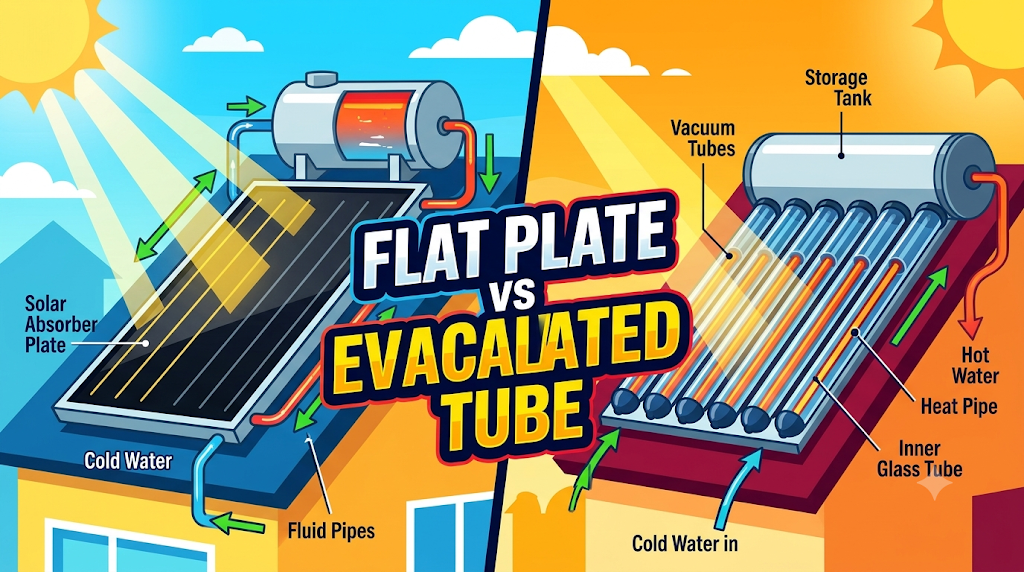
Solar water heaters are available in different technologies, and flat plate collectors and evacuated tube collectors are two widely used options. Both systems use sunlight to heat water and reduce dependence on conventional electricity or other heating sources. However, their collector designs, heat absorption methods and performance in different weather conditions are different. Flat plate solar water heaters use an insulated flat collector with an absorber plate, while evacuated tube systems use glass tubes designed to reduce heat loss.
Choosing between a flat plate and an evacuated tube solar water heater depends on climate, daily hot-water requirements, installation space, water quality and budget. Flat plate systems are known for their durable construction and relatively simple design, whereas evacuated tube systems can provide effective heating in colder conditions because of their insulating vacuum layer. Understanding these differences helps homeowners select a suitable solar water heating system.
Flat Plate vs Evacuated Tube Solar Water Heater: Quick Comparison
| Feature | Flat Plate Collector | Evacuated Tube Collector |
|---|---|---|
| Collector design | Flat absorber plate | Glass vacuum tubes |
| Heat absorption | Absorber plate | Absorber inside tubes |
| Heat loss | Generally higher | Generally lower |
| Cold-weather performance | Good | Often advantageous |
| Installation cost | Varies by model | Varies by model |
| Durability | Strong rigid construction | Glass tubes need careful handling |
| Maintenance | Relatively simple | Tube inspection may be required |
| Water quality sensitivity | Depends on system design | Depends on system design |
| Roof installation | Requires suitable mounting | Requires suitable mounting |
| Best suited for | Many residential and commercial uses | Cold conditions and suitable installations |
1. Working Principle
Flat Plate Solar Water Heater
A flat plate solar water heater uses a flat absorber plate that captures sunlight and converts it into heat. The absorber transfers this heat to water flowing through connected tubes.
The collector is generally enclosed in an insulated box with a transparent cover that allows sunlight to enter while reducing heat loss.
Evacuated Tube Solar Water Heater
An evacuated tube solar water heater uses specially designed glass tubes containing an absorber that captures solar energy.
The space between the glass layers is evacuated to create a vacuum. This vacuum acts as insulation and reduces heat loss to the surrounding air.
Depending on the design, heat is transferred to water through direct circulation or a heat-pipe arrangement.
2. Heating Efficiency and Performance
Flat Plate Solar Water Heater
Flat plate collectors absorb sunlight through their dark absorber surface. They can provide effective water heating under suitable sunlight conditions.
However, heat loss can increase when the difference between water temperature and outdoor temperature becomes larger.
Evacuated Tube Solar Water Heater
Evacuated tube collectors reduce heat loss through their vacuum insulation.
This helps maintain effective heat collection in colder environments. Their performance still depends on sunlight intensity, collector quality, orientation and system design.
3. Performance During Winter
Flat Plate Solar Water Heater
Flat plate collectors can heat water during winter when sufficient sunlight is available. However, their performance may decrease in cold and windy conditions because of greater heat loss.
Proper insulation can help maintain the temperature of stored water.
Evacuated Tube Solar Water Heater
Evacuated tube collectors are generally well suited to colder conditions because their vacuum insulation reduces heat loss.
They can maintain useful heating performance even when outdoor temperatures are low, provided sufficient sunlight is available.
4. Initial Installation Cost
Flat Plate Solar Water Heater
The cost of a flat plate solar water heater depends on collector size, tank capacity, materials and manufacturer.
Some models have a relatively straightforward construction, which can make installation and servicing simpler.
Evacuated Tube Solar Water Heater
The cost of an evacuated tube solar water heater depends on the number of tubes, tank capacity, construction quality and overall system design.
Replacement tubes may also add to long-term maintenance expenses if individual tubes become damaged.
5. Durability and Construction
Flat Plate Solar Water Heater
Flat plate collectors generally use a rigid frame, absorber plate, insulation and protective transparent cover.
Their solid construction can provide good durability when suitable materials and corrosion protection are used.
Evacuated Tube Solar Water Heater
Evacuated tube collectors use glass tubes that provide thermal insulation and solar absorption.
The glass tubes can be vulnerable to physical damage if handled improperly. Their durability depends on glass quality, installation and protection from external impacts.
6. Maintenance Requirements
Flat Plate Solar Water Heater
Flat plate systems generally require periodic cleaning of the collector surface and inspection of pipes, insulation, storage tanks and connections.
Their rigid construction makes routine inspection relatively straightforward. However, mineral deposits and corrosion may require attention depending on water quality.
Evacuated Tube Solar Water Heater
Evacuated tube systems require inspection of glass tubes, seals, connections and the storage tank.
Damaged or broken tubes may need replacement. Dust and dirt should also be cleaned from the glass surfaces to maintain sunlight absorption.
7. Performance in Different Weather Conditions
Flat Plate Solar Water Heater
Flat plate collectors perform well in sunny conditions and can provide effective water heating for everyday household requirements.
However, wind and low outdoor temperatures can increase heat loss, particularly when the collector is operating at higher temperatures.
Evacuated Tube Solar Water Heater
Evacuated tube collectors have an advantage in reducing heat loss because of their vacuum insulation.
They can be suitable for colder climates and conditions where maintaining higher water temperatures is important. However, cloudy weather still reduces available solar energy.
8. Water Quality and Scaling
Flat Plate Solar Water Heater
Water quality is an important consideration for flat plate systems. Hard water can cause mineral deposits inside water passages, reducing heat transfer and affecting performance.
Indirect systems with heat exchangers can help separate the collector circuit from household water, depending on the design.
Evacuated Tube Solar Water Heater
Evacuated tube systems are also affected by water quality, particularly when water circulates directly through passages where mineral deposits can develop.
The maintenance requirements depend on whether the system uses direct water circulation or a separate heat-transfer arrangement.
9. Lifespan and Reliability
Flat Plate Solar Water Heater
Flat plate collectors can provide long-term service when manufactured using quality materials and properly maintained.
Their lifespan depends on absorber quality, corrosion protection, glass cover, insulation and operating conditions.
Evacuated Tube Solar Water Heater
Evacuated tube systems can also provide long-term service, but individual tubes may require replacement if damaged or if their vacuum insulation is lost.
The storage tank, seals and other components also influence overall system reliability.
10. Which Solar Water Heater Is Better for Different Applications?
| Application | More Suitable Option |
|---|---|
| Sunny residential locations | Both |
| Cold-weather locations | Evacuated Tube |
| High-temperature water requirements | Depends on system design |
| Simple collector construction | Flat Plate |
| Reduced heat loss | Evacuated Tube |
| Greater resistance to physical tube damage | Flat Plate |
| Regular household hot-water use | Both |
| Easy inspection of collector structure | Flat Plate |
Advantages and Disadvantages
Flat Plate Solar Water Heater
Advantages
- Strong and rigid collector construction.
- Suitable for residential and commercial applications.
- Relatively straightforward maintenance.
- No individual evacuated glass tubes.
- Good performance in suitable sunny conditions.
Disadvantages
- Generally experiences greater heat loss than evacuated tube collectors.
- Performance can be affected by cold and windy conditions.
- Hard-water scaling can affect water passages.
- Collector weight and installation requirements need consideration.
Evacuated Tube Solar Water Heater
Advantages
- Vacuum insulation reduces heat loss.
- Suitable for colder climates.
- Can provide effective heating under suitable sunlight conditions.
- Individual damaged tubes can often be replaced.
- Available in different capacities and designs.
Disadvantages
- Glass tubes can break due to physical impact.
- Requires inspection of individual tubes.
- Replacement tubes may add maintenance costs.
- Installation quality is important for long-term performance.
Frequently Asked Questions (FAQs)
1. Which is better, flat plate or evacuated tube solar water heater?
Both are useful technologies. Flat plate systems offer rigid construction, while evacuated tube systems generally reduce heat loss and can be advantageous in colder climates.
2. Which solar water heater is better for winter?
Evacuated tube solar water heaters are generally advantageous in winter because their vacuum insulation reduces heat loss. Actual performance still depends on sunlight and system design.
3. Do evacuated tubes break easily?
Evacuated tubes are made of glass and can break due to physical impact or improper handling. Quality tubes and proper installation help reduce this risk.
4. Can a flat plate solar water heater work during cloudy weather?
Yes, it can collect some diffuse sunlight, but heating performance generally decreases when available sunlight is reduced.
5. Which system requires less maintenance?
Flat plate systems generally have simpler collector construction. However, maintenance requirements for both systems depend on water quality, materials and installation design.
Conclusion
Flat plate and evacuated tube solar water heaters both use sunlight to provide hot water, but their construction and heat-loss characteristics are different. Flat plate collectors offer rigid construction and straightforward inspection, while evacuated tube collectors provide better thermal insulation and can be advantageous in colder conditions.
Final Verdict: Flat Plate Solar Water Heater is a good choice for households looking for a rigid and straightforward collector design. Evacuated Tube Solar Water Heater is generally the better option for colder locations where reducing heat loss is important. The final decision should consider local climate, water quality, installation cost and maintenance requirements.
Disclaimer
Solar water heater prices, heating performance, efficiency and lifespan may vary depending on manufacturer specifications, collector design, water quality, installation conditions and weather. Consult a qualified solar water heating professional before selecting a system.