IIT Bombay vs IIT Madras
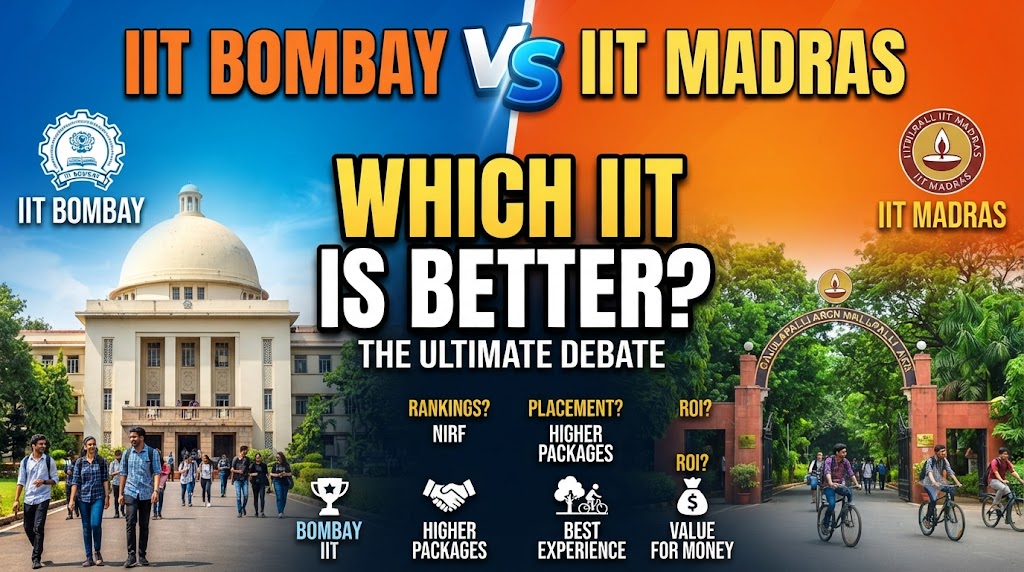
IIT Bombay and IIT Madras are two of India’s leading engineering institutes. Both offer undergraduate, postgraduate, and research programs across engineering, science, technology, and related fields. In the 2025 NIRF Engineering ranking, IIT Madras was ranked 1st in India, while IIT Bombay was ranked 3rd.
However, the IIT Bombay vs IIT Madras comparison cannot be decided by ranking alone. The right choice can depend on the course, department, research interests, campus environment, location, fees, and career plans. Comparing these factors can help students understand how the two institutes differ.
Quick Comparison: IIT Bombay vs IIT Madras
| Feature | IIT Bombay | IIT Madras |
|---|---|---|
| Full Name | Indian Institute of Technology Bombay | Indian Institute of Technology Madras |
| Location | Mumbai, Maharashtra | Chennai, Tamil Nadu |
| NIRF Engineering Rank 2025 | 3 | 1 |
| Institute Type | Institute of National Importance | Institute of National Importance |
| Academic Areas | Engineering, technology, sciences, design, management and related fields | Engineering, technology, sciences, management and related fields |
| Major Advantage | Location in Mumbai and strong academic ecosystem | Top position in NIRF Engineering 2025 and broad academic ecosystem |
| Campus Environment | Residential campus in Mumbai | Residential campus in Chennai |
| Choice Depends On | Course, department, career goals and location | Course, department, career goals and location |
IIT Bombay vs IIT Madras: Academic Comparison
Both IIT Bombay and IIT Madras provide a wide range of academic programs. The institutes cover engineering, technology, sciences and other disciplines, although the exact programs and specializations vary.
When comparing the two, students should look beyond the institute name. The department, curriculum, electives, faculty, laboratories, and research opportunities can be more important for a particular career goal.
IIT Bombay Academics
IIT Bombay offers programs across engineering, technology, science, design, management, and related areas. Its academic environment also includes undergraduate, postgraduate, and doctoral education.
Students interested in a particular branch should examine the department’s curriculum and available specializations before making a decision.
IIT Madras Academics
IIT Madras also offers a broad range of programs in engineering, science, technology, and related disciplines.
Its academic structure includes undergraduate, postgraduate, and research programs. As with IIT Bombay, the suitability of a program depends on the student’s specific academic and career interests.
IIT Bombay vs IIT Madras: NIRF Ranking
The 2025 NIRF Engineering ranking placed IIT Madras at Rank 1 and IIT Bombay at Rank 3 in India.
This provides a useful national-level comparison, but ranking should not be treated as the only measure of an institute’s suitability for an individual student.
NIRF rankings use multiple parameters. These include teaching and learning resources, research and professional practice, graduation outcomes, outreach and inclusivity, and perception.
Therefore, a student should also examine the specific department and program before making a final choice.
IIT Bombay vs IIT Madras: Research
Research is an important part of both IITs.
Both institutes have research activities across engineering, science, technology, and interdisciplinary areas. Students interested in research should compare the faculty and laboratories associated with their preferred subject.
What to Compare for Research
Before choosing between IIT Bombay and IIT Madras, students can examine:
- Faculty research areas
- Department laboratories
- Research projects
- Postgraduate opportunities
- Doctoral programs
- Industry and academic collaborations
- Interdisciplinary research opportunities
The strongest fit can therefore vary from one department to another.
IIT Bombay vs IIT Madras: Fees
Fees depend on the academic program, admission category, year of admission, and applicable fee policies.
For the 2026-27 undergraduate intake, IIT Bombay lists academic fees of ₹1,34,150 for Indian GEN/EWS/OBC-NCL students for the Autumn Semester, with separate hostel and mess charges. Its official fee page also states that the fee structure can be revised.
IIT Madras’s official 2026-27 fee circular lists ₹1,00,000 tuition fee per semester for its B.Tech, B.S., and Dual Degree programs for Indian students, along with other institute charges. The institute also provides fee remission provisions for eligible categories and income groups.
These figures are not directly equivalent because the fee structures contain different components. Students should check the latest official fee circulars before comparing the total cost.
Other Costs to Consider
A realistic fee comparison should include:
- Tuition or academic fees
- Hostel charges
- Mess expenses
- One-time charges
- Medical or student services charges
- Travel expenses
- Scholarships and fee remission
The final cost can therefore differ from the headline academic fee.
IIT Bombay vs IIT Madras: Location
Location is another major difference.
IIT Bombay is in Mumbai, while IIT Madras is in Chennai.
Mumbai is one of India’s major financial and commercial centres. Chennai is a major industrial, technology, automotive, and educational centre in southern India.
Students who want to pursue internships, networking, entrepreneurship, or employment opportunities outside the campus may consider the surrounding city as part of their decision.
IIT Bombay vs IIT Madras: Campus Life
Both institutes provide residential campus environments with academic facilities and student activities.
Campus life includes opportunities in areas such as:
- Technical activities
- Cultural events
- Sports
- Student clubs
- Entrepreneurship
- Research
- Competitions
The actual experience depends on a student’s interests and participation. Therefore, students should compare the specific clubs, festivals, facilities, and activities that matter to them.
IIT Bombay vs IIT Madras: Career Opportunities
Both institutes provide students with access to career services and recruitment opportunities.
However, career outcomes can vary considerably by department, degree, academic year, specialization, and individual student performance.
For this reason, students should avoid judging the two institutes using only one placement number.
Instead, compare:
- Department-specific placement reports
- Types of recruiters
- Job roles
- Internship opportunities
- Higher-study opportunities
- Entrepreneurship support
- Alumni networks
This approach gives a more useful picture of career possibilities.
IIT Bombay vs IIT Madras: Which One Should You Choose?
There is no universal answer for every student.
IIT Bombay may suit you if:
- You prefer studying in Mumbai.
- Your preferred department matches your academic interests at IIT Bombay.
- You value the professional ecosystem around Mumbai.
- The institute’s research and extracurricular opportunities fit your goals.
IIT Madras may suit you if:
- Your preferred program or department is a strong fit at IIT Madras.
- You prefer studying in Chennai.
- IIT Madras’s academic and research environment matches your interests.
- Its current program structure and opportunities suit your career plans.
IIT Bombay vs IIT Madras: Final Comparison
IIT Bombay and IIT Madras are both established IITs with extensive academic and research opportunities. In the 2025 NIRF Engineering ranking, IIT Madras was ranked 1st and IIT Bombay 3rd.
The more useful decision is to compare the specific branch, curriculum, faculty, research opportunities, fees, location, campus environment, and career goals. A national ranking can provide context, but it does not determine the right institute for every student.
Disclaimer
Education Disclaimer: Admission requirements, eligibility criteria, fees, courses, seat availability, placement information, academic rules, and other institute policies may change over time. Students should verify the latest information through the official IIT Bombay, IIT Madras, JoSAA, and other relevant official sources before making admission or career decisions.