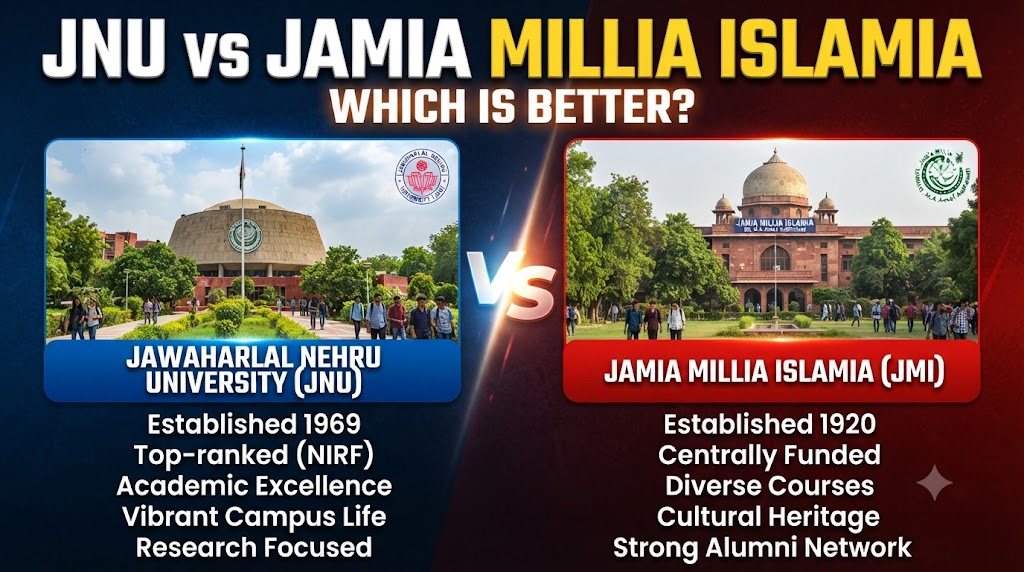
Jawaharlal Nehru University vs Jamia Millia Islamia
Choosing between Jawaharlal Nehru University and Jamia Millia Islamia can be difficult because both are prominent central universities in New Delhi. However, they differ in academic structure, course choices, campus environment, research focus and student experience.
In this Jawaharlal Nehru University vs Jamia Millia Islamia comparison, we will compare their courses, academic structure, undergraduate and postgraduate study, admission, campus life, research opportunities and career suitability. The better university depends on your subject, study level and future goals.
Quick Comparison Table
| Feature | Jawaharlal Nehru University | Jamia Millia Islamia |
|---|---|---|
| Common Name | JNU | JMI |
| Location | New Delhi | New Delhi |
| University Type | Central University | Central University |
| Academic Structure | Schools, centres and specialised programmes | Faculties, departments and centres |
| Undergraduate Options | More limited compared with JMI | Broad range of programmes |
| Postgraduate Study | Strong focus | Broad range of programmes |
| Research | Strong research-oriented environment | Research across multiple disciplines |
| Campus Experience | Centralised university campus | Integrated university campus |
| Best Suited For | Specialised study, postgraduate education and research | Diverse academic programmes and integrated university study |
Academic Structure
The academic structure is one of the main differences between JNU and JMI.
Jawaharlal Nehru University has an academic structure based around schools, centres and specialised programmes. It has a strong identity in postgraduate education, advanced study and research.
Jamia Millia Islamia, commonly known as JMI, has faculties, departments and centres covering a broad range of academic disciplines.
Which academic structure is better?
There is no universal winner.
JNU may suit students who want a specialised academic environment with a strong emphasis on postgraduate education and research.
JMI may be more suitable for students who want a broad selection of programmes within an integrated university structure.
Courses and Subject Choices
Course selection should be one of the most important factors in this comparison.
JNU is known for programmes across areas such as social sciences, international studies, languages, sciences and other specialised fields.
JMI also offers programmes across a wide range of disciplines, including humanities, social sciences, sciences, engineering, technology, education, architecture and other areas.
Therefore, students should compare the exact course and department rather than choosing only on the basis of the university’s overall reputation.
Undergraduate Study
JNU and JMI differ considerably in their undergraduate offerings.
JMI provides a broad selection of undergraduate programmes across different academic areas.
JNU also offers undergraduate programmes, but its overall academic identity is more strongly associated with postgraduate study and research.
Which is better for undergraduate students?
JMI may have an advantage for students looking for a wider selection of undergraduate programmes.
Students considering JNU should check whether their preferred undergraduate programme is available and compare its structure with the corresponding options at JMI.
The specific course, eligibility and admission process should ultimately determine the choice.
Postgraduate Education
Postgraduate education is an important part of both universities.
JNU has a particularly strong emphasis on postgraduate study and research. Students interested in advanced academic work may find its specialised schools and centres relevant to their goals.
JMI also offers postgraduate programmes across many disciplines through its faculties and departments.
For postgraduate students, the best choice depends on the exact programme, faculty expertise, research opportunities and career relevance.
Which is better for postgraduate study?
JNU may be more suitable for students whose priorities are specialised postgraduate education and research.
JMI may be better for students who want postgraduate study across a broad range of disciplines and programmes.
Admission
Admission procedures can vary depending on the programme and academic year.
Students should check the latest official information before applying because eligibility requirements, admission routes, dates and other rules may change.
Applicants to JNU should check the requirements for their selected programme.
Similarly, JMI applicants should review the current eligibility criteria and admission procedure for their chosen course.
Which university has better admission opportunities?
Neither university is automatically better for every student.
Your eligibility, preferred programme and admission route should determine the decision.
It is better to compare the exact programmes you qualify for rather than comparing the universities only by name.
Campus Life
Both universities provide an integrated campus experience, but their academic cultures can feel different.
JNU offers a centralised campus environment with a strong postgraduate and research-oriented atmosphere.
JMI also provides an integrated university campus with students studying across many different academic disciplines.
Which has better campus life?
JNU may suit students who prefer a research-oriented university atmosphere and a strong postgraduate academic environment.
JMI may suit students who want a broader mix of undergraduate, postgraduate and professional-oriented programmes within one university campus.
The better option depends on your preferred academic and social environment.
Research Opportunities
Research is an important part of both universities.
JNU has a particularly strong research-oriented academic structure, with specialised schools and centres supporting advanced study across different fields.
JMI also has research opportunities across its faculties, departments and centres.
For students planning to pursue research, an academic career or higher education, the specific department and research area are more important than the university name alone.
Which is better for research?
For students primarily focused on postgraduate research and specialised academic study, JNU may have an advantage.
However, JMI can also be a suitable choice when its particular department, faculty and research facilities match the student’s interests.
Career Opportunities
A university’s reputation alone does not determine career success.
Your course, academic performance, internships, projects, practical skills, communication abilities and professional experience can all influence your future opportunities.
JNU can be a strong fit for students interested in areas such as research, academia, social sciences, international studies, languages and other specialised fields.
JMI offers a broad academic environment that can suit students pursuing careers across humanities, sciences, technology, education, engineering and other disciplines.
Therefore, the best choice depends on your intended career path and the relevance of the selected course.
Jawaharlal Nehru University vs Jamia Millia Islamia: Which Is Better for You?
Your priorities can make the decision easier.
Choose JNU if:
- You are interested in postgraduate education.
- You have a strong interest in research.
- You prefer a specialised academic environment.
- Your subject interests match JNU’s academic schools and programmes.
- You are considering an academic or research-oriented career.
Choose JMI if:
- You want a broad range of undergraduate programmes.
- You want to study across diverse academic disciplines.
- You prefer an integrated university campus.
- Your preferred course is particularly suitable at JMI.
- You want options across academic and professional fields.
Jawaharlal Nehru University vs Jamia Millia Islamia: Final Verdict
There is no single winner in the Jawaharlal Nehru University vs Jamia Millia Islamia comparison.
JNU may be the better choice for students who prioritise specialised postgraduate education, research and academic study. JMI may be the better choice for students seeking a broader range of undergraduate and postgraduate programmes across different disciplines.
Before making a final decision, compare the specific course, department, eligibility requirements, admission process, academic environment and long-term career goal.
Disclaimer: University courses, admission criteria, eligibility requirements, fees, dates, policies and other academic information may change over time. Students should verify the latest details directly from the official websites of Jawaharlal Nehru University and Jamia Millia Islamia before making admission or education-related decisions.