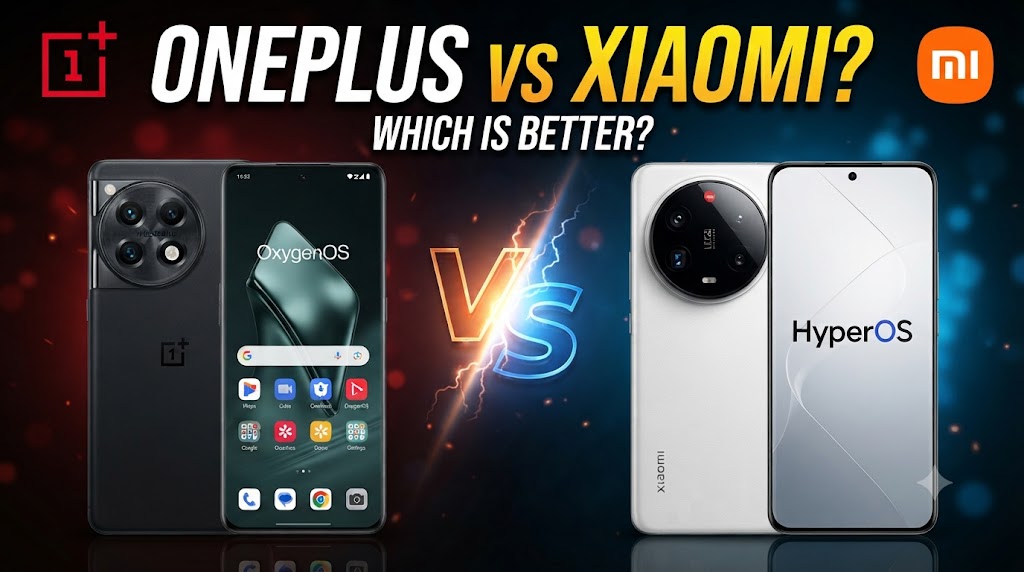
OnePlus vs Xiaomi
Choosing a new smartphone can be confusing when two well-known brands offer strong features at different prices. OnePlus vs Xiaomi is a common comparison because both brands offer phones across several price segments, from affordable and mid-range devices to premium smartphones. However, their strengths can differ depending on what you value most, such as performance, cameras, battery life, software, design, or charging speed.
OnePlus is widely associated with performance-focused smartphones, fast charging, smooth displays, and its OxygenOS software experience. Xiaomi, meanwhile, has a broad smartphone portfolio and also operates Redmi as a major phone brand, giving buyers many options across different budgets. Xiaomi’s current India portfolio includes both Xiaomi and Redmi phones, while OnePlus continues to offer models across premium and mid-range segments. (OnePlus)
Quick Comparison: OnePlus vs Xiaomi
| Feature | OnePlus | Xiaomi |
|---|---|---|
| Product range | Premium and mid-range focused | Very broad range through Xiaomi and Redmi |
| Performance | Strong focus on high performance | Strong performance across several price segments |
| Display | Often emphasizes high refresh-rate displays | Offers high-quality displays across many models |
| Cameras | Strong flagship and premium camera systems | Wide range of camera-focused models |
| Battery | Large batteries on several current models | Large batteries available across multiple models |
| Charging | Known for very fast charging | Also offers fast and very fast charging |
| Software | OxygenOS | Xiaomi HyperOS |
| Gaming | Strong performance-oriented approach | Strong gaming options, depending on model |
| Budget choices | More limited than Xiaomi/Redmi | Very broad selection |
| Best suited for | Performance-focused buyers | Buyers wanting more choices across budgets |
Specifications and features vary by individual model and market.
OnePlus vs Xiaomi: Performance
Performance is one of the most important areas in a OnePlus vs Xiaomi comparison.
OnePlus has traditionally placed considerable emphasis on powerful processors and smooth everyday performance. Its current OnePlus 15, for example, uses the Snapdragon 8 Elite Gen 5 platform and includes performance-oriented features for gaming and multitasking. (OnePlus)
Xiaomi also offers powerful processors, especially in its higher-end Xiaomi models. Its wider portfolio means that performance varies considerably depending on the phone’s price and model.
Which is better for performance?
It depends on the models being compared.
For buyers looking at premium performance-focused phones, OnePlus can be particularly appealing. Xiaomi also competes strongly in the premium segment, while its Redmi range gives buyers additional performance choices at lower prices.
Practical meaning: Don’t choose only by brand name. Compare the processor, RAM, storage technology, cooling system, and software optimization of the exact models.
OnePlus vs Xiaomi: Display
Both brands offer smartphones with high-refresh-rate displays, AMOLED technology, and different screen sizes.
OnePlus currently highlights a 165Hz LTPO display on the OnePlus 15, showing the brand’s focus on smooth scrolling and gaming. (OnePlus)
Xiaomi also offers high-refresh-rate AMOLED displays on several phones. However, the exact panel technology and refresh rate depend on the model.
Which is better for display?
There is no universal winner.
OnePlus may appeal to users who prioritize smooth motion and gaming-oriented displays. Xiaomi can be attractive to buyers who want different display choices across several price ranges.
Practical meaning: For a fair comparison, check brightness, resolution, refresh rate, LTPO support, HDR capabilities, and display size rather than comparing brands alone.
OnePlus vs Xiaomi: Camera Quality
Camera performance can vary significantly between individual phones.
OnePlus has invested heavily in camera hardware and image processing in its premium phones. The current OnePlus 15, for example, features a triple 50MP rear camera system with wide, ultra-wide, and periscope telephoto cameras. (OnePlus)
Xiaomi also has a strong presence in camera-focused smartphones. Its current Indian portfolio includes premium Xiaomi models and phones associated with Leica camera collaboration. (Mi Poland)
Which is better for cameras?
The answer depends heavily on the particular models.
Xiaomi can be a strong option for buyers who place a high priority on photography and camera versatility. OnePlus also offers advanced camera hardware, particularly in its higher-end phones.
Practical meaning: Check actual camera samples and compare the main camera, ultra-wide camera, telephoto capability, OIS, low-light performance, and video features of the two models you are considering.
OnePlus vs Xiaomi: Battery Life
Battery capacity is another important part of the comparison.
OnePlus has introduced very large batteries in recent flagship phones. The OnePlus 15, for example, has a 7,300mAh battery according to OnePlus. (OnePlus)
Xiaomi also offers phones with large batteries. Its current portfolio includes models with different battery capacities, depending on the segment and model. (Mi Poland)
Which is better for battery life?
Both brands can provide strong battery performance.
However, battery life depends on more than capacity. Display size, processor efficiency, software optimization, network conditions, gaming, and brightness can all affect how long a phone lasts.
Practical meaning: A larger battery does not automatically mean longer real-world battery life.
OnePlus vs Xiaomi: Charging Speed
Fast charging is a major selling point for both brands.
OnePlus currently promotes 120W SUPERVOOC wired charging on the OnePlus 15 and also supports 50W AIRVOOC wireless charging. (OnePlus)
Xiaomi also offers fast-charging technologies across its smartphone range. However, charging speeds differ substantially between models.
Which is better for charging?
Both brands provide fast-charging options, but the exact charging speed should be checked for the specific phone.
If charging speed is one of your top priorities, compare the advertised wired charging wattage, wireless charging support, charger availability, and charging time rather than choosing based only on the brand.
OnePlus vs Xiaomi: Software Experience
OnePlus uses OxygenOS, while Xiaomi uses HyperOS.
OnePlus currently promotes OxygenOS 16 on its latest flagship, with features that connect the phone’s software experience with AI tools and other functions. (OnePlus)
Xiaomi uses HyperOS across its newer ecosystem of phones and other connected products. Xiaomi also promotes HyperOS as part of its broader device ecosystem. (Mi Poland)
Which software is better?
This is largely a matter of preference.
OnePlus may appeal to users who prefer the OxygenOS experience. Xiaomi may be more suitable for people who already use Xiaomi products and want to connect devices within its ecosystem.
Practical meaning: Before buying, check the exact software version, update policy, pre-installed apps, and features of the specific model.
OnePlus vs Xiaomi: Gaming
Gaming performance depends primarily on the processor, cooling system, display, touch response, battery, and software optimization.
OnePlus emphasizes gaming performance on its latest flagship, including a dedicated gaming engine and claims around sustained frame rates in supported games. (OnePlus)
Xiaomi also offers performance-focused smartphones, including models under its Redmi and Xiaomi ranges.
Which is better for gaming?
Both can be good gaming choices.
For demanding games, compare the exact processor, thermal design, display refresh rate, touch sampling, sustained performance, and battery capacity.
OnePlus vs Xiaomi: Price and Value
Price is where the comparison becomes more complicated.
Xiaomi has a broader portfolio in India because its range includes both Xiaomi and Redmi smartphones. The current Xiaomi India phone catalogue includes entry-level, mid-range, and premium devices. (Mi Poland)
OnePlus also offers phones at different levels, but its range is more concentrated around mid-range and premium smartphones.
Therefore, Xiaomi generally gives buyers more choices when they are shopping across different budgets, while OnePlus can be particularly attractive when the buyer is focused on performance-oriented mid-range or premium devices.
Practical meaning: Compare phones in the same price bracket. Comparing a premium OnePlus with an entry-level Redmi phone would not give a meaningful brand-level result.
OnePlus vs Xiaomi: Design and Build Quality
Both brands offer smartphones with different materials, designs, and levels of protection.
OnePlus emphasizes premium construction on its flagship phones. The OnePlus 15, for example, includes Gorilla Glass Victus 2 and multiple IP protection ratings. (OnePlus)
Xiaomi also offers premium build quality on selected models, while lower-priced devices naturally use different materials and specifications.
Which has better design?
There is no single answer for the entire brand.
If build quality matters to you, compare the exact phone’s frame material, glass protection, IP rating, weight, thickness, and overall ergonomics.
OnePlus vs Xiaomi: Which Brand Offers More Choice?
This is an area where Xiaomi has a particularly broad presence.
Xiaomi’s India catalogue currently contains Xiaomi-branded phones as well as a large Redmi range. The official catalogue lists multiple Redmi and Xiaomi series across different segments. (Mi Poland)
OnePlus has a smaller and more focused smartphone portfolio.
Practical meaning: Xiaomi can make it easier to find a phone within a specific budget, while OnePlus offers a more focused selection for buyers interested in its particular software and performance approach.
OnePlus vs Xiaomi: Which Phone Brand Is Better?
There is no single answer for every buyer.
OnePlus may suit you better if you prioritize:
- Strong performance
- Gaming
- Fast charging
- High-refresh-rate displays
- OxygenOS
- Performance-focused premium phones
Xiaomi may suit you better if you prioritize:
- A wider range of prices
- More model choices
- Xiaomi and Redmi options
- Camera-focused models
- Fast charging
- A broader device ecosystem
The important point is that both brands cover different needs. A particular OnePlus phone can be a better choice than a particular Xiaomi phone, while another Xiaomi model can be a better fit than another OnePlus model.
OnePlus vs Xiaomi: Final Verdict
The OnePlus vs Xiaomi comparison does not have one universal winner.
Choose OnePlus if your priority is a performance-focused smartphone with features such as fast charging, high-refresh-rate displays, gaming capabilities, and OxygenOS.
Choose Xiaomi if you want more smartphone choices across different budgets or are interested in Xiaomi’s broader phone and device ecosystem.
Before buying, compare the exact OnePlus and Xiaomi models, their current prices, cameras, processor, battery, charging, software support, and warranty. That model-to-model comparison is more useful than choosing a brand based only on reputation.
Disclaimer
Smartphone specifications, features, software versions, availability, and prices can change over time and may differ by country, model, storage variant, and retailer. The information in this article is intended for general comparison and buying research. Always check the manufacturer’s official specifications and current price before making a purchase.