Samsung vs Xiaomi
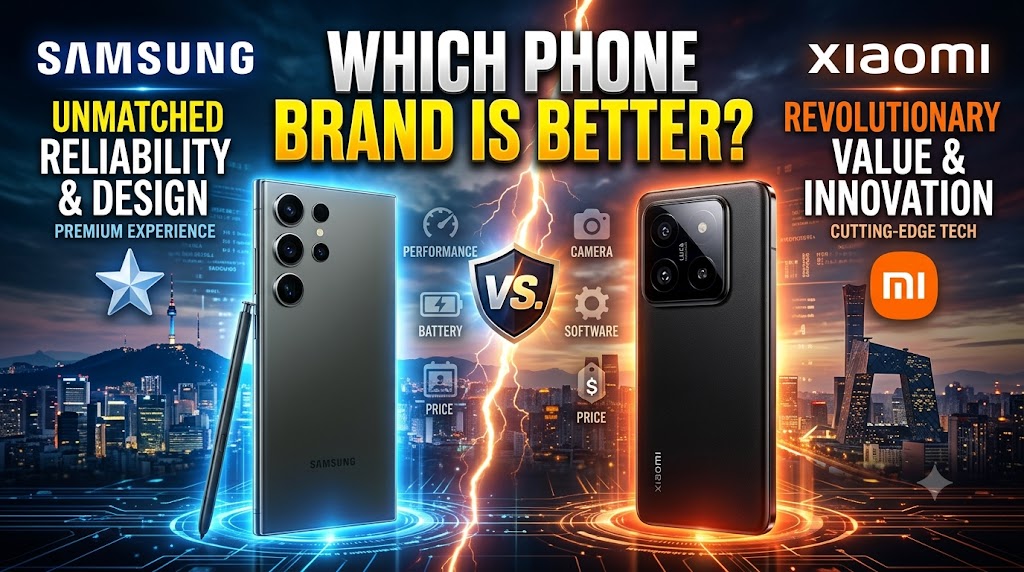
Samsung is one of the world’s major smartphone brands, offering devices across budget, mid-range, and premium segments. Its flagship Galaxy S series focuses on high-end displays, cameras, performance, software features, and long-term support, while other Galaxy series target different budgets. Samsung’s smartphones use Android with One UI, and premium models can include features such as Galaxy AI, advanced camera systems, and the S Pen. Because Samsung sells phones at many price levels, its strengths can vary considerably depending on the model being compared.
Xiaomi is a major smartphone brand known for offering competitive hardware across budget, mid-range, and premium segments. Its Xiaomi, Redmi, and POCO product families target different types of buyers, with features such as high-resolution displays, large batteries, fast charging, and performance-focused processors available on selected models. Xiaomi smartphones use Android with HyperOS. Premium Xiaomi models can also offer advanced camera systems and flagship processors. Therefore, comparing the exact Samsung and Xiaomi models is more useful than assuming one brand is always better.
Quick Comparison Table
| Feature | Samsung | Xiaomi |
|---|---|---|
| Main Strengths | Display, software, cameras, ecosystem | Hardware, charging, value |
| Operating System | Android + One UI | Android + HyperOS |
| Premium Lineup | Galaxy S Series | Xiaomi flagship series |
| Budget & Mid-Range | Galaxy A and other series | Redmi and Xiaomi series |
| Performance | Strong, model-dependent | Strong, model-dependent |
| Camera | Strong flagship cameras | Strong flagship cameras |
| Battery | Strong | Strong |
| Fast Charging | Moderate to very fast depending on model | Often very fast on selected models |
| Software Experience | One UI | HyperOS |
| Ecosystem | Galaxy ecosystem | Xiaomi ecosystem |
| Productivity | S Pen on selected models | Feature-dependent |
| Best For | Software, display, ecosystem | Hardware value and charging |
| Overall Result | Strong all-round option | Strong value-focused option |
1. Performance
| Samsung | Xiaomi |
|---|---|
| Uses Qualcomm, MediaTek, and Samsung processors depending on model | Uses Qualcomm and MediaTek processors depending on model |
| High-end Galaxy S models offer flagship performance | Xiaomi flagship models offer flagship performance |
| Strong gaming and multitasking options | Strong gaming and multitasking options |
| Performance varies by Galaxy model | Performance varies by Xiaomi model |
Both brands offer powerful smartphones, but there is no brand-wide performance winner. The processor, RAM, storage technology, cooling system, and software optimization of the specific phone are more important.
For demanding gaming or heavy multitasking, buyers should compare the exact chipsets and thermal systems rather than simply choosing Samsung or Xiaomi.
🏆 Winner: Depends on the Model
2. Display
| Samsung | Xiaomi |
|---|---|
| AMOLED displays widely used in mid-range and premium models | AMOLED displays widely used in mid-range and premium models |
| High refresh rates on many models | High refresh rates on many models |
| Excellent color and brightness on premium Galaxy phones | High-resolution and high-brightness displays on selected premium phones |
| Strong display technology across multiple price ranges | Strong display specifications for the price |
Samsung has a long-standing strength in smartphone display technology, and its premium Galaxy phones offer high-quality AMOLED panels.
Xiaomi also provides impressive displays, particularly in its upper price segments, where high resolution, high refresh rates, and strong brightness can be available at competitive prices.
🏆 Winner: Samsung
Samsung has a slight overall advantage in display quality and consistency across its premium smartphone range.
3. Camera
| Samsung | Xiaomi |
|---|---|
| Advanced multi-camera systems on flagship Galaxy phones | Advanced multi-camera systems on selected Xiaomi flagships |
| Strong computational photography | Strong camera hardware and image processing |
| Dedicated zoom cameras on selected models | Dedicated telephoto cameras on selected premium models |
| Strong video capabilities | Strong photography and video capabilities |
Both companies offer capable camera phones. Samsung emphasizes computational photography, zoom, video, and a consistent camera experience across its flagship range.
Xiaomi has also invested heavily in premium imaging, including partnerships and large camera sensors on selected flagship models.
The actual winner depends heavily on the two models being compared.
🏆 Winner: Depends on the Model
4. Battery Life
| Samsung | Xiaomi |
|---|---|
| Large batteries available across many models | Large batteries available across many models |
| Strong battery optimization | Large battery capacities on many models |
| Battery capacity varies by model | Battery capacity varies by model |
| Good options across different price ranges | Strong battery-focused options |
Both brands offer smartphones with good battery endurance. However, battery life depends on processor efficiency, display settings, software optimization, network use, and individual usage.
A larger battery does not automatically mean longer real-world battery life.
🏆 Winner: Tie
5. Charging Speed
| Samsung | Xiaomi |
|---|---|
| Charging speed varies by model | Very fast charging available on selected models |
| Premium models generally focus more on balanced charging | High-wattage charging is a major feature on selected Xiaomi phones |
| Wireless charging available on selected premium models | Wireless charging available on selected premium models |
Xiaomi generally has a stronger focus on very high charging speeds. Selected Xiaomi phones support charging rates considerably higher than many Samsung models.
Samsung’s approach is generally more conservative, although charging speed varies across its product range.
🏆 Winner: Xiaomi
Xiaomi is the stronger choice for users who prioritize very fast charging.
6. Software Experience
| Samsung | Xiaomi |
|---|---|
| One UI | HyperOS |
| Android-based | Android-based |
| Extensive customization | Extensive customization |
| Strong multitasking and ecosystem features | Strong system and customization features |
| Galaxy AI on supported models | Xiaomi AI features on supported models |
One UI and HyperOS both offer many features and customization options. Samsung’s One UI has a mature ecosystem experience and integrates closely with Galaxy devices.
Xiaomi’s HyperOS also provides extensive customization and integration with Xiaomi products.
The better interface is largely a matter of personal preference.
🏆 Winner: Depends on User’s Needs
7. Software Updates and Long-Term Support
| Samsung | Xiaomi |
|---|---|
| Strong update commitments on newer premium models | Update support varies by model |
| Long-term security support on selected devices | Newer premium devices can receive extended support |
| Clear software support policies for many current Galaxy devices | Support period differs across Xiaomi, Redmi, and POCO models |
Long-term software support is important if you plan to keep your phone for several years.
Samsung has made long-term software support a major strength of its newer flagship and selected mid-range devices. Xiaomi’s support has improved, but the exact commitment depends on the device.
🏆 Winner: Samsung
Samsung has the clearer advantage for buyers who prioritize long-term software support.
8. Design and Build Quality
| Samsung | Xiaomi |
|---|---|
| Premium materials on flagship models | Premium materials on selected flagship models |
| Slim and refined flagship designs | Premium and distinctive flagship designs |
| Strong water and dust resistance on selected models | Water and dust resistance on selected premium models |
| Consistent Galaxy design language | More varied design approaches |
Both brands produce well-designed smartphones, but the materials and durability features depend on the price category.
Samsung’s premium Galaxy models generally offer a refined and consistent build, while Xiaomi often focuses on combining premium construction with competitive hardware.
🏆 Winner: Tie
9. AI and Smart Features
| Samsung | Xiaomi |
|---|---|
| Galaxy AI on supported devices | Xiaomi AI features on supported devices |
| AI photo editing | AI photo editing |
| Writing and productivity tools | AI productivity and imaging features |
| Strong integration with Galaxy ecosystem | Integration with Xiaomi ecosystem |
Both brands are increasingly incorporating AI into smartphones. The available tools differ by model, software version, and region.
Samsung currently has a particularly broad AI feature ecosystem across supported Galaxy devices, while Xiaomi also provides AI-powered features on newer models.
🏆 Winner: Samsung
Samsung has a stronger overall AI ecosystem and broader integration across its flagship experience.
10. Ecosystem
| Samsung | Xiaomi |
|---|---|
| Galaxy phones, tablets, watches, earbuds and other devices | Xiaomi phones, tablets, watches, earbuds and smart-home products |
| Strong device integration | Broad smart-device ecosystem |
| Samsung DeX on supported models | Xiaomi ecosystem integration |
| Strong Windows integration | Strong integration with Xiaomi devices |
Samsung has developed a mature ecosystem around Galaxy smartphones, tablets, watches, earbuds, and other products.
Xiaomi also has a broad ecosystem, particularly for smart-home and connected devices.
🏆 Winner: Samsung
Samsung has an advantage for users who want a mature smartphone-centered ecosystem.
11. Productivity Features
| Samsung | Xiaomi |
|---|---|
| S Pen on selected Galaxy Ultra models | No comparable built-in stylus on most models |
| Samsung DeX on supported devices | Desktop-style functionality depends on model and software |
| Strong multitasking | Strong multitasking |
| Advanced ecosystem integration | Xiaomi device integration |
Samsung has a major advantage if productivity is important because selected Galaxy Ultra phones include the S Pen. Samsung DeX also provides a desktop-style interface on supported devices.
Xiaomi offers strong multitasking and software features, but its lineup does not generally provide the same integrated stylus experience.
🏆 Winner: Samsung
12. Value for Money
| Samsung | Xiaomi |
|---|---|
| Strong premium and mid-range options | Strong budget, mid-range, and premium options |
| Premium features can come at a higher price | Competitive hardware at many price points |
| Strong long-term software support | Strong specifications for the price |
| Ecosystem adds value for Galaxy users | Hardware and charging can offer strong value |
Xiaomi traditionally competes aggressively on specifications and pricing. Buyers can often find high-resolution displays, large batteries, fast charging, and powerful processors at competitive prices.
Samsung may cost more for comparable hardware, but its software support, ecosystem, display technology, and additional features can provide extra value.
🏆 Winner: Xiaomi
Xiaomi generally has the stronger value proposition for buyers who prioritize hardware specifications and price.
Final Comparison Table
| Category | Samsung | Xiaomi | Winner |
|---|---|---|---|
| Performance | Strong | Strong | Depends on Model |
| Display | Excellent | Excellent | Samsung |
| Camera | Strong | Strong | Depends on Model |
| Battery | Strong | Strong | Tie |
| Charging | Good to very fast | Very fast on selected models | Xiaomi |
| Software | One UI | HyperOS | Depends on User |
| Software Support | Strong | Model-dependent | Samsung |
| Design & Build | Premium | Premium on selected models | Tie |
| AI Features | Strong | Strong | Samsung |
| Ecosystem | Very strong | Strong | Samsung |
| Productivity | S Pen + DeX on selected models | Model-dependent | Samsung |
| Value for Money | Good | Strong | Xiaomi |
Final Verdict
There is no single winner between Samsung and Xiaomi for every buyer. Samsung is stronger in areas such as software support, ecosystem integration, display quality, and productivity features, while Xiaomi is particularly competitive in hardware specifications, charging speed, and value for money.
Choose Samsung if you:
- Want long-term software support.
- Prefer One UI.
- Want a strong smartphone ecosystem.
- Prioritize display quality.
- Need S Pen and DeX on supported Galaxy models.
- Want a well-rounded premium smartphone experience.
Choose Xiaomi if you:
- Want strong hardware for your budget.
- Prioritize very fast charging.
- Want high-end specifications at a competitive price.
- Prefer HyperOS.
- Are comfortable choosing between Xiaomi, Redmi, and POCO models based on features and price.
🏆 Overall Result: Depends on the User’s Needs
Samsung is the better choice for users who prioritize software support, ecosystem integration, display quality, and productivity features. Xiaomi is the better choice for buyers who prioritize hardware specifications, fast charging, and value for money.
The most accurate buying decision should always compare the exact Samsung and Xiaomi models at the same price level, because the differences can change significantly from one model to another.
Disclaimer
Smartphone specifications, prices, software features, update policies, and availability can change by model and market. Always verify the latest information and current price of the specific Samsung or Xiaomi phone before purchasing.