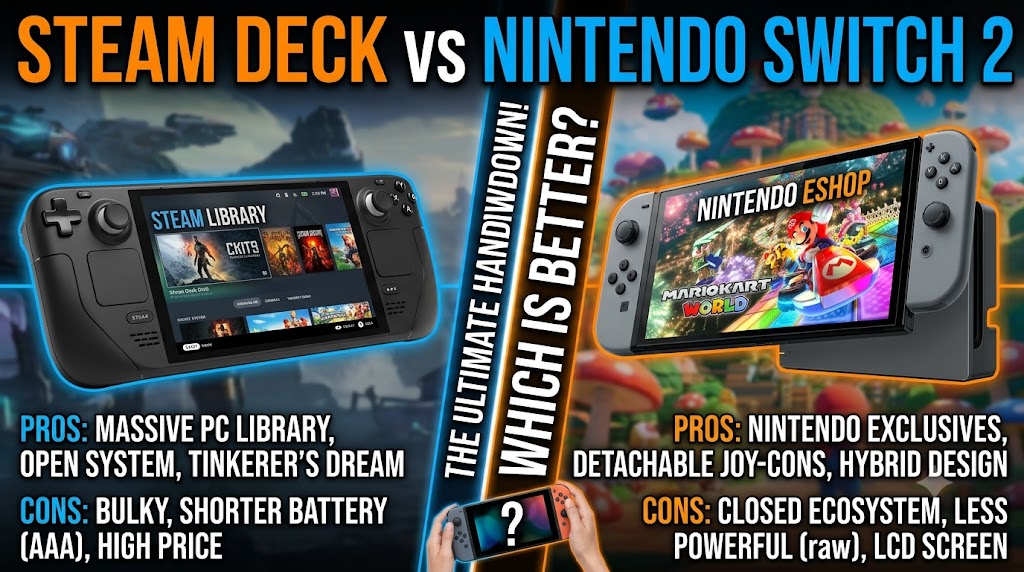
Steam Deck vs Nintendo Switch 2
Steam Deck
The Steam Deck is Valve’s handheld gaming PC designed to bring a large portion of the Steam library into a portable format. The current Steam Deck OLED features a 7.4-inch HDR OLED touchscreen with a 1280 × 800 resolution and up to a 90Hz refresh rate. It uses a custom AMD APU with four Zen 2 CPU cores and eight RDNA 2 GPU compute units, alongside 16GB of LPDDR5 memory. The OLED model also includes a 50Wh battery, Wi-Fi 6E, a microSD card slot and SteamOS 3.
Nintendo Switch 2
The Nintendo Switch 2 is Nintendo’s current-generation hybrid gaming system. It features a 7.9-inch 1920 × 1080 LCD touchscreen with HDR10 support and variable refresh rate up to 120Hz. Nintendo uses a custom NVIDIA processor, and the system includes 256GB of UFS storage, Wi-Fi 6 and support for both Nintendo Switch 2 and compatible Nintendo Switch games. Its Joy-Con 2 controllers can also be detached, while the system can be used in handheld, tabletop and TV modes.
Quick Comparison Table
| Feature | Steam Deck OLED | Nintendo Switch 2 |
|---|---|---|
| Type | Handheld gaming PC | Hybrid gaming console |
| Operating System | SteamOS 3 | Nintendo system software |
| Display | 7.4-inch HDR OLED | 7.9-inch LCD |
| Resolution | 1280 × 800 | 1920 × 1080 |
| Refresh Rate | Up to 90Hz | Up to 120Hz VRR |
| HDR | Yes | Yes |
| Storage | 512GB / 1TB NVMe SSD | 256GB UFS |
| Storage Expansion | microSD | microSD Express |
| RAM | 16GB LPDDR5 | Nintendo does not list RAM in its public consumer specification |
| Main Game Platform | Steam/PC games | Nintendo games and compatible Switch games |
| Portability | Excellent | Excellent |
| TV Gaming | Yes, through USB-C/dock | Yes, through dock |
| Controllers | Built-in controls | Detachable Joy-Con 2 |
| Trackpads | Two | No |
| Keyboard/Mouse Flexibility | Stronger | Limited |
| Game Modding | Stronger | More limited |
| Battery Rating | Approx. 3–12 hours | Approx. 2–6.5 hours |
| Weight | Approx. 640g | Approx. 534g with Joy-Con 2 |
| Best For | Portable PC gaming | Nintendo and hybrid console gaming |
1. Gaming Performance
Steam Deck OLED
The Steam Deck OLED uses a 6nm AMD APU with four Zen 2 CPU cores and eight RDNA 2 GPU compute units. Its APU operates within a 4–15W power range. Valve’s official specifications list 16GB of LPDDR5 memory.
Because Steam Deck is a PC, actual performance can vary depending on the game, resolution, graphics settings and software configuration.
Nintendo Switch 2
Nintendo Switch 2 uses a custom NVIDIA processor and has a 1920 × 1080 built-in display. Nintendo also supports VRR up to 120Hz and HDR10 on the internal screen.
Its games are developed specifically for Nintendo’s hardware, allowing developers to optimize software for the platform.
What this means for the user: Both systems are capable handheld gaming devices, but they approach performance differently. Steam Deck provides PC-style control over settings, while Switch 2 offers a tightly integrated console platform.
🏆 Winner: Depends on the Game
2. Display Quality
Steam Deck OLED
Steam Deck OLED has a 7.4-inch HDR OLED display with a 1280 × 800 resolution, up to 90Hz refresh rate and a peak HDR brightness of 1,000 nits. Valve also lists a contrast ratio above 1,000,000:1 and 110% P3 color gamut.
OLED technology provides deep blacks and strong contrast.
Nintendo Switch 2
Switch 2 uses a larger 7.9-inch LCD display with 1920 × 1080 resolution. It supports HDR10 and VRR up to 120Hz.
The higher native resolution gives Switch 2 a sharper pixel count than Steam Deck OLED.
What this means for the user: Steam Deck OLED has the advantage of OLED contrast and HDR presentation, while Switch 2 has a larger, higher-resolution panel.
🏆 Winner: Depends on User’s Needs
3. Resolution
Steam Deck OLED
The Steam Deck OLED’s native display resolution is 1280 × 800. This lower resolution can also reduce the rendering workload compared with a higher-resolution screen.
Nintendo Switch 2
Switch 2 has a 1920 × 1080 handheld display. Nintendo also supports higher output resolutions when the console is connected to a compatible television through its dock.
What this means for the user: Switch 2 has the clear advantage in native handheld resolution.
🏆 Winner: Nintendo Switch 2
4. Refresh Rate
Steam Deck OLED
The Steam Deck OLED display supports refresh rates up to 90Hz.
Nintendo Switch 2
Nintendo Switch 2’s display supports VRR up to 120Hz.
However, a game’s actual frame rate depends on its software and performance.
What this means for the user: The Switch 2 display has a higher maximum refresh rate, while both devices can provide smooth gameplay when supported by the game.
🏆 Winner: Nintendo Switch 2
5. Storage
Steam Deck OLED
The Steam Deck OLED is offered with 512GB and 1TB NVMe SSD configurations, and it also supports high-speed microSD expansion.
Nintendo Switch 2
Nintendo Switch 2 includes 256GB of internal UFS storage. It supports microSD Express cards for additional storage.
What this means for the user: Steam Deck OLED provides substantially more built-in storage in its current configurations, particularly the 1TB version.
🏆 Winner: Steam Deck OLED
6. Game Library
Steam Deck OLED
Steam Deck is a portable PC, giving users access to games distributed through Steam and other PC software when compatible. Valve also provides its Deck Verified system to help users understand how games work on Steam Deck.
However, not every PC game is equally compatible with SteamOS, and some titles may require additional configuration or may not work as expected.
Nintendo Switch 2
Switch 2 has its own Nintendo ecosystem and access to Nintendo’s first-party games. It can also play compatible physical and digital Nintendo Switch games. Nintendo states that some older Switch games may not be fully compatible, so compatibility should be checked for individual titles.
What this means for the user: Steam Deck is stronger for PC/Steam gaming, while Switch 2 is the better choice for Nintendo’s platform and its exclusive games.
🏆 Winner: Depends on User’s Game Preferences
7. Nintendo Exclusive Games
Steam Deck OLED
Steam Deck does not provide the native Nintendo console ecosystem. Nintendo’s major first-party franchises are designed around Nintendo platforms.
Nintendo Switch 2
Nintendo Switch 2 is the direct platform for Nintendo’s current-generation games and Nintendo’s ecosystem.
Nintendo also supports selected Switch 2 Edition upgrades for existing Switch games, adding improvements such as visual enhancements, performance improvements or additional features depending on the game.
What this means for the user: If games from Nintendo’s first-party ecosystem are a major reason for buying a handheld, Switch 2 is the obvious choice.
🏆 Winner: Nintendo Switch 2
8. PC Gaming Flexibility
Steam Deck OLED
Steam Deck is fundamentally a PC. Valve explicitly describes it as a device that can also be used as a PC, with USB-C connectivity for displays and peripherals. SteamOS also includes a desktop environment.
Users can connect keyboards, mice, displays and other peripherals.
Nintendo Switch 2
Switch 2 is designed primarily as a gaming console. Its software environment is much more controlled than a desktop PC.
What this means for the user: Steam Deck provides considerably more flexibility if you want a handheld that can also function as a small PC.
🏆 Winner: Steam Deck OLED
9. Controls
Steam Deck OLED
Steam Deck includes full-size analog sticks, traditional game controls, four assignable rear grip buttons, gyro controls and two 32.5mm trackpads with haptic feedback.
The trackpads are particularly useful for games designed around mouse input.
Nintendo Switch 2
Switch 2 uses Joy-Con 2 controllers that can be attached to the console or used in other configurations. The Joy-Con 2 controllers include motion controls and a mouse sensor.
What this means for the user: Steam Deck provides more traditional PC-oriented controls, while Switch 2 offers the distinctive flexibility of detachable Joy-Con 2 controllers.
🏆 Winner: Depends on User’s Needs
10. Portability
Steam Deck OLED
The Steam Deck OLED weighs approximately 640 grams and measures about 298 × 117 × 49mm.
It is portable, but it is relatively large compared with many traditional handheld consoles.
Nintendo Switch 2
Nintendo lists the Switch 2 at approximately 1.18 pounds, or about 534 grams, with Joy-Con 2 controllers attached.
That makes it lighter than the Steam Deck OLED.
What this means for the user: Both are portable, but Switch 2 is easier to carry for long periods because of its lower weight.
🏆 Winner: Nintendo Switch 2
11. Battery Life
Steam Deck OLED
Valve rates the Steam Deck OLED for approximately 3–12 hours of gameplay, depending on content and usage. Its battery capacity is 50Wh.
Nintendo Switch 2
Nintendo estimates approximately 2–6.5 hours of battery life, depending on the games being played. Its internal battery is rated at 5220mAh.
These are manufacturer estimates rather than guaranteed gaming times.
What this means for the user: Based on the official stated ranges, Steam Deck OLED has the longer maximum battery-life rating.
🏆 Winner: Steam Deck OLED
12. TV Gaming
Steam Deck OLED
Steam Deck can connect to external displays through USB-C DisplayPort functionality. Valve lists support for resolutions up to 8K at 60Hz or 4K at 120Hz under supported conditions.
Nintendo Switch 2
Switch 2 is specifically designed as a hybrid console and can transition from handheld gaming to TV gaming through its dock. Nintendo provides a dedicated Switch 2 dock with wired LAN connectivity.
What this means for the user: Both can be used with a TV, but the Switch 2’s handheld-to-TV design is more central to the product concept.
🏆 Winner: Nintendo Switch 2
13. Mod Support
Steam Deck OLED
Because Steam Deck is a PC, compatible games can offer access to PC modding communities and tools. The exact process depends on the game and the mod.
Nintendo Switch 2
Nintendo’s console environment is more controlled, and standard consumer use does not provide the same level of game modification flexibility found on PC.
What this means for the user: Players interested in mods and PC-style customization have substantially more flexibility with Steam Deck.
🏆 Winner: Steam Deck OLED
14. Operating System and Software Freedom
Steam Deck OLED
Steam Deck runs SteamOS 3, which is based on Arch Linux. Valve also provides a KDE Plasma desktop environment, allowing the device to be used for more than conventional console gaming.
Nintendo Switch 2
Switch 2 uses Nintendo’s proprietary console software environment and is designed around a controlled gaming experience.
What this means for the user: Steam Deck provides much greater software flexibility.
🏆 Winner: Steam Deck OLED
15. Ease of Use
Steam Deck OLED
SteamOS provides a console-like interface, and Valve has designed Steam Deck around a relatively straightforward handheld experience. However, PC compatibility can sometimes require additional configuration depending on the game.
Nintendo Switch 2
Switch 2 is built specifically as a console. Games are developed for the platform, and the system provides a controlled environment.
What this means for the user: Nintendo’s approach generally requires less PC-style troubleshooting.
🏆 Winner: Nintendo Switch 2
16. Storage Expansion
Steam Deck OLED
Steam Deck supports microSD cards and allows games to be stored on expandable storage. Valve lists support for UHS-I microSD, SDXC and SDHC cards.
Nintendo Switch 2
Switch 2 uses microSD Express cards for expansion, with Nintendo listing support for capacities up to 2TB. Older non-Express microSD cards are not supported for normal game storage on Switch 2.
What this means for the user: Both offer expandable storage, but the type of card required is different.
🏆 Winner: Tie
17. Backward Compatibility
Steam Deck OLED
Steam Deck’s PC platform can run many older PC games, although compatibility varies according to the game’s software, anti-cheat technology and other requirements.
Nintendo Switch 2
Nintendo Switch 2 supports compatible physical and digital Nintendo Switch games. Nintendo specifically notes that some Switch games may not be supported or fully compatible because Switch 2 uses different hardware.
What this means for the user: Both platforms offer access to older games, but neither should be treated as having perfect compatibility with every previous-generation title.
🏆 Winner: Depends on User’s Library
Final Comparison Table
| Category | Winner |
|---|---|
| Gaming Performance | Depends on the Game |
| Display Technology | Steam Deck OLED |
| Display Resolution | Nintendo Switch 2 |
| Maximum Refresh Rate | Nintendo Switch 2 |
| Built-in Storage | Steam Deck OLED |
| Game Library | Depends on User’s Preferences |
| Nintendo Exclusive Games | Nintendo Switch 2 |
| PC Gaming Flexibility | Steam Deck OLED |
| Controls | Depends on User’s Needs |
| Portability | Nintendo Switch 2 |
| Battery Life | Steam Deck OLED |
| TV Gaming | Nintendo Switch 2 |
| Mod Support | Steam Deck OLED |
| Software Flexibility | Steam Deck OLED |
| Ease of Use | Nintendo Switch 2 |
| Storage Expansion | Tie |
| Backward Compatibility | Depends on User’s Library |
Final Verdict
Choose Steam Deck OLED if:
- You primarily play PC games.
- You already have a large Steam library.
- You want greater software flexibility.
- You are interested in PC game mods.
- You want a handheld that can also function as a small PC.
- You value an OLED display and larger built-in SSD options.
- You prefer PC-style controls, including trackpads.
Choose Nintendo Switch 2 if:
- Nintendo games are your main priority.
- You want Nintendo’s current-generation exclusive titles.
- You want a lighter handheld.
- You prefer a simple console experience.
- You want a higher-resolution handheld display.
- You frequently switch between handheld, tabletop and TV gaming.
- You want detachable Joy-Con 2 controllers.
Overall Winner: Depends on Your Gaming Needs
Steam Deck OLED is the better choice for portable PC gaming. It offers SteamOS, PC flexibility, extensive controls, OLED technology and larger built-in storage options. Its biggest advantage is the ability to bring a PC gaming library into a handheld format.
Nintendo Switch 2 is the better choice for Nintendo gaming and hybrid console use. It has a larger 1080p display, up to 120Hz VRR, a lighter design and Nintendo’s current gaming ecosystem. It can also play compatible Nintendo Switch games.
Therefore, there is no universal winner. If your priority is PC gaming and flexibility, choose Steam Deck OLED. If your priority is Nintendo games, portability and a straightforward hybrid console experience, choose Nintendo Switch 2.
Disclaimer
Specifications, game compatibility, software support and available models can change over time. Steam Deck compatibility can vary between individual PC games, while Nintendo Switch 2 compatibility with older Switch games can vary by title. Always check the official manufacturer’s information for the exact model and game before purchasing.