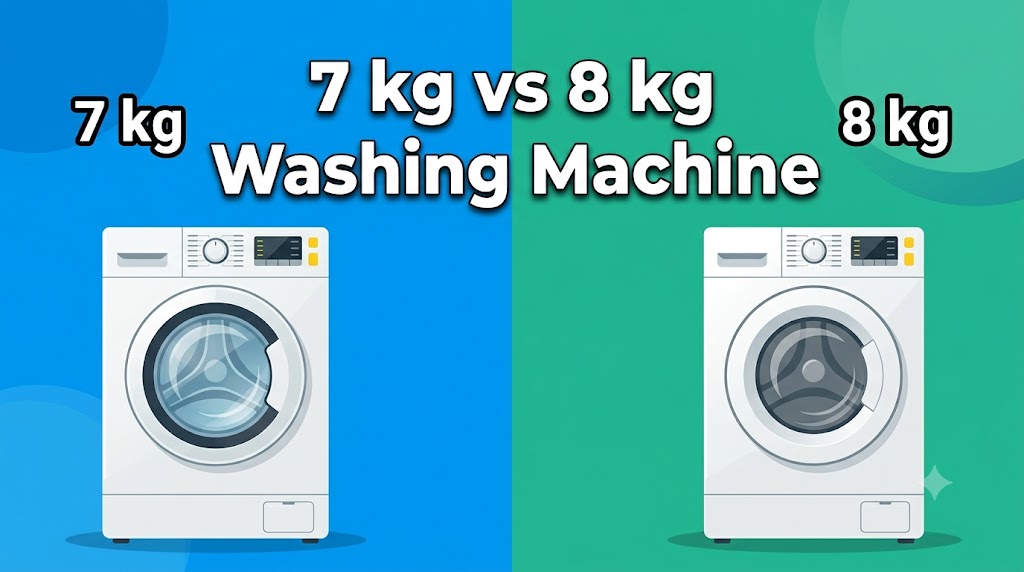
7 kg vs 8 kg Washing Machine
Introduction
Choosing between a 7 kg and an 8 kg washing machine depends on your household size, laundry habits, and the amount of clothing you wash in one cycle. Both capacities can handle regular household laundry, but an 8 kg washing machine can accommodate a larger load by weight. A 7 kg model may be sufficient for smaller households that wash clothes frequently, while an 8 kg model can offer greater flexibility for families with more laundry. The right choice depends on how much you wash, how often you use the machine, and the space available for installation.
Although the difference is only 1 kg, it can affect how you organise your laundry. A larger-capacity machine may allow you to wash more clothes in a single cycle, depending on the fabric type and manufacturer’s loading instructions. However, choosing a larger machine does not automatically mean lower electricity or water consumption. Actual consumption depends on the model, wash program, load size, and efficiency features. Comparing capacity, price, energy use, and practical requirements will help you select a washing machine that suits your household.
Quick Comparison Table
| Feature | 7 kg Washing Machine | 8 kg Washing Machine |
|---|---|---|
| Rated capacity | 7 kg of laundry | 8 kg of laundry |
| Best suited for | Smaller households | Small to medium households and larger laundry loads |
| Daily clothing | Suitable for regular laundry | Suitable for regular laundry with additional capacity |
| Bulky items | Depends on drum dimensions and item weight | Extra capacity may provide more flexibility |
| Number of wash cycles | Depends on laundry volume | May reduce cycles if you regularly wash larger loads |
| Water consumption | Depends on model and load | Depends on model and load |
| Electricity consumption | Depends on model and cycle | Depends on model and cycle |
| Purchase price | May be lower for comparable models | May be higher for comparable models |
| Space requirements | Depends on model dimensions | Depends on model dimensions |
| Main advantage | Sufficient capacity for smaller loads | Greater load capacity and flexibility |
1. Washing Capacity
7 kg Washing Machine
A 7 kg washing machine has a rated laundry capacity of 7 kg under the manufacturer’s specified conditions. It can be suitable for everyday clothing, such as shirts, trousers, undergarments, and other household garments.
For a household that washes small or moderate loads regularly, this capacity may be sufficient. However, bulky bedding can take up considerable drum space even when its weight is relatively low.
8 kg Washing Machine
An 8 kg washing machine has a rated capacity of 8 kg, giving it approximately 14.3% more rated capacity than a 7 kg model.
This additional capacity can help when you have more clothes to wash or prefer combining laundry into fewer loads. However, you must still follow the manufacturer’s loading recommendations for different fabrics and wash programs.
Verdict: An 8 kg washing machine is better if you regularly need the extra capacity. A 7 kg model is sufficient if your usual laundry loads fit comfortably within its limit.
2. Which Capacity Is Better for Your Family Size?
7 kg Washing Machine
A 7 kg model may suit a household of one to three people, particularly when laundry is washed frequently and loads are relatively small.
It can also work for a larger household that washes clothes daily rather than collecting several days of laundry.
8 kg Washing Machine
An 8 kg model may suit a household of three to five people, especially when several family members generate laundry every day.
It can also be useful for smaller households that prefer washing less frequently or regularly handle larger loads.
These household-size ranges are general guidelines, not strict rules. Clothing habits, work uniforms, children’s clothes, bedding, and washing frequency can change the capacity you need.
Verdict: Choose according to your actual laundry volume rather than family size alone.
3. Washing Bulky Clothes and Bedding
7 kg Washing Machine
A 7 kg machine can wash many ordinary clothing loads and some bedding, depending on the drum dimensions and manufacturer’s instructions. However, bulky blankets, large bedsheets, and comforters may require more room to move freely.
8 kg Washing Machine
An 8 kg model provides greater rated capacity and may offer more flexibility for larger loads. This can be useful for households that frequently wash bedsheets, towels, and other bulky items.
However, the capacity rating alone does not guarantee that a particular blanket or comforter will fit properly. Drum size and the item’s care instructions also matter.
Verdict: An 8 kg model is worth considering if you regularly wash bulky household laundry, provided the item fits within the manufacturer’s recommendations.
4. Water Consumption
7 kg Washing Machine
A 7 kg machine may use less water for some comparable wash cycles because of its smaller capacity. However, actual consumption varies according to the machine’s design, water-level settings, load sensing, and selected program.
8 kg Washing Machine
An 8 kg machine may use more water in certain cycles, but this is not guaranteed. Some models adjust water consumption according to the load and wash program.
If you frequently need two loads in a 7 kg machine but can wash the same laundry in one suitable 8 kg load, the larger machine could reduce total water use.
Verdict: Compare the published water consumption of specific models and consider how many cycles you normally run. Capacity alone does not determine which machine saves more water.
5. Electricity Consumption
7 kg Washing Machine
A 7 kg model may have lower electricity consumption in certain comparable situations, but the result depends on its motor, heating system, wash duration, spin speed, and energy-efficiency design.
8 kg Washing Machine
An 8 kg model can consume more electricity in some conditions, but a more efficient model may perform better than a less efficient 7 kg alternative.
If the larger machine allows you to combine laundry into fewer cycles, your total electricity use may also be affected.
Verdict: Compare energy-efficiency labels and consumption figures for the actual models. Do not assume that the smaller capacity always has the lowest running cost.
6. Purchase Price
7 kg Washing Machine
A 7 kg model may cost less than a comparable 8 kg model, making it an attractive option when purchase price is the main concern.
However, the price also depends on the brand, loading type, motor technology, wash programs, and additional features.
8 kg Washing Machine
An 8 kg model may cost more, but the difference varies considerably between brands and product ranges.
If you regularly need additional capacity, paying more for an 8 kg machine may be worthwhile. If you rarely fill a 7 kg machine, the extra capacity may not justify the additional cost.
Verdict: Compare models with similar features, warranty coverage, and efficiency ratings before deciding which offers better value.
7. Washing Time and Number of Cycles
7 kg Washing Machine
A 7 kg machine works well when your usual laundry fits within its recommended load. If you regularly have more laundry than it can accommodate, you may need to run additional cycles.
8 kg Washing Machine
An 8 kg machine can handle a larger rated load, which may help reduce the number of cycles when you have enough suitable laundry to fill it.
However, a larger capacity does not necessarily mean a shorter individual wash cycle. Cycle duration depends on the selected program and the machine’s operating settings.
Verdict: An 8 kg machine may be more convenient for larger weekly laundry loads, while a 7 kg machine can be adequate for smaller, frequent washes.
8. Space and Installation
7 kg Washing Machine
A 7 kg model may be compact, but its actual dimensions depend on the design. It can be a practical option when the installation area is limited.
8 kg Washing Machine
An 8 kg model may have a larger drum or a different overall design, but not every 8 kg machine occupies more floor space than every 7 kg model.
Before purchasing, measure the available width, depth, and height. Also allow sufficient room for water connections, drainage, ventilation where required, and opening the lid or door.
Verdict: Compare the actual dimensions rather than choosing based on capacity alone.
9. Which Washing Machine Should You Buy?
Choose a 7 kg washing machine if:
- You have a relatively small household and modest laundry requirements.
- You wash clothes frequently in smaller loads.
- You want to avoid paying for capacity you rarely use.
- A particular 7 kg model offers the features and efficiency you need.
Choose an 8 kg washing machine if:
- You regularly wash larger loads of clothing.
- Your household generates substantial daily or weekly laundry.
- You want additional flexibility for suitable bedding and bulky items.
- You expect the extra capacity to reduce the number of cycles you run.
Conclusion
A 7 kg washing machine can be a practical choice for smaller households and regular, modest laundry loads. An 8 kg washing machine offers approximately 14.3% more rated capacity, which can be useful for families with greater laundry requirements or people who prefer washing larger loads less frequently.
Neither capacity is automatically more economical. Your final decision should depend on your normal laundry volume, water and electricity consumption, available space, purchase budget, and the specifications of the individual models. If your laundry regularly approaches the 7 kg limit, an 8 kg machine may provide useful flexibility. Otherwise, a 7 kg machine may meet your needs perfectly well.
Disclaimer: Actual capacity suitability, prices, dimensions, energy consumption, water use, and cycle duration vary by model and usage. Check the manufacturer’s specifications and loading instructions before purchasing.