Top Load Agitator vs Impeller Washing Machine
Introduction
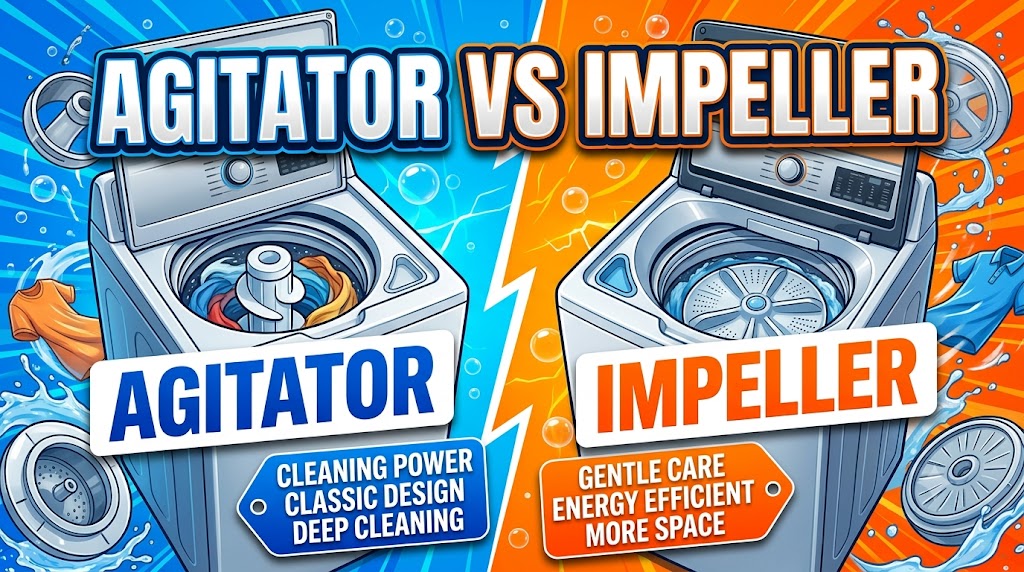
Choosing between a top load agitator and an impeller washing machine depends on your laundry habits, available space, and cleaning preferences. Both types load clothes from the top and use water and detergent to clean them, but their washing mechanisms are different. An agitator machine uses a central post that moves clothes through the wash water, while an impeller machine uses a low-profile plate or disc at the bottom of the drum to create water movement and move clothes against one another.
The main difference between these two washing machine designs is how they move clothes during a wash cycle. Agitator models may appeal to households that prefer traditional washing action, while impeller models often provide more open space inside the drum for bulky laundry. However, cleaning performance, water consumption, fabric care, and cycle duration depend on the individual model. Understanding these differences can help you choose a washing machine that suits your regular laundry needs rather than relying on the design alone.
Quick Comparison Table
| Feature | Top Load Agitator | Top Load Impeller |
|---|---|---|
| Washing mechanism | Central rotating or moving post | Low-profile plate or disc |
| Drum space | Central post occupies some space | More open space inside the drum |
| Cleaning action | Clothes move around the agitator | Clothes move through water and against each other |
| Fabric care | Depends on the agitator design and cycle | Can provide gentler washing, depending on the model |
| Bulky laundry | Central post may limit loading space | Open drum can make loading bulky items easier |
| Water consumption | Varies by model and cycle | Varies by model and cycle |
| Washing performance | Depends on design, load, and settings | Depends on design, load, and settings |
| Price | Depends on brand and features | Depends on brand and features |
| Best suited for | People who prefer traditional agitator washing | People who prefer an open drum design |
1. Washing Mechanism
Top Load Agitator Washing Machine
An agitator washing machine has a central post inside the drum. During the wash cycle, the post moves back and forth or rotates according to the machine’s design. This action moves clothes through the water and helps loosen dirt.
The central agitator creates a more direct mechanical washing action. However, the results depend on the wash program, detergent, load size, and the specific agitator design.
Top Load Impeller Washing Machine
An impeller washing machine uses a low-profile plate or disc at the bottom of the drum. It creates water movement and helps clothes move against one another during washing.
Because there is no tall central post, the drum has more open space. This design can make it easier to load larger items, although the actual capacity and drum dimensions still matter.
Verdict: An agitator is suitable for people who prefer a central-post washing mechanism, while an impeller is worth considering if you want more open space inside the drum.
2. Cleaning Performance
Agitator
The agitator creates direct movement within the laundry load. This can help remove everyday dirt and stains, depending on the wash cycle and machine design.
However, an agitator does not automatically guarantee better cleaning. Overloading the drum or choosing an unsuitable cycle can affect the results.
Impeller
An impeller relies on water movement and interaction between clothes to help clean the laundry. Its performance depends on how effectively the machine circulates water and moves the load.
Some impeller models clean everyday clothing effectively, but heavily soiled garments may require a suitable cycle, stain treatment, or longer washing time.
Verdict: Neither design is always better at cleaning. Compare independent performance information and the available wash programs for the specific models you are considering.
3. Fabric Care
Agitator
The central post creates direct contact and movement within the load. Depending on its shape, movement, and selected cycle, this may increase mechanical action on some garments.
Delicate fabrics should be washed using the appropriate cycle and care-label instructions.
Impeller
Many impeller machines offer a less obstructed washing space and may provide gentler washing action on suitable settings. However, an impeller is not automatically gentler than every agitator model.
Fabric care depends on the machine’s design, load size, wash settings, and the type of clothing being washed.
Verdict: If you frequently wash delicate garments, compare the available gentle cycles and fabric-care guidance instead of choosing by mechanism alone.
4. Drum Space and Bulky Laundry
Agitator
The central post takes up some of the available drum space. This can make it less convenient to arrange bulky items such as large blankets or comforters.
The machine may still accommodate bulky laundry if its rated capacity and drum dimensions allow it.
Impeller
The low-profile washing plate leaves more of the drum unobstructed. This can make loading and arranging bulky garments easier.
However, the stated capacity does not guarantee that every blanket or comforter will fit comfortably. Always check the manufacturer’s loading instructions.
Verdict: An impeller is often the more convenient design when an open drum is important, particularly for bulky laundry.
5. Water and Energy Consumption
Agitator
Water and electricity consumption depend on the machine’s efficiency, selected cycle, load size, and available water-level settings. Some models use more water than others, so the mechanism alone does not establish operating cost.
Impeller
Impeller machines may use different water levels and wash patterns depending on their design. Some models can be efficient, but an impeller does not guarantee lower water or electricity consumption.
For a meaningful comparison, check the manufacturer’s energy information, water-use specifications, and applicable efficiency labels.
Verdict: Choose the model with better verified efficiency figures for your normal laundry loads rather than assuming that either mechanism always saves more water or electricity.
6. Washing Time
Agitator
Some agitator models offer relatively straightforward wash cycles, but the total time depends on the program, water level, load sensing, and machine settings.
Impeller
Impeller models may use different wash patterns and cycle durations. Some programs can take longer to complete, especially when the machine adjusts its operation for the load.
Verdict: Neither design is consistently faster. Compare the actual cycle durations of the models you are considering.
7. Price and Maintenance
Agitator
The price depends on the brand, capacity, motor, controls, and additional features. Maintenance requirements also vary by model.
Impeller
Impeller washing machines are available at different price levels. Their cost and maintenance requirements depend on the construction, motor, components, and warranty.
In either case, check the warranty coverage, service availability in your area, and the cost of commonly replaced parts before purchasing.
Verdict: There is no universal price or maintenance winner. Compare similarly sized models with similar features and warranty coverage.
8. Which Washing Machine Should You Choose?
Choose a top load agitator washing machine if:
- You prefer the traditional central-post washing mechanism.
- You want a model whose cleaning performance suits your everyday laundry.
- You have compared its capacity, wash programs, and efficiency with alternatives.
Choose a top load impeller washing machine if:
- You prefer a drum with more open space.
- You frequently load bulky clothing or bedding that fits within the machine’s specifications.
- You want to compare models that offer suitable fabric-care and efficiency features.
Conclusion
A top load agitator washing machine and a top load impeller washing machine can both be good choices. An agitator provides a central-post washing mechanism, while an impeller offers a more open drum that can be convenient for loading larger items. Neither design is automatically superior in cleaning performance, fabric care, water consumption, or operating cost.
Before buying, compare the specific models for washing performance, capacity, energy and water efficiency, cycle duration, warranty, and local service support. The better choice is the machine that meets your household’s laundry needs and provides reliable performance within your budget.
Disclaimer: Washing performance, water and electricity consumption, cycle duration, fabric care, prices, and maintenance requirements vary by model, brand, and usage. Check the manufacturer’s specifications and care instructions before purchasing.