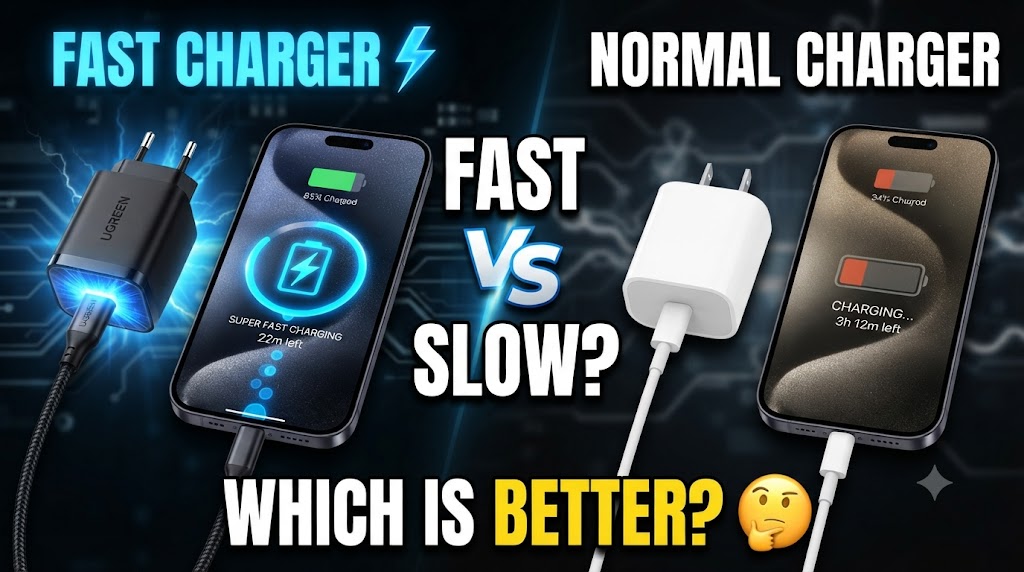
Fast Charger vs Normal Charger
A fast charger vs normal charger comparison is useful when deciding whether faster charging is worth choosing over a standard charging option. Both chargers can recharge compatible devices, but they may differ in power output, charging technology, charging time, and compatibility. A fast charger is designed to deliver higher power when the device and cable support the required charging standard. A normal charger generally provides lower power and may take longer to recharge the same device.
In this fast charger vs normal charger comparison, we will compare charging speed, power output, compatibility, convenience, heat, battery considerations, cost, and everyday use. This will help you decide which charger is more suitable for your smartphone, tablet, or other compatible device.
Quick Comparison Table
| Feature | Fast Charger | Normal Charger |
|---|---|---|
| Charging speed | Usually faster | Usually slower |
| Power output | Generally higher | Generally lower |
| Charging technology | Supports fast-charging standards | Usually uses standard charging |
| Charging time | Shorter with compatible devices | Longer |
| Compatibility | Requires device and cable support for full benefit | Generally works with compatible basic charging |
| Convenience | Better when time is limited | Suitable for routine charging |
| Heat generation | Can produce more heat during higher-power charging | Generally lower charging power |
| Battery impact | Depends on device and charging system | Depends on device and charging system |
| Price | Often more expensive | Often more affordable |
| Best for | Quick charging | Basic everyday charging |
Fast Charger vs Normal Charger: Main Difference
The main difference is charging power and the technology used to deliver that power.
A fast charger can provide higher power when the connected device supports the relevant fast-charging technology. The phone and charger communicate to determine an appropriate charging level.
A normal charger generally provides lower power. As a result, charging can take longer, especially when the device has a large battery.
Winner: Fast Charger for charging speed.
However, faster does not automatically mean better for every situation. If you normally charge your phone overnight, a normal charger may already meet your needs.
Charging Speed
Charging speed is the biggest advantage of a fast charger.
A compatible fast charger can significantly reduce the time required to recharge a device compared with a lower-power charger. However, the actual speed depends on several factors.
These include:
- Charger power output
- Device charging capability
- Charging protocol
- Cable capability
- Battery temperature
- Current battery level
- Manufacturer-specific charging technology
Therefore, buying a high-wattage charger does not guarantee that every phone will charge at that wattage.
Winner: Fast Charger.
Power Output
Fast chargers generally offer higher power output than normal chargers.
For example, a fast charger may support USB Power Delivery or another charging standard that allows compatible devices to request higher power.
A normal charger may provide enough power for basic charging but may not support the higher power levels required for rapid charging.
Always check the charger’s rated output rather than relying only on the word “fast” in the product description.
Winner: Fast Charger.
Device Compatibility
Compatibility is important when choosing a fast charger.
A fast charger works at its full supported capability only when the device and cable also support the necessary charging technology.
If your phone supports a particular fast-charging standard but your charger does not, the phone may charge at a lower speed.
Similarly, using a cable that does not support the required power level can limit charging performance.
Winner: Depends on your devices and accessories.
Charging Time
A fast charger can be especially useful when you have limited time.
For example, if you need to leave home soon and your phone battery is low, faster charging can provide more usable battery power in a shorter period.
A normal charger may be perfectly adequate when there is plenty of time available.
Winner: Fast Charger.
Heat During Charging
Higher charging power can generate more heat, although modern devices and chargers use charging controls to manage power and temperature.
Actual heat depends on the device, charger, cable, environment, battery condition, and charging technology.
A normal charger operates at lower power in many cases, which can result in less heat during charging.
However, this does not mean that every fast charger will become excessively hot or that every normal charger will remain cool.
Winner: Depends on the specific charger and charging conditions.
Does Fast Charging Damage the Battery?
Fast charging does not automatically mean that a battery will be damaged.
Modern smartphones generally use charging-management systems designed to regulate power, temperature, and charging behavior.
Battery aging is affected by multiple factors, including temperature, charging patterns, battery chemistry, and the amount of time the battery spends at high charge levels.
Therefore, using a compatible charger from a reputable manufacturer is more important than simply avoiding fast charging.
Winner: Tie.
Both can be suitable when used with compatible devices and appropriate chargers.
Convenience
Fast charging offers a clear advantage when you need your device ready quickly.
It can be particularly useful for people who frequently forget to charge their phones, travel often, or need to recharge during short breaks.
Normal charging is still convenient when the device can remain connected for longer periods.
Winner: Fast Charger.
Cost
Normal chargers are often available at lower prices because they may have lower power output and fewer advanced charging capabilities.
Fast chargers can cost more, particularly when they support higher power levels, USB Power Delivery, multiple ports, or advanced charging technologies.
However, the cheapest charger is not necessarily the best option. Safety certifications, build quality, compatibility, and power specifications should also be considered.
Winner: Normal Charger for lower initial cost.
Which Is Better for Overnight Charging?
If you normally charge your phone overnight, charging speed may be less important.
A normal charger can provide enough time to recharge the device while you sleep. A fast charger can also be used if it is compatible with the device, but its main advantage of saving time may not matter when the phone is connected for several hours.
Modern smartphones also use charging-management features to control charging behavior.
Winner: Normal Charger for simple overnight charging.
Which Is Better for Travel?
A fast charger can be more useful during travel because charging opportunities may be limited.
When you have only a short time at an airport, hotel, café, or other location, faster charging can help you restore battery power more quickly.
A compact fast charger with suitable ports can also reduce the need to carry separate chargers for compatible devices.
Winner: Fast Charger.
Fast Charger vs Normal Charger: Which Should You Buy?
Choose a fast charger if:
- You often need to recharge your phone quickly.
- You have a compatible smartphone or tablet.
- You travel frequently.
- You want to reduce charging time.
- Your device supports a modern fast-charging standard.
- You want a charger that can potentially support higher-power devices.
Choose a normal charger if:
- You usually charge your device overnight.
- You do not need rapid charging.
- Your device does not support higher charging speeds.
- You want a simpler and potentially cheaper charging solution.
- Charging time is not an important concern.
Fast Charger vs Normal Charger: Which Is Better?
For most modern smartphone users, a fast charger is the better choice because it provides greater flexibility when charging time is limited.
However, a normal charger can still be the better option for people who usually charge their devices for several hours and do not need rapid charging.
The important point is to match the charger with your device. A high-wattage charger cannot automatically make a device charge faster than the charging limits supported by the device.
Final Verdict
In the fast charger vs normal charger comparison, the fast charger wins for speed, convenience, and travel, while a normal charger can be sufficient for routine charging and may cost less.
If your phone supports fast charging, buying a compatible fast charger from a reputable manufacturer is generally the more versatile choice. If you mainly charge your device overnight and want a basic charging solution, a normal charger may be all you need.
Disclaimer
Charging speed, power output, heat, compatibility, and supported charging standards can vary by device, charger, cable, manufacturer, and charging conditions. Always use a compatible charger and cable and follow the manufacturer’s charging recommendations.