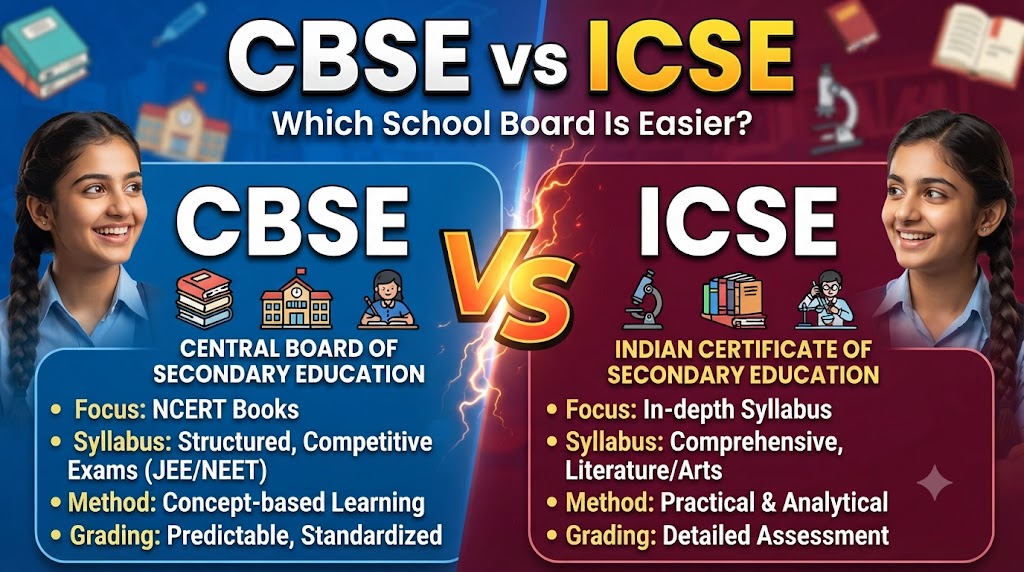
CBSE vs ICSE
Introduction
Choosing between CBSE and ICSE is an important decision for parents and students in India. Both are established school education systems, but they differ in curriculum structure, subject coverage, assessment patterns, and learning approach. CBSE is administered by the Central Board of Secondary Education, while ICSE refers to the Class 10 examination conducted by the Council for the Indian School Certificate Examinations (CISCE). Understanding these differences can help families decide which board’s academic structure may be more manageable for a particular student.
The word “easier” can mean different things for different students. A student who prefers a more structured syllabus may find one system more comfortable, while another student may prefer broader subject coverage and more detailed learning. The difficulty can also vary according to the school, teachers, subjects, and student’s study habits. Therefore, comparing the curriculum, workload, examinations, languages, and future education plans gives a more useful picture than simply calling one board easier.
Quick Comparison Table
| Feature | CBSE | ICSE |
|---|---|---|
| Board | Central Board of Secondary Education | Council for the Indian School Certificate Examinations |
| Class 10 Examination | CBSE Board Examination | ICSE Examination |
| Curriculum Style | Structured and focused | Broad and detailed |
| Subject Coverage | Generally more streamlined | Generally broader |
| English | Important subject | Strong emphasis on English |
| Assessment | Board exams with school-based assessment | Board exams with internal assessment components |
| Indian Competitive Exams | Widely used academic pathway | Students can also prepare with additional planning |
| School Availability | Very widespread in India | Available in many parts of India |
| Difficulty | Depends on student and subject | Depends on student and subject |
| Best Choice | Depends on learning style and future plans | Depends on learning style and future plans |
Curriculum Structure
CBSE
CBSE provides a structured curriculum covering core academic subjects. The syllabus is designed to provide a relatively focused academic pathway and is widely followed by schools throughout India.
Students who prefer studying a clearly structured syllabus may find this approach easier to organize.
ICSE
ICSE has a broader curriculum with greater emphasis on detailed subject learning. Students may encounter a wider range of topics and, depending on their subject choices, a relatively extensive academic workload.
Students who enjoy reading, writing, and studying subjects in greater detail may be comfortable with this approach.
Easier depends on the student: A focused curriculum may feel easier for some students, while broader subject coverage may suit others.
Syllabus and Subject Load
CBSE generally has a more streamlined academic structure. This can make it easier for students to organize their preparation, particularly when several subjects need to be managed together.
ICSE is known for broader subject coverage and detailed content. This can require students to spend more time across different subjects.
For students who prefer a more focused workload: CBSE may feel easier.
However, this is not a universal rule because individual subjects can differ significantly in difficulty.
English and Language Learning
English is important in both systems, but ICSE has traditionally placed strong emphasis on English language and literature.
Students who enjoy reading, writing, grammar, and detailed language studies may find ICSE comfortable.
CBSE also provides English language and literature education, but students may experience differences in the depth and structure of the curriculum.
Easier depends on the student’s strengths.
Mathematics
Both boards teach mathematics through structured syllabi, but the exact content and assessment approach can differ.
Students preparing for mathematics-heavy competitive examinations may also consider how their school curriculum fits with their additional preparation.
Rather than assuming that one board’s mathematics is always easier, students should compare the current syllabus and sample papers for their specific class.
Tie: The difficulty depends largely on the student’s mathematical foundation and preparation.
Science
Both CBSE and ICSE provide science education, but the depth and organization of topics can differ.
CBSE provides a structured science curriculum that can give students a clear academic foundation.
ICSE can involve detailed treatment of scientific concepts and may require students to manage a broader academic workload.
Easier depends on the student: Students who prefer concise and structured preparation may find CBSE more manageable, while students comfortable with detailed study may adapt well to ICSE.
Examinations and Assessment
CBSE and ICSE both use examinations along with school-based assessment components, but their assessment structures and subject requirements differ.
Students should look at the current examination pattern rather than relying only on general comparisons because boards can update their assessment policies.
Easier: Depends. A student’s familiarity with the question format and regular preparation can have a significant effect on perceived difficulty.
Competitive Exams in India
CBSE is widely used across India, and many students studying under CBSE also prepare for competitive examinations such as JEE and NEET.
ICSE students can also prepare for these examinations. However, they may need to supplement their school studies with preparation specifically targeted toward the relevant entrance-exam syllabus.
For students planning extensive Indian competitive-exam preparation, CBSE can provide a more familiar academic pathway.
School Availability
CBSE schools are widely available across India, including many cities and smaller towns.
ICSE schools are also available throughout India, but the number and distribution of schools can vary by location.
Winner: CBSE for wider availability.
Which Board Is Easier?
There is no universally easier board for every student.
CBSE may feel easier for students who prefer:
- A more structured curriculum
- Focused academic preparation
- A familiar pathway for Indian competitive examinations
- A large number of schools across India
ICSE may suit students who prefer:
- Broader subject coverage
- Detailed academic study
- Strong English and language learning
- A curriculum with wider subject exposure
The student’s learning style, strengths, study habits, school quality, and future plans are more important than simply choosing a board based on the word “easier.”
Conclusion
CBSE and ICSE have different curriculum structures and academic requirements, so the experience of difficulty can vary from one student to another. CBSE may be more manageable for students who prefer a structured and focused syllabus, while ICSE may suit students who are comfortable with broader and more detailed academic study.
Before choosing a board, parents should compare the current syllabus, subjects, assessment pattern, school quality, fees, location, and the student’s future education plans. The better fit depends on the individual student rather than a universal definition of which board is easier.
Disclaimer
Curriculum, examination patterns, assessment rules, admission requirements, and school policies can change over time. Always check the latest information from CBSE, CISCE, and the specific school before making an educational decision.