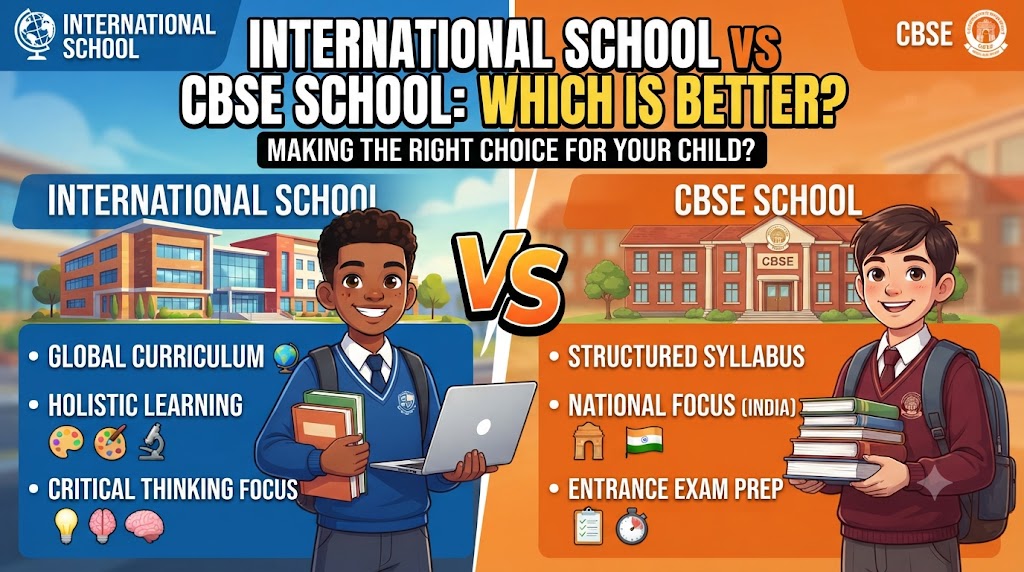
International School vs CBSE School
Introduction
Choosing between an international school and a CBSE school can affect a child’s learning style, academic path, and future education options. International schools generally follow international curricula such as IB, Cambridge, or other globally recognized programs, while CBSE schools follow the curriculum prescribed by the Central Board of Secondary Education in India. The two types of schools can differ in teaching methods, assessment patterns, subjects, fees, and opportunities. Understanding these differences can help parents choose a school that matches their child’s educational needs and future plans.
CBSE schools are widely available across India and provide a structured curriculum that is commonly used for Indian competitive and higher-education pathways. International schools may offer more curriculum choices, broader international exposure, and teaching approaches that emphasize inquiry, projects, or skills depending on the specific curriculum. However, not every international school follows the same program, and school quality can vary within both categories. Therefore, the right choice depends on factors such as curriculum, location, budget, learning style, and the child’s future education plans.
Quick Comparison Table
| Feature | International School | CBSE School |
|---|---|---|
| Curriculum | Depends on the international board, such as IB or Cambridge | CBSE curriculum |
| Main Focus | Can emphasize inquiry, projects, skills, and international perspectives | Structured academic curriculum with strong focus on core subjects |
| Recognition | Internationally recognized depending on the board | Widely recognized in India |
| Teaching Style | Often more activity-, inquiry-, or project-based, depending on curriculum | Generally structured and syllabus-oriented |
| Competitive Exams in India | Depends on curriculum and school preparation | Curriculum is closely aligned with many Indian academic pathways |
| International Education | Can provide a more direct international curriculum pathway | Students can also apply to international universities |
| School Availability | More concentrated in major cities and selected locations | Widely available across India |
| Fees | Often higher, but varies considerably | Varies widely and is often available across different fee levels |
| Best Suited For | Families seeking a particular international curriculum or global education environment | Families seeking the CBSE curriculum and a widely available Indian school pathway |
Curriculum
International School
An international school does not necessarily follow one single curriculum. Depending on the school, students may study programs such as the International Baccalaureate (IB), Cambridge International, or another international curriculum.
These curricula can place significant emphasis on concepts, independent learning, projects, research, and application of knowledge. However, the actual approach depends on the curriculum and the individual school.
CBSE School
CBSE schools follow the curriculum prescribed by the Central Board of Secondary Education. The curriculum provides structured learning across subjects and is used by a large number of schools in India.
For families who want their child’s education to follow the CBSE system, a CBSE school provides a straightforward pathway within the Indian school education system.
Better depends on your goal: An international curriculum may suit families specifically seeking an international education model, while CBSE may suit families wanting the established Indian CBSE pathway.
Teaching and Learning Style
International schools may use inquiry-based learning, projects, discussions, presentations, and practical activities, depending on their curriculum.
CBSE schools can also use activities, projects, practical work, and modern teaching methods, but the overall academic structure remains connected to the CBSE curriculum and assessment requirements.
Winner: Depends. The actual classroom experience depends heavily on the individual school and teachers rather than the school category alone.
Academic Assessment
Assessment in international schools varies according to the curriculum. Some international programs use a combination of coursework, projects, practical activities, and examinations.
CBSE students are assessed through school-based assessments and board examinations at the relevant stages. The assessment structure is more standardized within the CBSE system.
Winner: Depends. Students who prefer different forms of assessment may find one system more suitable than the other.
Indian Competitive Exams
For students planning to prepare for Indian competitive examinations, CBSE can provide a familiar academic foundation because of its widespread use and alignment with the Indian education system.
Students from international curricula can also prepare for Indian competitive examinations, but they may need to become familiar with the specific syllabus and examination requirements.
Winner: CBSE for a straightforward Indian academic pathway.
International University Options
International schools offering globally recognized curricula can provide an educational pathway that is familiar to universities in different countries.
However, studying in a CBSE school does not prevent students from applying to universities outside India. CBSE qualifications are recognized by universities internationally, although admission requirements vary by institution and country.
Winner: Depends. The curriculum, student’s academic record, chosen university, and admission requirements all matter.
Availability of Schools
CBSE schools are widely available across India, including smaller cities and towns. This can make it easier for families to find a CBSE school after relocation.
International schools are available in many Indian cities, but their availability is generally more limited and depends on the particular curriculum and location.
Winner: CBSE for wider availability across India.
Fees
School fees vary significantly in both categories.
International schools can have substantially higher fees because of their curriculum, facilities, infrastructure, activities, and other services. However, not every international school has the same fee structure.
CBSE schools range from relatively affordable schools to expensive private schools. Therefore, the CBSE label alone does not determine the total cost.
Winner: Depends on the individual school and family budget.
Transfer Between Schools
Moving between schools can be easier when the curriculum is similar. A child moving from one CBSE school to another may find the curriculum structure familiar.
Moving between different international curricula or between an international curriculum and CBSE can require adjustment because subjects, content, teaching methods, and assessment systems may differ.
Winner: CBSE for easier movement within the same Indian school system.
Which Is Better for Your Child?
There is no single answer for every family.
An international school may be suitable if you are specifically looking for an international curriculum, a particular teaching approach, or an education environment connected to overseas study plans.
A CBSE school may be suitable if you want the CBSE curriculum, wider school availability, and a familiar Indian academic pathway, particularly if the child may later pursue education or competitive examinations within India.
The individual school’s teachers, academic results, facilities, student support, fees, distance from home, and curriculum implementation should also be considered before making a decision.
Conclusion
International schools and CBSE schools offer different educational pathways. International schools can provide access to globally oriented curricula and, depending on the program, greater emphasis on inquiry, projects, and independent learning. CBSE schools provide a structured Indian curriculum that is widely available and familiar to students pursuing education in India.
Instead of choosing only by the school label, parents should compare the specific curriculum, teaching quality, fees, location, assessment system, and the child’s future education plans. The better option depends on what fits the child’s learning needs and the family’s long-term educational goals.
Disclaimer
School curricula, admission requirements, fees, assessment policies, and facilities can vary between schools and may change over time. Always check the latest information directly with the school and the relevant education board before making an admission decision.