Bluetooth Tracker vs GPS Tracker
Introduction
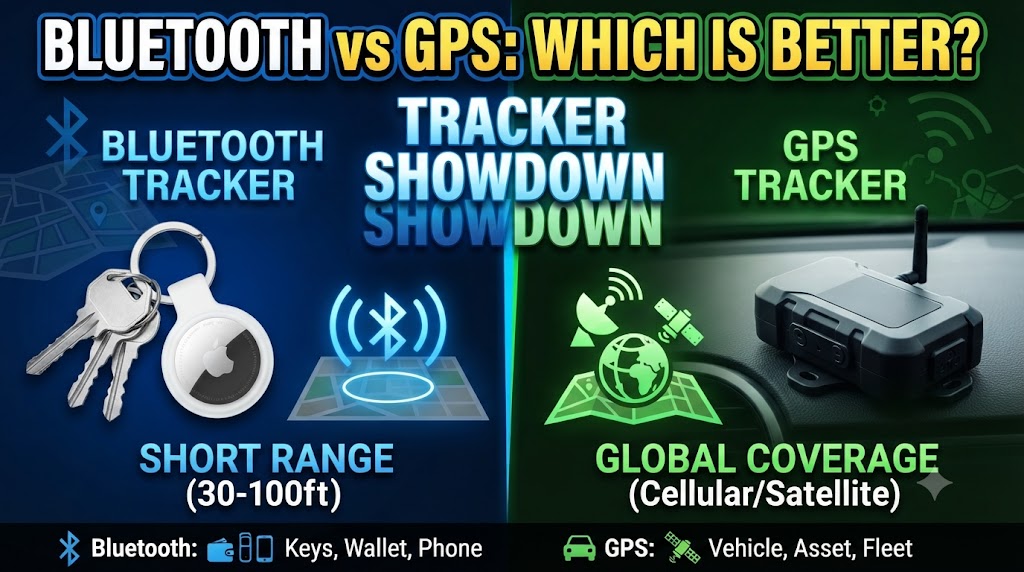
Bluetooth trackers and GPS trackers are both designed to help locate objects or assets, but they use different technologies. A Bluetooth tracker typically communicates with a nearby smartphone or uses a compatible device network to help determine the location of the tracked item. A GPS tracker uses satellite positioning and, in many products, a cellular connection to report its location over a wider area.
The main difference is range and how location information is obtained. Bluetooth trackers are generally suited to everyday items such as keys, bags, wallets, and luggage, particularly when the item is within Bluetooth range or can be detected through a compatible finding network. GPS trackers are designed for wider-area tracking and can be useful for vehicles, equipment, or other assets that need location information beyond normal Bluetooth range. The better choice depends on what you want to track and how frequently you need location updates.
Quick Comparison Table
| Feature | Bluetooth Tracker | GPS Tracker |
|---|---|---|
| Main technology | Bluetooth | GPS + communication network |
| Typical range | Short range directly; wider through compatible networks | Wide-area tracking |
| Internet/cellular connection | Not usually required for basic Bluetooth detection | Often required for remote tracking |
| Real-time tracking | Usually limited | Common on supported models |
| Battery life | Often long | Usually shorter |
| Size | Generally very compact | Varies by model |
| Subscription | Often no recurring fee | Some models require a subscription |
| Best for | Keys, wallets, bags, luggage | Vehicles, equipment, assets |
| Indoor finding | Can be useful nearby | GPS can be limited indoors |
| Long-distance tracking | Depends on finding network | Designed for wide-area tracking |
Bluetooth Tracker vs GPS Tracker: How Do They Work?
How Does a Bluetooth Tracker Work?
A Bluetooth tracker communicates wirelessly with nearby compatible devices.
When the tracker is within Bluetooth range, a smartphone or compatible device can communicate directly with it. Some Bluetooth tracking systems can also use a broader network of participating devices to help report the approximate location of a lost tracker.
This makes Bluetooth trackers particularly useful for small personal belongings.
How Does a GPS Tracker Work?
A GPS tracker uses signals from navigation satellites to determine its position. A compatible communication method, commonly cellular connectivity, can then send the location information to an app or tracking service.
Because the system can communicate over much greater distances, GPS trackers are commonly used for vehicles, equipment, and other assets that may move beyond Bluetooth range.
Tracking Range
Winner: GPS Tracker
GPS trackers are designed for wide-area tracking. A compatible GPS tracker can report its location even when it is far away from the person monitoring it, provided the tracker has the required satellite visibility and communication connectivity.
A Bluetooth tracker has a much shorter direct communication range. However, some Bluetooth tracker ecosystems can use nearby participating devices to help locate a tracker beyond direct Bluetooth range.
Practical meaning: For an item that may travel far away from you, GPS-based tracking is generally designed for wider-area location monitoring.
Indoor Tracking
Winner: Depends
GPS signals can be weaker or unavailable indoors, particularly inside buildings with limited satellite visibility.
Bluetooth trackers can be useful for locating nearby items indoors because a smartphone can communicate directly with the tracker when it is within range.
Some modern finding systems also use additional technologies, such as ultra-wideband on compatible devices, to provide more precise nearby finding.
Real-Time Tracking
Winner: GPS Tracker
Many GPS trackers are designed to provide periodic or near-real-time location updates through a mobile application.
Bluetooth trackers generally focus on helping locate personal items rather than continuously reporting their position.
However, Bluetooth finding networks can update the approximate location of a lost item when compatible devices detect the tracker.
The actual update frequency depends on the specific product and service.
Battery Life
Winner: Bluetooth Tracker
Bluetooth trackers often use small batteries designed to last for months or longer, depending on the model and usage.
GPS trackers generally consume more power because they may use satellite positioning and cellular or other communication systems. Their battery life can therefore be shorter, particularly when frequent location updates are enabled.
Some GPS trackers have larger rechargeable batteries to compensate for higher power consumption.
Subscription Cost
Winner: Bluetooth Tracker — generally
Many Bluetooth trackers do not require a monthly cellular tracking subscription for their basic finding functions.
GPS trackers that use cellular networks often require a subscription or data plan to transmit location information.
However, the exact cost structure varies by manufacturer and product.
Before purchasing a GPS tracker, check whether a recurring subscription is required.
Size and Portability
Winner: Bluetooth Tracker
Bluetooth trackers are commonly designed to be small enough to attach to keys, wallets, bags, luggage, and other personal belongings.
GPS trackers vary significantly in size. Some are compact, while others are larger because they contain a bigger battery and additional communication hardware.
For small everyday objects, a Bluetooth tracker is usually easier to carry.
Vehicle Tracking
Winner: GPS Tracker
GPS trackers are generally more suitable for vehicles because they can provide location information over a wide geographic area.
Depending on the model, a vehicle GPS tracker may provide location updates, movement information, and other tracking features.
A Bluetooth tracker can help locate a vehicle if it is detected by a compatible nearby device network, but it is not designed to provide the same type of continuous vehicle tracking.
Tracking Keys, Wallets, and Bags
Winner: Bluetooth Tracker
Bluetooth trackers are particularly suited to small personal belongings.
They can be attached to or placed inside items such as:
- Keys
- Wallets
- Backpacks
- Luggage
- Camera bags
- Personal accessories
Their small size and long battery life make them convenient for everyday item finding.
Tracking Equipment and Assets
Winner: GPS Tracker
GPS trackers can be more suitable for equipment and assets that move across larger areas.
For example, depending on the product and intended use, they can be used for vehicles, machinery, trailers, or other valuable equipment.
The appropriate tracker depends on the asset, installation requirements, battery availability, network coverage, and tracking needs.
Accuracy
Depends
GPS can provide geographic positioning using satellite signals, but accuracy can be affected by buildings, obstructions, atmospheric conditions, and the quality of the tracker.
Bluetooth tracking can be useful for determining whether an item is nearby, while some compatible systems can provide more precise short-range finding using additional technologies.
Therefore, the most useful technology depends on whether you need broad geographic location or nearby item finding.
Network Dependence
Depends
A basic Bluetooth tracker can communicate directly with a nearby phone without needing its own cellular connection.
Some Bluetooth finding systems rely on a network of compatible nearby devices to update the approximate location of a lost tracker.
GPS trackers that provide remote location updates commonly depend on cellular or another communication network to transmit their position.
If network coverage is unavailable, remote GPS tracking may be limited.
Privacy Considerations
Depends on the Product and Use
Both types of trackers can involve location-related data, so privacy settings and account security are important.
Bluetooth tracker manufacturers may provide features designed to reduce unwanted tracking and alert people when an unknown tracker appears to be moving with them.
GPS tracking services may store location information in an associated app or online account.
Before purchasing, review the manufacturer’s privacy policy, account-security options, tracking alerts, and data-handling practices.
Bluetooth Tracker vs GPS Tracker: Pros and Cons
Bluetooth Tracker
Pros
- Small and lightweight
- Usually long battery life
- Often no monthly subscription for basic use
- Useful for keys, wallets, bags, and luggage
- Simple to carry
- Can use compatible finding networks for lost-item location
Cons
- Limited direct Bluetooth range
- Not designed for continuous wide-area tracking
- Location updates can depend on nearby compatible devices
- Less suitable for vehicle tracking
GPS Tracker
Pros
- Designed for wide-area tracking
- Useful for vehicles and equipment
- Can provide remote location updates
- Suitable for movement monitoring on supported models
- Can provide more frequent location information
Cons
- Often requires more power
- Some products require a recurring subscription
- Can be larger than Bluetooth trackers
- GPS performance can be limited indoors or where satellite signals are obstructed
- Cellular coverage may be required for remote reporting
Which Is Better for Different Users?
Bluetooth Tracker Is Better For:
- People who frequently lose keys
- Wallet and bag tracking
- Luggage tracking
- Everyday personal belongings
- Users wanting long battery life
- People who prefer a small tracking device
- Users who do not need continuous remote tracking
GPS Tracker Is Better For:
- Vehicle owners
- Equipment tracking
- Asset monitoring
- Users needing wide-area location information
- People who need more frequent location updates
- Situations where the tracked object can move far away
Bluetooth Tracker vs GPS Tracker: Which Is Better?
Overall Choice: Depends on What You Need to Track
A Bluetooth tracker is more suitable for everyday belongings such as keys, wallets, bags, and luggage. It is generally compact, power-efficient, and convenient for nearby finding or compatible device-network-based location finding.
A GPS tracker is more suitable when you need wider-area location monitoring for vehicles, equipment, or other assets. It can provide remote location updates, but it may require more power, network connectivity, and sometimes a recurring subscription.
So, choose a Bluetooth tracker for everyday item finding and a GPS tracker when wide-area or remote tracking is the main requirement.
Disclaimer
Tracking range, location accuracy, battery life, network requirements, subscription fees, and available features vary by product and manufacturer. Bluetooth finding networks depend on compatible nearby devices, while GPS trackers may depend on satellite visibility and cellular or other communication coverage. Always check the product’s specifications, privacy features, service requirements, and applicable laws before purchasing or using a tracker.