Wi-Fi Extender vs Mesh Wi-Fi
Introduction
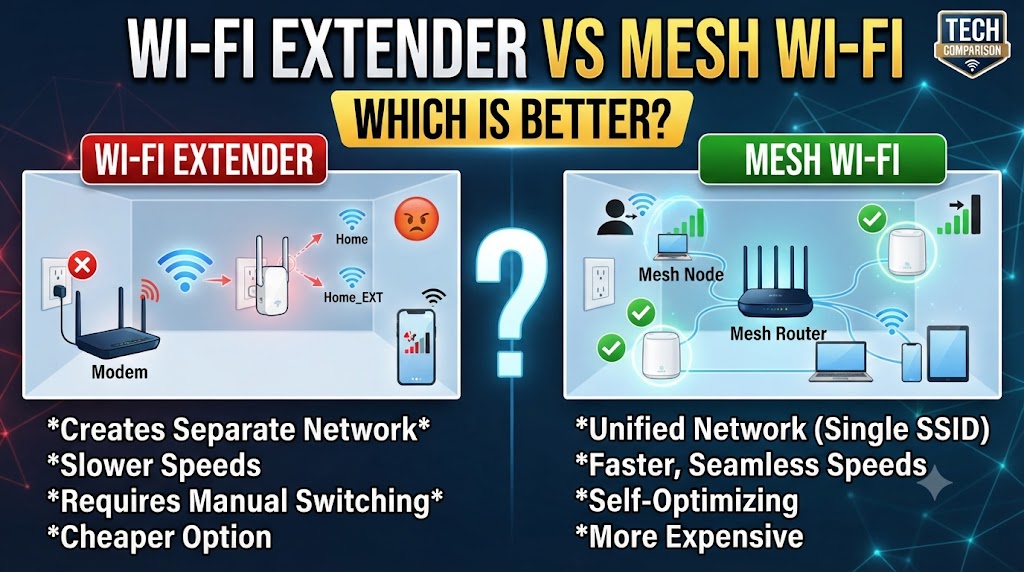
When a single router cannot provide reliable Wi-Fi throughout your home or office, you may consider a Wi-Fi Extender vs Mesh Wi-Fi solution. Both can improve wireless coverage, but they work differently. A Wi-Fi extender receives an existing wireless signal and retransmits it, while a mesh Wi-Fi system uses multiple coordinated units to provide Wi-Fi across a larger area.
The better option depends on the size of your property, the number of weak-signal areas, your budget, and how much performance and convenience you need. A Wi-Fi extender can be practical for a small coverage gap, while mesh Wi-Fi can be more suitable for larger homes or networks that need broader and more consistent coverage.
Quick Comparison Table
| Feature | Wi-Fi Extender | Mesh Wi-Fi |
|---|---|---|
| Main purpose | Extends an existing Wi-Fi network | Creates a larger coordinated Wi-Fi network |
| Coverage | Suitable for limited coverage gaps | Suitable for larger areas |
| Network design | Usually works with an existing router | Uses a mesh router and one or more nodes |
| Roaming | Depends on the setup | Designed for smoother movement between nodes |
| Setup | Usually simple | Simple but involves multiple units |
| Performance | Depends on the connection to the router | Depends on node placement and backhaul |
| Network management | Can have separate settings | Usually managed as one system |
| Expansion | Add compatible extenders | Add compatible mesh nodes |
| Best for | Small dead zones | Larger homes and offices |
| Cost | Usually lower | Usually higher |
What Is a Wi-Fi Extender?
A Wi-Fi extender, also called a range extender, is a networking device designed to increase the coverage of an existing Wi-Fi network.
It receives the wireless signal from your main router and retransmits it to an area where the signal is weak. For example, if your router provides good coverage in the living room but the signal becomes weak in a bedroom, an extender can help bring Wi-Fi to that area.
How Does a Wi-Fi Extender Work?
The basic arrangement is:
Main Router → Wi-Fi Signal → Wi-Fi Extender → Extended Wi-Fi Coverage
The extender needs to receive a usable signal from the main router. Therefore, placing it inside an area where the original signal is already extremely weak may not produce good results.
A Wi-Fi extender can be useful when you have one particular area where the router’s coverage is insufficient.
What Is Mesh Wi-Fi?
Mesh Wi-Fi is a wireless networking system that uses multiple coordinated units to provide Wi-Fi coverage across a larger area.
A typical mesh system contains a main mesh router and one or more additional mesh nodes. These units work together to provide coverage throughout the property.
The basic arrangement is:
Internet → Mesh Router → Mesh Nodes → Wi-Fi Devices
Unlike a basic extender setup, mesh systems are designed as a coordinated network rather than simply rebroadcasting the router’s signal.
How Does Mesh Wi-Fi Work?
The main mesh unit connects to the internet, while additional nodes are placed around the home or office.
Depending on the system, mesh nodes may communicate with each other wirelessly or through Ethernet. A wired connection between nodes is commonly called Ethernet backhaul.
When you move around the property, compatible mesh systems can help your device transition between mesh nodes without requiring you to manually switch between different Wi-Fi networks.
Wi-Fi Extender vs Mesh Wi-Fi: Main Differences
1. Coverage
A Wi-Fi extender is generally useful when you need to solve a specific coverage problem.
For example, if most of your house has good Wi-Fi but one bedroom or corner has weak coverage, adding an extender may be enough.
Mesh Wi-Fi is designed for broader coverage. Multiple nodes can be placed in different parts of a home or office to create a larger wireless coverage area.
Winner: Mesh Wi-Fi for larger areas.
2. Network Roaming
Roaming becomes important when you move around your home while using a smartphone, laptop, or tablet.
A mesh system is designed to operate as one coordinated network, which can make movement between coverage areas more convenient.
With a traditional extender, the roaming experience can depend on the router and extender models, configuration, and device compatibility.
Winner: Mesh Wi-Fi
3. Performance
The performance of both solutions depends on several factors, including distance, walls, interference, Wi-Fi standard, device capabilities, and backhaul.
A wireless extender uses part of its wireless connection to communicate with the main router. Therefore, its performance can be affected by the quality of that connection.
A mesh system can also use wireless communication between nodes. However, some mesh systems support Ethernet backhaul, which can provide a wired connection between nodes.
Winner: Depends on the setup.
4. Setup
A Wi-Fi extender is usually straightforward to install. You normally connect it to the existing router’s Wi-Fi network and position it in an appropriate location.
A mesh system requires replacing or supplementing your existing network with compatible mesh hardware. However, many modern mesh systems are designed to be configured through a mobile app.
Winner: Wi-Fi Extender for a simple single-area expansion.
5. Network Management
With a typical extender, the network experience can depend on how the extender and router are configured.
Mesh systems are generally designed to provide centralized management. Depending on the manufacturer, an app may allow you to manage connected devices, nodes, guest networks, security settings, and other features from one interface.
Winner: Mesh Wi-Fi
6. Scalability
If one extender is not enough, you may need additional networking equipment, depending on the network design and compatibility.
Mesh systems are specifically designed to expand by adding compatible nodes.
This makes mesh Wi-Fi convenient when you need coverage across multiple floors or a larger property.
Winner: Mesh Wi-Fi
Wi-Fi Extender vs Mesh Wi-Fi for a Small Home
For a small home with only one weak Wi-Fi area, a Wi-Fi extender may be sufficient.
For example, if your router covers most rooms but the signal is weak in one bedroom, an extender can provide a relatively simple solution.
There may be little reason to install a multi-node mesh system if the coverage problem is limited to one small area.
Suitable choice: Wi-Fi Extender for a simple coverage gap.
Wi-Fi Extender vs Mesh Wi-Fi for a Large Home
A larger house can have more walls, floors, rooms, and distances that make it difficult for one router to provide consistent coverage.
In this situation, multiple mesh nodes can be placed strategically throughout the property.
A mesh system can therefore be more convenient when you need coverage in several different areas.
Suitable choice: Mesh Wi-Fi for broader coverage.
Wi-Fi Extender vs Mesh Wi-Fi for a Multi-Story House
Multi-story buildings can be challenging because floors and reinforced structures can affect wireless signals.
A mesh system with appropriately positioned nodes can provide coverage across different floors.
However, the exact result depends on the building structure and node placement. Ethernet backhaul can also be useful when Ethernet cabling is available.
Suitable choice: Mesh Wi-Fi when multiple floors need coordinated coverage.
Which Is Better for Gaming?
Gaming performance depends on latency, connection stability, network congestion, and the quality of the connection between the gaming device and the router.
A wireless extender can work for gaming, but its performance depends heavily on the wireless connection between the extender and router.
A mesh system can offer a more coordinated network, and systems supporting Ethernet backhaul can provide another connection option.
For a stationary gaming PC or console, however, a direct Ethernet connection can still be preferable when practical.
Result: Depends on the network setup; neither mesh nor extender automatically guarantees better gaming performance.
Which Is Better for CCTV Cameras?
For Wi-Fi CCTV cameras, coverage and connection stability are important.
A Wi-Fi extender can help when cameras are located just beyond the router’s normal coverage area.
For multiple cameras spread across a larger property, a properly designed mesh network may provide more convenient overall coverage.
However, wired CCTV networking can be preferable where reliable Ethernet connectivity is available.
Result: Depends on the camera locations and network design.
Which Is More Affordable?
A Wi-Fi extender is generally the simpler option when you only need to improve coverage in one area.
A mesh system usually requires multiple units, so the initial hardware cost can be higher.
Therefore, the price difference can be significant when comparing a single extender with a complete multi-node mesh system.
Winner: Wi-Fi Extender for a lower-cost basic expansion.
Which One Should You Choose?
Choose a Wi-Fi Extender if:
- You have one small Wi-Fi dead zone.
- Your existing router works well in most areas.
- You want a relatively inexpensive solution.
- You do not want to replace your existing router.
- Running Ethernet cable is difficult.
- You need a simple coverage improvement.
Choose Mesh Wi-Fi if:
- You have a large home or office.
- Multiple areas have weak Wi-Fi.
- You need broader coverage.
- You frequently move around the property while using Wi-Fi devices.
- You want centralized network management.
- You expect to expand your Wi-Fi coverage later.
Wi-Fi Extender vs Mesh Wi-Fi: Overall Result
There is no single solution that is better for every situation.
A Wi-Fi extender is generally more suitable for a limited coverage problem where the existing router already performs well.
Mesh Wi-Fi is generally more suitable when you need broader coverage across multiple rooms, floors, or larger areas and want the network to operate as a coordinated system.
Therefore, the practical choice depends mainly on coverage requirements, network layout, budget, and the features you need.
Conclusion
A Wi-Fi extender and mesh Wi-Fi system both help solve wireless coverage problems, but they are designed for different situations. An extender is a straightforward way to expand an existing router’s coverage, especially when there is only one weak area.
Mesh Wi-Fi is designed for larger and more demanding coverage requirements. Its coordinated nodes, centralized management, and expansion options can make it more suitable for larger homes and offices.
If you only need to fix a small dead zone, an extender may be enough. If several areas need reliable and coordinated Wi-Fi coverage, a mesh system may be the more appropriate solution.
Disclaimer
Disclaimer: Wi-Fi speed, coverage, latency, roaming, and overall performance can vary depending on the router or mesh system, extender model, Wi-Fi standard, building structure, distance, interference, number of connected devices, and backhaul connection. Product specifications, features, and prices may change over time. Check the manufacturer’s latest specifications before purchasing.