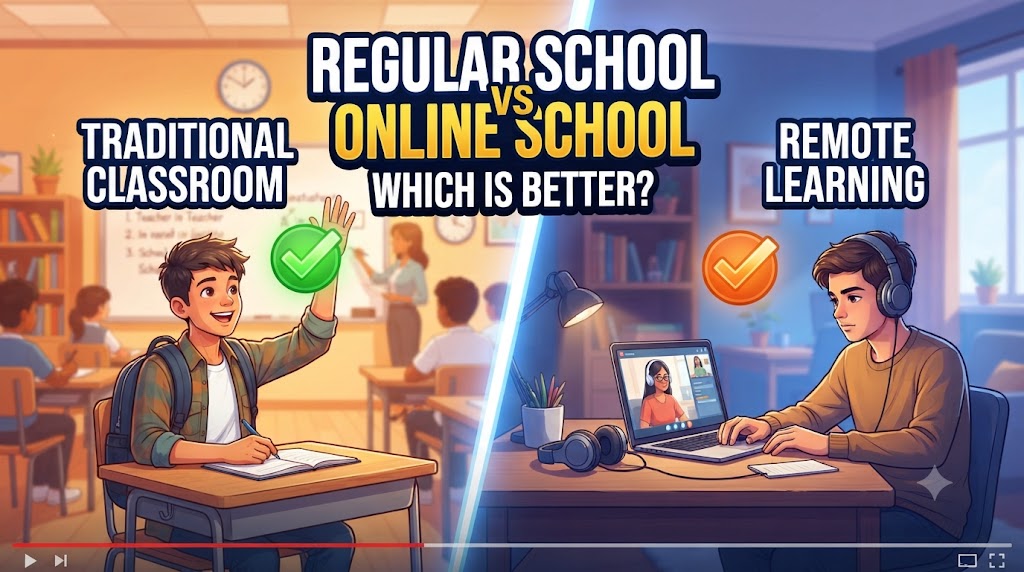
Regular School vs Online School
Introduction
Choosing between a regular school and an online school is an important decision for parents and students. Both learning options can help children develop academic knowledge, but they differ in classroom interaction, flexibility, social development, daily routines, and access to teachers. Regular schools provide face-to-face instruction and opportunities to learn with classmates, while online schools use digital platforms to deliver lessons remotely. The right choice depends on the child’s age, learning preferences, family circumstances, available technology, and the quality of the educational programme.
Regular school is often a suitable choice for children who benefit from direct teacher support, structured routines, practical activities, and daily interaction with other students. Online schooling may be more convenient for families who need flexibility, live far from suitable schools, or prefer remote learning. However, not every online programme offers the same curriculum, qualifications, or level of teacher interaction. Parents should verify recognition, assessment arrangements, student support, and eligibility for future education before choosing either option.
Quick Comparison Table
| Feature | Regular School | Online School |
|---|---|---|
| Learning environment | Physical classroom | Digital learning environment |
| Teacher interaction | Face-to-face | Through online platforms |
| Daily routine | Usually fixed school timings | May be flexible or scheduled |
| Social interaction | Frequent in-person interaction | Depends on live classes and activities |
| Travel | Usually requires commuting | No daily school commute |
| Learning flexibility | Generally less flexible | Often more flexible |
| Practical activities | Easier access to classroom-based activities | Depends on equipment and programme |
| Parental involvement | Varies by child and age | May be higher, especially for younger children |
| Technology needs | Usually limited for routine classroom learning | Reliable internet and suitable devices often required |
| Best suited for | Students who benefit from classroom structure | Students who need flexibility and can learn effectively online |
1. Regular School vs Online School: Learning Environment
Regular School
Regular schools provide a dedicated environment for learning. Students attend classrooms, follow a timetable, and participate in lessons under the direct supervision of teachers.
Teachers can often notice confusion, changes in participation, or difficulties with a subject during classroom activities. Students may also access libraries, laboratories, sports facilities, and other school resources, depending on the institution.
Online School
Online schools deliver lessons through digital platforms. Students may attend live classes, watch recorded lessons, complete assignments, and communicate with teachers online.
The quality of the learning experience depends on the programme’s teaching methods, student support, and technology. A well-designed online school can provide structured lessons, but students may need a quiet workspace and reliable internet access.
Verdict: Regular school generally offers a more structured physical learning environment, while online school provides greater location flexibility.
2. Regular School vs Online School: Teacher Support
Regular School
Students can ask questions directly during lessons and receive immediate clarification when teachers are available. Teachers may also provide face-to-face guidance during classwork and school activities.
However, the amount of individual attention depends on class size, teacher availability, and school quality.
Online School
Online students can receive support through live video lessons, messages, discussion boards, and scheduled meetings. Some programmes provide recorded explanations that students can revisit.
However, students who hesitate to ask questions online or struggle with independent learning may find it harder to get timely help.
Verdict: Regular school often makes direct interaction easier, but a well-supported online school can also provide effective teaching.
3. Regular School vs Online School: Social Development
Regular School
Children interact with classmates and teachers throughout the school day. Group projects, sports, classroom discussions, and extracurricular activities create opportunities to develop communication, cooperation, and conflict-resolution skills.
These experiences can be particularly valuable for children who are still learning to build friendships and work with others.
Online School
Online students can develop friendships through virtual group activities, live discussions, clubs, and offline social activities organised by their families.
However, daily face-to-face interaction may be more limited. Parents may need to arrange additional opportunities for sports, hobbies, and socialising.
Verdict: Regular school generally provides more frequent in-person social interaction.
4. Regular School vs Online School: Flexibility and Time Management
Regular School
Regular schools typically follow fixed start times, class schedules, and attendance requirements. This structure can help students establish routines and separate study time from leisure.
The fixed schedule may be challenging for families who travel frequently or have other significant commitments.
Online School
Online schooling can reduce commuting and may offer flexible schedules, especially when recorded lessons are available. Students can sometimes revisit difficult topics and plan their study time more independently.
However, live online schools may still require attendance at fixed times. Students must also manage distractions and complete assignments on schedule.
Verdict: Online school is generally more flexible, particularly when it offers recorded lessons and self-paced study.
5. Regular School vs Online School: Costs and Convenience
Regular School
Regular schooling may involve tuition fees, uniforms, books, transport, meals, and other expenses. The total cost varies widely between government and private schools.
Families must also account for commuting time and daily travel arrangements.
Online School
Online schooling can reduce transport expenses and some school-related costs. However, families may need to pay for tuition, devices, internet access, software, and additional learning materials.
Not every online school is cheaper than a regular school. Parents should compare the total annual cost rather than considering tuition alone.
Verdict: Online schooling can reduce travel-related expenses, but overall affordability depends on the programme and household needs.
6. Regular School vs Online School: Practical Learning and Activities
Regular School
Students may have direct access to laboratories, libraries, sports grounds, art rooms, and supervised practical activities. These facilities can support hands-on learning and extracurricular development.
Their availability depends on the school and the resources it provides.
Online School
Online schools may use virtual laboratories, simulations, digital projects, and home-based experiments. These methods can help explain many concepts, but they may not fully replace specialised equipment or supervised practical sessions.
Parents should check how science practicals, physical education, examinations, and other required activities are handled.
Verdict: Regular school generally offers more direct access to physical facilities and hands-on activities.
7. Regular School vs Online School: Which Is Better for Different Students?
| Student situation | Option to consider | Why |
|---|---|---|
| Young child needing close supervision | Regular school | Provides daily structure and direct adult support |
| Child who enjoys group activities | Regular school | Offers frequent face-to-face interaction |
| Student living far from suitable schools | Online school | Reduces the need to travel |
| Student who needs flexible study hours | Online school | Some programmes offer self-paced lessons |
| Student needing laboratory access | Regular school | May provide supervised practical facilities |
| Student who manages independent study well | Either option | Teaching quality and programme suitability matter |
| Student with frequent travel commitments | Online school | Can offer greater continuity if the programme permits |
These are general considerations, not fixed rules. Individual learning needs and the quality of the school or online programme should guide the decision.
Advantages and Disadvantages
Regular School
Advantages
- Direct, face-to-face teacher interaction.
- Frequent opportunities for social development.
- Structured routines and supervised learning.
- Access to physical facilities and extracurricular activities.
- Easier coordination of many group-based activities.
Disadvantages
- Daily commuting takes time.
- Fixed schedules offer less flexibility.
- Fees and transport can increase household expenses.
- The classroom environment may not suit every student’s learning preferences.
Online School
Advantages
- Reduced commuting and travel time.
- Greater flexibility in programmes offering self-paced learning.
- Lessons may be accessible from different locations.
- Recorded classes can support revision.
- May suit students who learn effectively in a digital environment.
Disadvantages
- Requires suitable devices and reliable internet access.
- Face-to-face social interaction may be limited.
- Screen time can increase.
- Students need effective time management and self-discipline.
- Practical activities and supervision depend on the programme.
Final Verdict: Regular School vs Online School
Regular school is generally the better starting choice for younger children who benefit from classroom routines, direct teacher support, practical activities, and frequent social interaction. It provides a structured environment in which children can develop academic and interpersonal skills together.
Online school may be a better fit for families who need flexibility, students who manage independent learning well, or children who cannot conveniently access a suitable physical school. Its success depends on teaching quality, supervision, technology, and opportunities for social development.
Before enrolling, verify the programme’s recognition, curriculum, examination arrangements, teacher qualifications, and eligibility for future education. The best choice is the one that meets the child’s educational needs while providing a safe, supportive, and sustainable learning environment.
Disclaimer
School recognition, curriculum requirements, examination arrangements, and eligibility rules may change. In India, parents should verify the current recognition and examination arrangements of an online school or programme with the relevant education authorities and recognised boards before enrolling a child.