Fixed-Tilt vs Solar Tracking System
Introduction
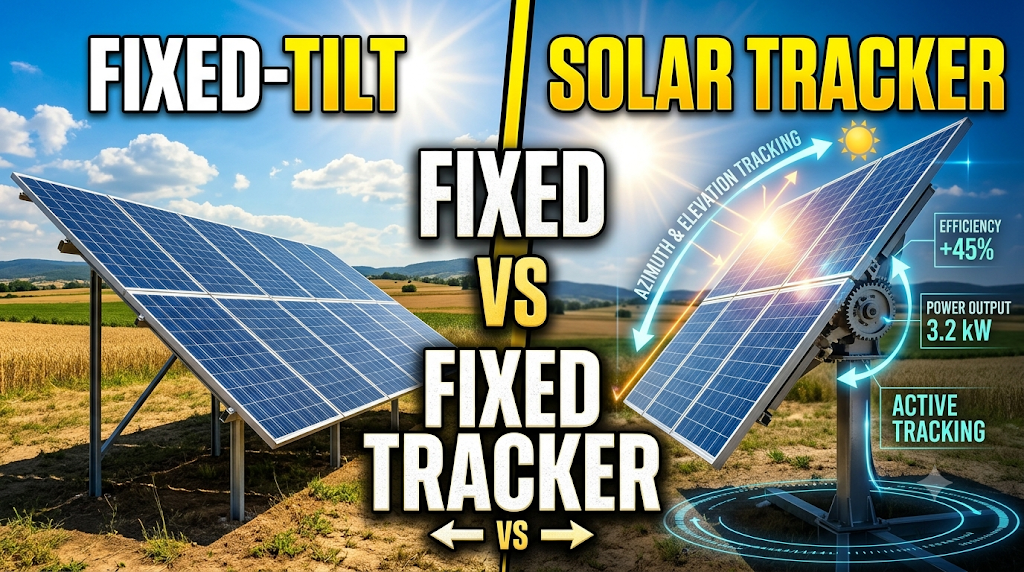
Solar panel mounting systems play an important role in determining how much electricity a solar power plant can generate. Two commonly discussed options are fixed-tilt solar systems and solar tracking systems. Both are designed to position solar panels toward sunlight, but they work differently. A fixed-tilt system keeps panels at a predetermined angle, while a tracking system automatically changes the panel position to follow the sun throughout the day. Choosing between them depends on installation size, available land, budget, electricity requirements and maintenance expectations.
Although both systems can generate electricity efficiently, their performance and installation requirements are different. Fixed-tilt systems are generally simpler, more affordable and easier to maintain, making them suitable for residential and many commercial installations. Solar tracking systems can capture more sunlight during the day and increase electricity generation, particularly in large ground-mounted solar projects. However, their moving components introduce additional costs and maintenance requirements. Understanding these differences can help property owners and solar project developers select the right mounting technology.
Quick Comparison Table
| Feature | Fixed-Tilt Solar System | Solar Tracking System |
|---|---|---|
| Panel Position | Remains at a fixed angle | Moves to follow the sun |
| Electricity Generation | Standard solar generation | Generally higher generation |
| Sunlight Capture | Limited by fixed orientation | Better alignment with sunlight |
| Installation Cost | Generally lower | Generally higher |
| Maintenance | Low | Higher |
| Moving Parts | No tracking mechanism | Motors and moving components |
| Installation Space | Generally easier to arrange | Requires additional spacing |
| Mechanical Complexity | Simple | More complex |
| Residential Suitability | Excellent | Usually less practical |
| Large Solar Farms | Suitable | Particularly suitable |
| Long-Term Maintenance | Relatively simple | Requires mechanical inspection |
| Best For | Homes and budget-conscious projects | Large ground-mounted projects |
1. Working Principle
Fixed-Tilt Solar System
A fixed-tilt solar system uses mounting structures that hold solar panels at a predetermined angle and direction. Once installed, the panels remain in the same position throughout the day and across the seasons.
The installation angle is selected according to geographical location, roof orientation, available space and solar project requirements. Since there are no automatic moving mechanisms, the system has a relatively simple design.
Solar Tracking System
A solar tracking system uses mechanical and electronic components to adjust the position of solar panels according to the sun’s movement. It helps panels receive sunlight from a more favourable direction during different hours of the day.
There are two common types:
- Single-Axis Solar Tracker: Moves panels along one axis, generally following the sun from east to west.
- Dual-Axis Solar Tracker: Adjusts panels along two axes to follow the sun’s changing position more closely.
Tracking systems are commonly considered for large ground-mounted solar installations where additional electricity generation can justify the added investment.
2. Electricity Generation
Fixed-Tilt Solar System
Fixed-tilt panels generate electricity whenever sunlight reaches their surface. However, their angle cannot automatically adjust when the sun moves across the sky.
As a result, their electricity generation depends on the selected installation angle, sunlight availability, weather conditions and panel orientation.
Solar Tracking System
Solar tracking systems adjust panel positions to capture sunlight more effectively throughout the day. This can increase electricity generation compared with an appropriately designed fixed-tilt installation.
The actual improvement depends on location, climate, tracker design, shading and system configuration. The additional generation is particularly valuable for large solar power projects.
Winner: Solar Tracking System for potential electricity generation per installed capacity.
3. Installation Cost
Fixed-Tilt Solar System
Fixed-tilt systems generally have lower installation costs because they use simpler mounting structures without automatic tracking mechanisms.
Their straightforward design also reduces the number of mechanical and electrical components required for installation.
Solar Tracking System
Solar tracking systems require additional components, including motors, controllers, sensors and specialised mounting structures.
These components increase the initial investment. However, the additional electricity generation may help offset the higher installation cost in suitable large-scale projects.
Winner: Fixed-Tilt Solar System for lower initial investment.
4. Maintenance Requirements
Fixed-Tilt Solar System
Fixed-tilt systems require relatively little mechanical maintenance because their mounting structures do not contain moving tracking components.
Routine inspections, panel cleaning, electrical checks and structural inspections are still necessary.
Solar Tracking System
Tracking systems require additional maintenance because their motors, drive mechanisms, controllers and moving connections need periodic inspection.
Mechanical wear or tracking mechanism problems can affect system operation if maintenance is neglected.
Winner: Fixed-Tilt Solar System for simpler maintenance.
5. Space and Installation Requirements
Fixed-Tilt Solar System
Fixed-tilt systems are comparatively straightforward to arrange because their panels remain stationary. Their mounting structures can be designed to suit different roof and ground-mounted installations.
They are suitable for residential rooftops, commercial buildings and large solar farms.
Solar Tracking System
Tracking systems need sufficient clearance for panel movement and to prevent neighbouring rows from creating excessive shadows.
Their mechanical arrangements also require suitable ground conditions and structural planning. Consequently, they are generally more practical for open ground-mounted projects than conventional rooftops.
Winner: Fixed-Tilt Solar System for installation flexibility.
6. Reliability and Durability
Fixed-Tilt Solar System
Fixed-tilt mounting structures have fewer moving components, which makes their mechanical design relatively simple. Their long-term performance depends on mounting quality, material selection, corrosion protection and weather resistance.
Solar Tracking System
Solar tracking systems can provide reliable performance when properly designed and maintained. However, their additional mechanical and electronic components create more potential maintenance requirements.
Wind loads, dust, weather conditions and mechanical wear must be considered during installation.
Winner: Fixed-Tilt Solar System for mechanical simplicity.
7. Residential vs Commercial Applications
Fixed-Tilt Solar System
Fixed-tilt systems are generally the practical choice for residential rooftops because they are simpler, require less maintenance and can be installed on available roof space.
They are also widely suitable for commercial buildings and ground-mounted projects.
Solar Tracking System
Solar tracking systems are more commonly considered for utility-scale solar farms and large ground-mounted commercial projects.
At this scale, additional electricity generation can have a meaningful impact on the overall project economics. For most ordinary residential installations, the additional complexity and cost are difficult to justify.
Winner:
- Residential installations: Fixed-Tilt Solar System.
- Large solar farms: Solar Tracking System may be more suitable.
Advantages and Disadvantages
Fixed-Tilt Solar System
Advantages
- Lower initial installation cost.
- Simple mounting structure.
- Less mechanical maintenance.
- No tracking motors or controllers.
- Suitable for residential rooftops.
- Straightforward installation and inspection.
Disadvantages
- Cannot follow the sun automatically.
- May generate less electricity than tracking systems.
- Panel orientation remains unchanged throughout the day.
Solar Tracking System
Advantages
- Follows the sun throughout the day.
- Can increase electricity generation.
- Can improve energy production per installed capacity.
- Useful for large ground-mounted solar projects.
- Single-axis and dual-axis options are available.
Disadvantages
- Higher initial investment.
- More mechanical components.
- Requires additional maintenance.
- Needs careful installation and structural planning.
- Not generally practical for ordinary residential rooftops.
Which Is Better: Fixed-Tilt or Solar Tracking System?
Both mounting technologies have advantages, but the better choice depends on the installation requirements.
A fixed-tilt solar system is generally better for homes, small businesses and projects where affordability, simple installation and low maintenance are important. It provides a practical way to install solar panels without adding complicated moving mechanisms.
A solar tracking system can be a better choice for large ground-mounted solar farms where increasing electricity generation is a major priority. Its additional installation and maintenance costs may be justified when the extra energy production improves the overall project economics.
Final Verdict: Fixed-Tilt Solar System is the better practical choice for most residential installations, while Solar Tracking System can be the better investment for suitable large-scale solar projects.
Frequently Asked Questions (FAQs)
1. What is the main difference between fixed-tilt and solar tracking systems?
A fixed-tilt system keeps solar panels at one predetermined angle, whereas a solar tracking system automatically adjusts panel positions to follow the sun.
2. Which solar mounting system generates more electricity?
Solar tracking systems generally generate more electricity than comparable fixed-tilt systems because they can capture sunlight more effectively throughout the day. Actual results depend on installation conditions.
3. Are solar tracking systems suitable for residential rooftops?
They are technically possible in specialised installations, but fixed-tilt systems are generally more practical for residential rooftops because they require less space, investment and maintenance.
4. Is a solar tracking system more expensive?
Yes. Tracking systems generally cost more because they require additional motors, controllers, moving structures and installation work.
5. Which system requires less maintenance?
Fixed-tilt systems generally require less mechanical maintenance because they do not have automatic tracking mechanisms or moving components.
6. What are single-axis and dual-axis solar trackers?
Single-axis trackers move solar panels along one axis, while dual-axis trackers adjust their position along two axes to follow the sun more closely.
7. Which system is better for a large solar power plant?
Both can be suitable. Solar tracking systems can be attractive for large ground-mounted projects when their additional energy generation justifies the investment and maintenance costs.
Disclaimer
Solar panel generation, installation costs, maintenance requirements and overall performance may vary depending on geographical location, weather conditions, mounting design, equipment quality and project size. Consult a qualified solar professional before selecting a solar mounting system.