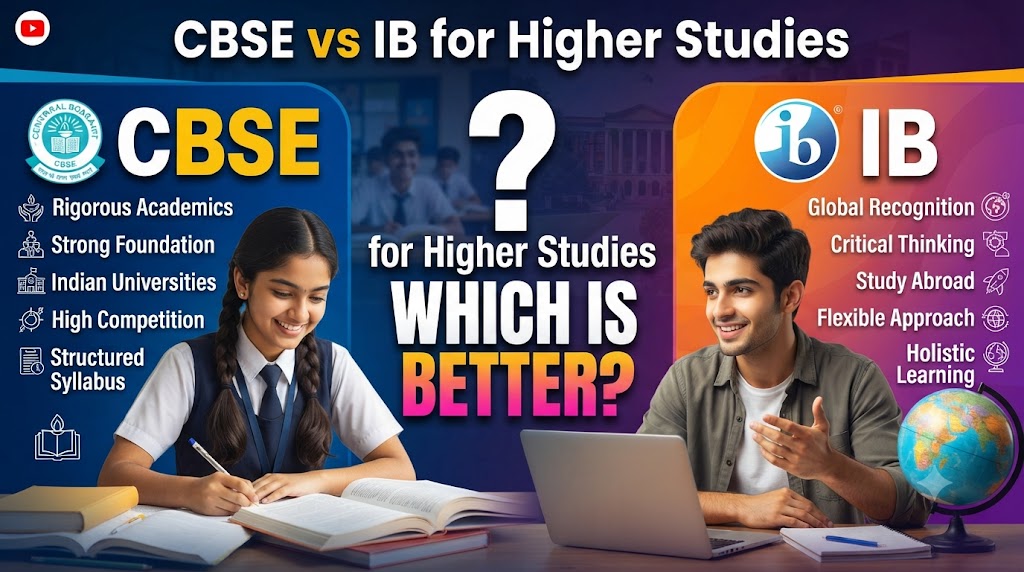
CBSE vs IB for Higher Studies
Introduction
Choosing between CBSE and the International Baccalaureate (IB) can influence a student’s academic experience and preparation for higher education. Both pathways can help students enter universities, but they differ in curriculum structure, assessment methods, subject choices, and learning approaches. CBSE follows a nationally structured curriculum widely used across India, while IB programmes emphasise inquiry, independent research, conceptual understanding, and international perspectives. The better choice depends on the student’s preferred learning style, future university plans, financial circumstances, and the subjects they want to study.
For students planning to pursue higher studies in India, CBSE can be a practical option because of its widespread availability and familiarity with Indian entrance examinations. IB may be attractive to students considering international universities or those who prefer research-oriented, interdisciplinary learning. However, neither curriculum guarantees admission to a particular university or country. Students must check the eligibility requirements, accepted qualifications, subject prerequisites, and application procedures of their target institutions before choosing a school curriculum.
Quick Comparison Table
| Feature | CBSE | IB |
|---|---|---|
| Curriculum | National curriculum | International curriculum framework |
| Learning approach | Structured subject-based learning | Inquiry, conceptual understanding, and independent learning |
| University options | Indian and international universities | Indian and international universities |
| Indian entrance exams | Often convenient for NCERT-aligned preparation | May require additional preparation for some Indian entrance exams |
| International applications | Accepted by many universities, subject to requirements | Recognised by many universities, subject to requirements |
| Assessment | Board examinations and school assessments, depending on level | Varies by programme; combines internal and external assessment |
| Research work | Depends on subject and school requirements | Research and extended academic work feature in relevant programmes |
| Subject flexibility | Depends on the prescribed curriculum and school offerings | Programme-specific subject choices |
| School availability | Widely available in India | Available at selected schools |
| Cost | Varies by school | Often higher at private IB schools |
| Best suited for | Many students focused on Indian education pathways | Students who value inquiry-based learning and may pursue international pathways |
1. CBSE vs IB: Curriculum and Learning Approach
CBSE
CBSE follows a structured national curriculum. Students study prescribed subjects and prepare for school assessments and board examinations at relevant stages.
The curriculum can provide a clear academic foundation, particularly for students planning to take Indian entrance examinations. NCERT textbooks are widely used for many CBSE subjects and are relevant to several national examination pathways.
IB
The International Baccalaureate offers different programmes for different age groups. The Diploma Programme (DP), commonly taken by students aged 16–19, includes six subject groups alongside its core components: Theory of Knowledge, the Extended Essay, and Creativity, Activity, Service.
This structure encourages students to develop research skills, critical thinking, independent learning, and connections between different subjects.
Verdict: CBSE may suit students who prefer a structured national curriculum, while IB may suit students who enjoy research, inquiry, and interdisciplinary learning.
2. CBSE vs IB for Indian Universities
CBSE
CBSE is widely offered across India, and its qualifications are familiar to many Indian universities. Students can plan their subject choices around the eligibility requirements of undergraduate courses.
For engineering, medicine, and other competitive pathways, students should check the current requirements of examinations such as JEE Main, JEE Advanced, and NEET-UG, where applicable.
IB
IB Diploma Programme students can also apply to Indian universities, subject to the institution’s admission rules and qualification requirements.
However, applicants may need to provide specific documentation, meet subject prerequisites, or satisfy equivalence and eligibility conditions. Requirements can vary by institution and programme.
Students planning to pursue medicine or engineering in India should verify the applicable subject, examination, and qualification requirements well before selecting their IB subjects.
Verdict: CBSE is often a more straightforward option for students focused on Indian entrance-exam pathways, but IB can also lead to Indian university admission when requirements are met.
3. CBSE vs IB for International Universities
CBSE
Many international universities accept applications from CBSE students. Admissions teams generally assess the student’s academic record, required subjects, grades, English-language proficiency where applicable, and other application components.
Students may need to complete standardised tests or provide additional documents, depending on the country and university.
IB
The IB Diploma Programme is offered internationally, and many universities are familiar with its qualification structure. Its subject choices and research components can help students demonstrate academic interests and independent learning.
Some universities publish specific IB score requirements or subject-level prerequisites. These requirements vary by course and institution.
Verdict: IB can be particularly convenient for students targeting international universities, but CBSE is also a recognised pathway. Admission requirements matter more than the board name alone.
4. CBSE vs IB: Teaching Methods and Assessment
CBSE
CBSE students typically follow prescribed subject curricula, with assessment methods depending on the class and subject. Board examinations are an important component at relevant stages.
A student’s ability to apply knowledge depends on teaching quality, practical activities, revision, and independent study.
IB
IB programmes place emphasis on inquiry, reflection, communication, and application of knowledge. In the Diploma Programme, assessment can include externally assessed examinations and internally assessed coursework, depending on the subject.
Students need to manage assignments, research, deadlines, and examinations together.
Verdict: IB may appeal to students who enjoy continuous coursework and independent investigation. CBSE may suit students who prefer a more familiar Indian academic structure.
5. CBSE vs IB: Subject Choices and Career Planning
CBSE
CBSE students select from the subject combinations offered by their schools and permitted by the applicable curriculum. Science, commerce, and humanities pathways can support a wide range of university and career options.
Students should check prerequisites early, especially for courses that require particular subjects in Classes 11 and 12.
IB
The IB Diploma Programme allows students to select subjects across its prescribed groups, subject to programme rules and school availability. Students also complete the programme’s core components.
This structure can support broad learning, but students must select suitable subjects and levels for their intended university courses. Not every school offers every subject.
Verdict: Both pathways can support varied careers. The best option depends on subject availability and the entry requirements of the student’s intended degree.
6. CBSE vs IB: Fees and School Availability
CBSE
CBSE schools are widely available across India, including government and private institutions. Fees vary significantly according to school type, location, and facilities.
This wider availability can make it easier for families to find a school that fits their budget and location.
IB
IB programmes are offered by authorised schools, and availability is more limited. Many IB schools are private international or independent schools, where tuition and additional programme expenses may be substantial.
Fees vary, so families should compare the total cost, including admission charges, learning resources, activities, and examination fees.
Verdict: CBSE is generally easier to access and may be more affordable, while IB can require a larger financial commitment at many schools.
7. Advantages and Disadvantages
CBSE
Advantages
- Widely available across India.
- Familiar qualification for many Indian university pathways.
- Convenient alignment with NCERT-based preparation for several national entrance examinations.
- A structured curriculum and established board examination system.
- A broad range of school fees and institutional options.
Disadvantages
- Learning experiences vary considerably between schools.
- Some students may prefer more inquiry-based or interdisciplinary coursework.
- International university applicants must still meet each institution’s requirements.
IB
Advantages
- Emphasis on research, critical thinking, and independent learning.
- Internationally familiar Diploma Programme qualification.
- Opportunities to develop writing, reflection, and time-management skills.
- Flexible subject choices within programme requirements.
- Coursework and research can help students explore academic interests in depth.
Disadvantages
- Often more expensive at private IB schools.
- Fewer schools offer IB programmes in India.
- Coursework and independent research can create a demanding workload.
- Students targeting Indian entrance exams may need additional exam-specific preparation.
Final Verdict: CBSE vs IB for Higher Studies
CBSE is often the practical choice for students planning to pursue higher education in India, especially if they intend to take national entrance examinations and want a widely available school pathway.
IB may be a strong choice for students who value inquiry-based learning and are considering international universities, particularly when their preferred IB subjects match their intended degree.
However, both curricula can lead to higher education in India and abroad. Before deciding, compare university eligibility rules, subject prerequisites, school quality, fees, and the student’s learning preferences. Choosing a curriculum that supports the student’s actual goals is more important than assuming one board is universally better.
Disclaimer
University admission criteria, qualification equivalence rules, subject prerequisites, entrance-exam requirements, and school fees may change. Check the latest official university, examination authority, CBSE, and International Baccalaureate information before making educational decisions.