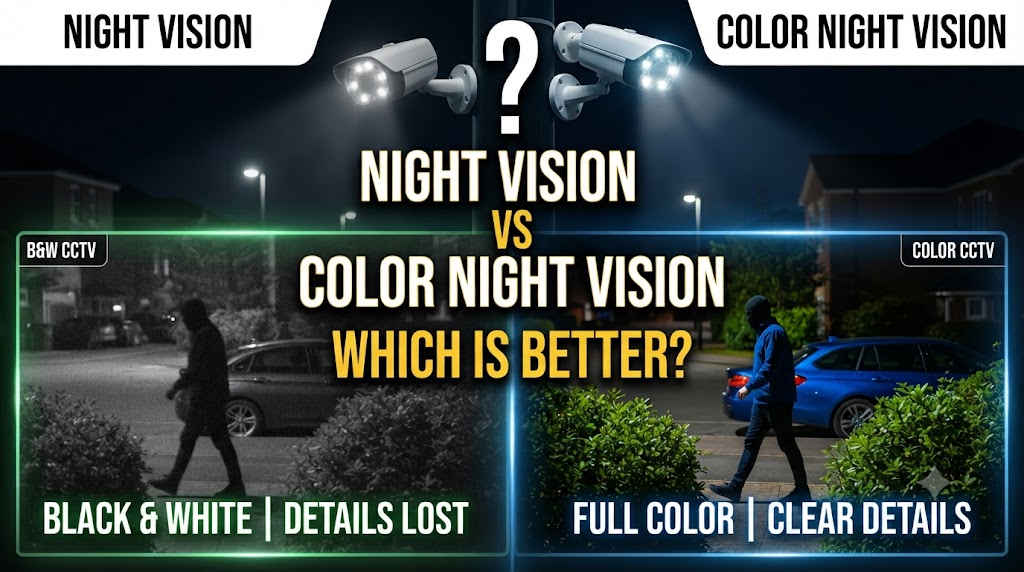
Night Vision vs Color Night Vision CCTV
Choosing a CCTV camera for nighttime surveillance is not only about resolution. The camera’s night-vision technology also affects how clearly you can see people, vehicles, clothing, and other details after dark. Traditional night vision usually uses infrared (IR) illumination and produces black-and-white footage, while color night-vision cameras are designed to retain color in very low-light conditions. (Axis White Papers)
The important difference is how each system handles darkness. Traditional IR cameras can provide useful black-and-white images even when visible light is very low, while advanced color technologies use highly sensitive sensors, lenses, image processing, and sometimes visible supplemental light to produce color footage. However, color night vision still depends on the camera and available lighting, so not every “full-color” camera performs the same way in complete darkness. (Axis Communications)
Quick Comparison Table
| Feature | Traditional Night Vision | Color Night Vision |
|---|---|---|
| Night-time image | Usually black and white | Color in low-light conditions |
| Main technology | IR illumination | High-sensitivity sensor, optics and image processing |
| Visibility in very low light | Very good | Depends on camera technology and available light |
| Color identification | Limited | Better |
| Clothing/vehicle color | Usually difficult to identify accurately | Easier when sufficient light is available |
| IR illumination | Common | May use visible light, IR, or both depending on model |
| Visible light at night | Usually not required | Some models use supplemental white/warm light |
| Light pollution | Generally low with IR | Can be higher if visible supplemental light is used |
| Motion at night | Good with suitable IR illumination | Can be very good with sufficient light and good sensor performance |
| Best suited for | General night surveillance | Situations where color details are important |
What Is Traditional CCTV Night Vision?
Traditional CCTV night vision commonly uses infrared illumination. When the scene becomes dark, the camera switches to a night mode and uses near-infrared light to capture the scene. Because conventional IR imaging does not preserve normal color information, the resulting video is generally grayscale or black and white. (Axis White Papers)
The major advantage is that IR illumination can provide surveillance without requiring normal visible lighting. Integrated IR LEDs can illuminate the scene while remaining largely invisible to the human eye, although some IR LEDs can produce a faint glow. (Axis Communications)
How Traditional IR Night Vision Works
A typical day/night camera uses an IR-cut filter. During the day, the filter helps maintain normal color reproduction. At night, the filter is removed so the sensor can use available near-infrared light. The camera then produces a grayscale image. (Axis White Papers)
This approach is useful when your main requirement is to see movement and objects clearly rather than identify their exact colors.
What Is Color Night Vision CCTV?
Color night vision is designed to retain color information in low-light conditions instead of automatically switching to conventional black-and-white IR footage.
Different manufacturers use different technologies. For example, Axis Lightfinder uses highly light-sensitive sensors, optics and image processing to maintain color in very low light. Hikvision ColorVu similarly uses technologies such as large-aperture lenses, sensitive sensors and image processing to improve full-color night imaging. (Axis Communications)
Some color cameras can also use supplemental visible light. Hikvision’s Smart Hybrid Light cameras, for example, can use infrared, white light or a smart combination depending on the situation. Dahua’s Smart Dual Light technology can switch between IR and warm light when a target is detected. (Hikvision)
Does Color Night Vision Work in Complete Darkness?
This is an important point.
Color night vision should not automatically be understood as color video in absolute darkness. A camera needs usable light to capture a high-quality visible-light color image. Advanced low-light technologies can work with extremely small amounts of light, but when there is not enough visible light, the camera may need supplemental illumination or another imaging method. (Axis White Papers)
Therefore, always check the actual camera’s specifications and night-illumination system rather than relying only on the term “Color Night Vision.”
Night Vision vs Color Night Vision: Image Quality
Both technologies can produce useful nighttime surveillance footage, but they provide different types of information.
Traditional IR footage can offer a clear view of shapes, people and vehicles. However, the loss of color can remove useful identifying information.
Color night vision can preserve details such as the color of clothing, vehicles, signs and objects when the camera has enough usable light. This can be valuable when reviewing an incident later. Axis notes that color information can help identify people, objects and vehicles in surveillance footage. (Axis White Papers)
Practical Meaning
If you mainly need to know whether someone entered an area, traditional IR night vision can be sufficient.
If you need to know what color clothing or vehicle was involved, color night vision can provide additional information when lighting conditions support it.
Night Vision vs Color Night Vision for Identification
Identification is one of the biggest reasons to consider color night vision.
With conventional IR, the camera sees reflected infrared light rather than normal visible colors. As a result, different colored objects may appear similar in grayscale footage. Axis explains that IR illumination can affect forensic color information because the reflected IR intensity does not correspond directly to the visible color of an object. (Axis White Papers)
Color night vision can retain visible color information in low-light conditions. This may help distinguish:
- Clothing colors
- Vehicle colors
- Signs and markings
- Objects in an entrance or parking area
- Other visually distinctive details
However, color alone does not guarantee identification. Resolution, lens quality, camera placement, exposure, lighting, distance and motion also affect the final image.
Night Vision vs Color Night Vision in Complete Darkness
For completely dark areas, traditional IR has a practical advantage because the camera can add infrared illumination to the scene.
A conventional day/night camera can use integrated or external IR illumination to produce images even when visible light is extremely limited. (Axis Communications)
Color systems vary more widely.
Some advanced color cameras can maintain color with extremely low ambient light. Others use built-in white or warm illumination to create the visible light required for full-color footage. Some hybrid models can switch between IR and visible illumination depending on the situation. (Hikvision)
Practical Meaning
For a completely dark compound, check whether the color camera has effective supplemental lighting.
For an area with streetlights, porch lights or other ambient illumination, a good low-light color camera may be able to maintain color without constantly using bright visible light.
Nighttime Motion and Moving Objects
Nighttime motion can be challenging for any CCTV camera because less light generally means the camera has less information available to produce a clean image.
Advanced low-light color technologies can use higher light sensitivity and shorter exposure times to reduce motion blur. Axis states that Lightfinder is designed to maintain shorter exposure times and improve the clarity of moving objects in low-light conditions. (Axis Communications)
Traditional IR cameras can also perform well with moving subjects when the IR illumination, shutter settings, lens and camera placement are appropriate.
So, the technology name alone should not determine your choice. Look at the complete camera specification and actual nighttime performance.
IR Night Vision vs Color Night Vision: Lighting
Lighting is one of the biggest differences between the two approaches.
Traditional IR cameras normally use infrared illumination. Because IR is outside normal visible light, it can provide nighttime monitoring without illuminating the area like a conventional lamp. (Axis Communications)
Color night-vision cameras may use existing ambient light or built-in visible supplemental lighting. Some modern cameras intelligently switch between IR and warm/white light to balance color information and light pollution. (Dahua Technology)
Which Is More Discreet?
Traditional IR night vision is generally more discreet because it does not need continuous visible illumination.
Color night vision can also be discreet when it relies on existing ambient light or a highly sensitive sensor. However, a camera using visible white or warm supplemental lighting will be noticeable when that light turns on.
Power and Light Pollution
IR illumination can be useful when you want nighttime monitoring without adding visible lighting to the property.
Visible supplemental lighting can provide color footage, but it can also create additional light in the monitored area. Dahua’s Smart Dual Light technology is specifically designed to switch between IR and warm light based on detected activity, helping reduce unnecessary visible illumination. (Dahua Technology)
The actual power consumption depends on the camera model, illumination level and operating mode. Therefore, the specifications of the particular camera should be checked before installation.
Night Vision vs Color Night Vision for Home CCTV
For a normal home, both options can work well.
Traditional night vision can be suitable for:
- Gates
- Driveways
- Stairways
- Side passages
- Backyards
- Areas with little importance placed on color identification
Color night vision can be useful for:
- Main entrances
- Parking areas
- Front gates
- Shops attached to homes
- Areas where identifying vehicle or clothing color matters
The better choice depends on the amount of available light and what you expect the footage to show.
Night Vision vs Color Night Vision for Shops and Businesses
Businesses may benefit from color information because nighttime incidents can involve vehicles, clothing, packages, signs or other objects where color is useful.
For example, a camera covering a shop entrance may provide more useful forensic information if it can retain color in low light.
However, traditional IR can still be a practical choice for areas where the primary requirement is reliable nighttime visibility rather than color information.
Installation Considerations
The camera should be selected according to the actual environment.
Before buying, check:
- How dark the area becomes at night.
- Whether streetlights or other ambient lighting are available.
- The camera’s minimum illumination specification.
- Whether the camera has built-in IR LEDs.
- Whether it has visible supplemental lighting.
- The expected monitoring distance.
- Whether moving people or vehicles need to be captured clearly.
- Whether color identification is important.
- Whether visible light at night would disturb neighbors or nearby areas.
- Whether the camera’s lens and resolution are suitable for the required distance.
A camera with excellent specifications can still produce poor footage if it is installed too far from the target or pointed toward a strong light source.
Which Should You Choose?
There is no single choice that suits every CCTV installation.
Choose traditional night vision if:
- The area becomes very dark.
- You mainly need reliable nighttime visibility.
- You prefer discreet infrared illumination.
- Color identification is not a major requirement.
- You want a straightforward night-surveillance setup.
Consider color night vision if:
- Color details are important.
- The area has some ambient light.
- You want more natural-looking nighttime footage.
- Identifying clothing or vehicle colors could be useful.
- You are willing to use visible supplemental lighting when required.
Final Verdict
Traditional night vision and color night vision serve different surveillance needs. Traditional IR night vision is designed to provide dependable visibility in dark conditions, usually in black and white. Color night vision aims to preserve color information in low-light conditions and, depending on the model, may use advanced sensors, image processing and supplemental visible lighting. (Axis White Papers)
If your priority is reliable visibility in very dark areas, traditional IR night vision can be a practical solution. If your priority is preserving color details for identification, a suitable color night-vision camera can provide additional information.
The key is to choose according to the actual lighting, distance, movement and identification requirements of your CCTV location rather than choosing only by the camera’s marketing name.
Internal Linking Suggestions
You can internally link this article to other relevant Parkhu CCTV comparison articles:
- 2MP vs 5MP CCTV Camera: Which Resolution Is Better?
- 5MP vs 8MP CCTV Camera: Which Should You Buy?
- IP Camera vs Analog Camera: Which CCTV System Is Better?
These links can help readers understand the relationship between CCTV resolution, camera type and nighttime performance.
Disclaimer
CCTV camera specifications, night-vision technology, illumination range, image quality and features can vary by model and manufacturer. Prices, specifications and available features may change over time. Always check the manufacturer’s current specifications and installation requirements before purchasing or installing a CCTV camera.