IP Camera vs Analog Camera
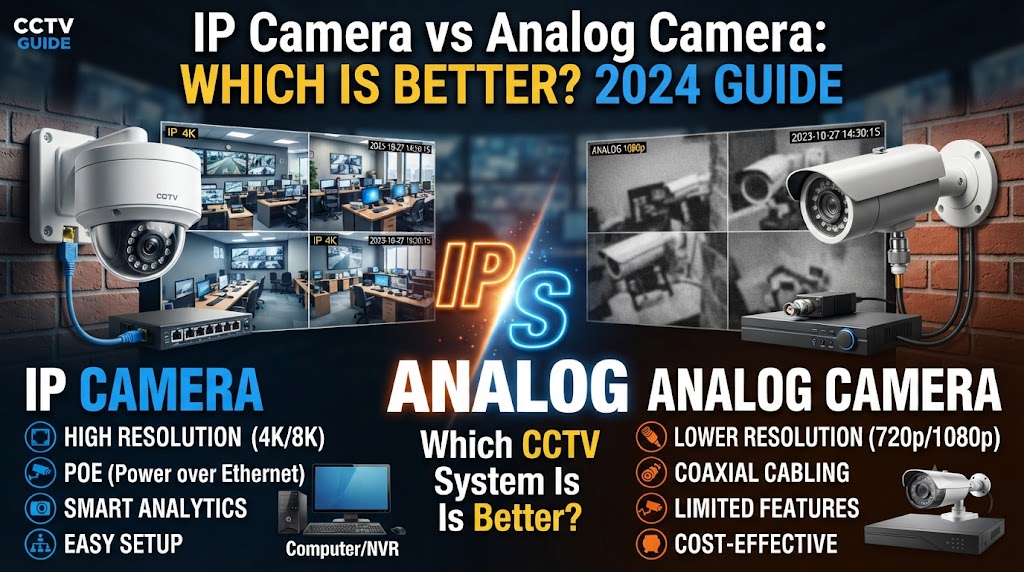
Choosing between an IP camera and an analog camera depends on your existing CCTV setup, image-quality requirements, installation, budget and the features you need. An IP camera sends digital video over a network, while traditional analog CCTV uses a camera-to-recorder connection over coaxial cabling. Modern HD-over-coax systems have improved significantly, so the difference is no longer simply “digital versus low quality.” (Axis Newsroom)
IP systems can offer higher resolutions, network connectivity, analytics and easier integration with other network-based security equipment. Analog systems, particularly modern HD-TVI and similar technologies, can provide high-definition video while allowing users to continue using existing coaxial infrastructure. Therefore, this IP camera vs analog camera comparison looks at image quality, cabling, recording, installation, features, cost and practical use.
Quick Comparison: IP Camera vs Analog Camera
| Feature | IP Camera | Analog Camera |
|---|---|---|
| Video transmission | Network/IP | Coaxial cable in traditional systems |
| Recorder | NVR | DVR |
| Image resolution | Wide range, including high resolutions | Modern HD analog can also support high resolutions |
| Network connectivity | Built in | Usually requires additional networking equipment |
| Cabling | Ethernet/network cabling | Coaxial cable, often with separate power |
| Power options | PoE available on supported systems | Separate power or PoC on supported systems |
| Installation | Can be more network-focused | Convenient for existing coaxial installations |
| Advanced analytics | Broad support on many models | Available on selected modern systems |
| Existing CCTV upgrade | May require network infrastructure | Can reuse compatible coaxial cabling |
| Best suited for | New installations and advanced network systems | Existing coaxial systems and simpler upgrades |
IP Camera vs Analog Camera: How Do They Work?
An IP camera is a network camera. It converts the camera image into digital data and sends it through a network. This allows the camera to communicate with an NVR and other network devices. Axis describes IP or network video cameras as cameras that connect to a network and can integrate with other systems such as access control and video analytics. (Axis Newsroom)
An analog CCTV camera sends its video signal through a compatible transmission system to a DVR. Traditional analog systems used lower-resolution video, but modern HD-over-coax technologies have substantially improved the available image quality.
For example, Hikvision’s Turbo HD system supports HD video over coaxial cable and offers resolutions including 2MP, 5MP and 8MP on supported cameras. (Hikvision)
IP Camera vs Analog Camera: Image Quality
Image quality depends on the exact camera rather than just the system type.
IP cameras have historically had an advantage in resolution and flexibility. Network cameras are available in many resolutions, including high-resolution models. Hikvision’s current network-camera range, for example, includes models up to 12MP. (Hikvision)
However, modern analog HD systems should not be confused with old low-resolution analog CCTV. HD-over-coax products can deliver high-definition images, including 4K on supported models. (Hikvision)
Which provides better image quality?
IP cameras have a broader high-resolution and feature range, but the exact camera matters.
A good 5MP or 8MP analog HD camera can provide a detailed image, while a low-end IP camera is not automatically better simply because it is an IP camera.
IP Camera vs Analog Camera: Cabling
Cabling is one of the biggest practical differences.
IP cameras commonly use Ethernet network cabling. Supported PoE cameras can receive power and transmit data over the same network cable.
Analog cameras traditionally use coaxial cable between the camera and DVR. Power is often supplied separately, although some modern analog systems support Power over Coax (PoC). Hikvision lists PoC as an option on supported Turbo HD cameras. (Hikvision)
Which is easier to install?
It depends on the property.
For a new installation, Ethernet-based IP infrastructure can be convenient because the same network architecture can support cameras and other network equipment.
For an existing CCTV installation with coaxial cables already installed, upgrading to modern analog HD cameras can be simpler because compatible cameras and DVRs can work with the existing cabling.
IP Camera vs Analog Camera: NVR vs DVR
IP camera systems normally use an NVR, or Network Video Recorder.
Analog CCTV systems normally use a DVR, or Digital Video Recorder.
The recorder is responsible for recording and managing the camera feeds. IP systems transmit digital video through the network to the NVR, while analog cameras send their video through their compatible transmission connection to the DVR.
The choice of recorder therefore needs to match the camera technology.
Can you mix IP and analog cameras?
Sometimes, yes.
Some modern recorders support multiple camera technologies. Hikvision, for example, describes Turbo HD DVRs that can support IP, analog, Turbo HD and third-party AHD cameras on supported systems. (Hikvision)
However, compatibility should always be checked for the exact DVR/NVR model and camera combination.
IP Camera vs Analog Camera: Resolution
IP cameras offer a broad range of resolutions.
For example, Hikvision’s network-camera comparison information includes 2MP, 4MP, 6MP, 8MP and 12MP options depending on the product series. (Hikvision)
Modern analog systems can also provide much higher resolutions than traditional analog CCTV. Hikvision’s Turbo HD information lists 2MP, 5MP and 8MP/4K options. (Hikvision)
Which is better for high resolution?
IP cameras generally offer more flexibility at the higher end.
However, if your requirement is simply 5MP or 8MP surveillance, a modern HD analog system may also meet that requirement.
IP Camera vs Analog Camera: Remote Viewing
IP cameras are naturally designed around network connectivity.
Once properly configured, an IP CCTV system can be integrated with network infrastructure and remote-access software.
Analog cameras themselves are not network cameras. Remote viewing normally depends on the DVR, which provides the network connection and remote-access functionality.
Therefore, both systems can support remote viewing when the appropriate recorder and network setup are used.
Which is better for remote access?
IP has a more direct network architecture.
However, a modern DVR-based analog system can also provide remote viewing, so this feature alone does not necessarily require replacing an existing analog system.
IP Camera vs Analog Camera: Advanced Features
Modern IP cameras can support features such as:
- Motion detection
- Line crossing
- Intrusion detection
- Human and vehicle classification
- Face-related analytics on supported models
- Multiple video streams
- Advanced low-light technologies
Hikvision’s network-camera product comparison lists features including line crossing, intrusion detection, human/vehicle detection, people counting and other analytics depending on the camera series. (Hikvision)
Modern analog cameras can also include advanced features. Hikvision’s Turbo HD range includes features such as WDR, EXIR illumination, motorized zoom and focus on selected models, and ColorVu technology on supported cameras. (Hikvision)
Which offers more advanced features?
IP cameras generally offer a wider range of network-based analytics and integration options.
The exact feature set still depends on the camera and recorder.
IP Camera vs Analog Camera: Storage
Both systems can record video digitally.
An IP system normally sends video to an NVR. An analog camera sends its signal to a DVR, where it is processed and recorded.
Storage requirements depend on factors such as:
- Resolution
- Frame rate
- Bitrate
- Compression
- Number of cameras
- Recording schedule
- Retention period
Hikvision notes that different streams can have different resource requirements, with the main high-resolution stream using more bandwidth and resources than a lower-quality sub-stream. (Hikvision Support USA)
Which uses less storage?
Neither system automatically wins.
Storage depends more on the camera’s recording settings and compression than simply whether the camera is IP or analog.
IP Camera vs Analog Camera: Distance
The practical transmission distance depends on the cable type, transmission technology and network equipment.
Analog HD systems can work over substantial coaxial cable distances when appropriate equipment and installation practices are used. Hikvision states that supported Turbo HD products can transmit HD video over coaxial cable at distances up to 2,600 feet (792 meters) in certain configurations. (Hikvision)
IP networks can also cover long distances by using appropriate network infrastructure, including switches, fiber or other transmission equipment.
Which is better for long distances?
It depends on the infrastructure.
A simple coaxial run may be convenient for an existing analog installation. For larger networked systems, Ethernet switches and fiber infrastructure can provide more flexibility.
IP Camera vs Analog Camera: Installation Cost
The total installation cost depends on the existing cabling, number of cameras, recorder, switches, power supplies and labor.
If a property already has suitable coaxial CCTV cables, replacing old analog cameras with modern HD analog cameras can avoid the cost of replacing all cabling.
For a new installation, IP cameras may require network switches and structured Ethernet cabling, but PoE can simplify power and data connections on supported cameras.
Axis also notes that video encoders can allow existing analog equipment and coaxial cabling to remain in use while adding some benefits of IP technology, enabling gradual migration. (Axis Communications)
Which is cheaper to install?
It depends on the installation.
An existing analog system can often be upgraded more economically by reusing compatible cabling.
A new IP system may have additional networking equipment costs, but PoE can simplify the physical installation.
IP Camera vs Analog Camera: Existing CCTV Upgrade
This is one of the most important considerations for homeowners and businesses.
Suppose you already have several analog cameras and coaxial cables installed.
You may not need to replace the entire infrastructure. Modern analog HD cameras can use compatible coaxial cabling, allowing an upgrade while retaining much of the existing system.
Hikvision specifically describes its Turbo HD technology as a solution for analog users who want higher-definition surveillance without replacing existing cabling structures. (Hikvision)
On the other hand, moving fully to IP may require network cabling, switches and an NVR, depending on the existing infrastructure.
IP Camera vs Analog Camera: Reliability
Both systems can provide reliable surveillance when correctly designed and installed.
An IP system depends on network infrastructure. Network switches, cables and configuration therefore become important parts of the CCTV system.
An analog system can be straightforward because the camera has a direct transmission path to the DVR through the appropriate cabling.
However, reliability ultimately depends on cable quality, power supply, recorder quality, environmental conditions and installation.
Which is more reliable?
Both can be reliable.
The better choice depends on whether the system is properly designed for the property and the required surveillance conditions.
IP Camera vs Analog Camera: Which CCTV System Is Better?
Choose IP cameras if you want:
- A network-based CCTV system
- Higher-resolution options
- Advanced analytics
- Easier integration with other network systems
- PoE on supported cameras
- Greater flexibility for future expansion
- A new CCTV installation with network infrastructure
Choose analog cameras if you want:
- To reuse existing coaxial CCTV cabling
- A simpler upgrade from an older analog system
- Modern HD surveillance without replacing all cabling
- A potentially straightforward DVR-based setup
- A cost-conscious upgrade where existing infrastructure is suitable
Final Verdict
In the IP camera vs analog camera comparison, neither technology is automatically the right choice for every installation.
IP cameras offer strong network connectivity, high-resolution options and extensive possibilities for analytics and system integration. They are particularly useful when building a new network-based surveillance system.
Modern analog cameras remain practical when existing coaxial infrastructure is available. HD-over-coax technologies can provide high-resolution video without necessarily requiring a complete cabling replacement. (Hikvision)
Therefore, choose based on your existing cables, required resolution, number of cameras, advanced features, expansion plans, recorder compatibility and installation cost rather than choosing only by the camera type.
Disclaimer
CCTV specifications, prices, features, compatibility and availability can change by manufacturer, model and region. Analog CCTV can refer to different technologies, including traditional analog and modern HD-over-coax systems, so actual performance varies by product. IP camera systems also differ in resolution, analytics, networking and power requirements. Always check the manufacturer’s current specifications and compatibility information before purchasing or installing a CCTV system.