CBSE vs ICSE for JEE and NEET
Introduction
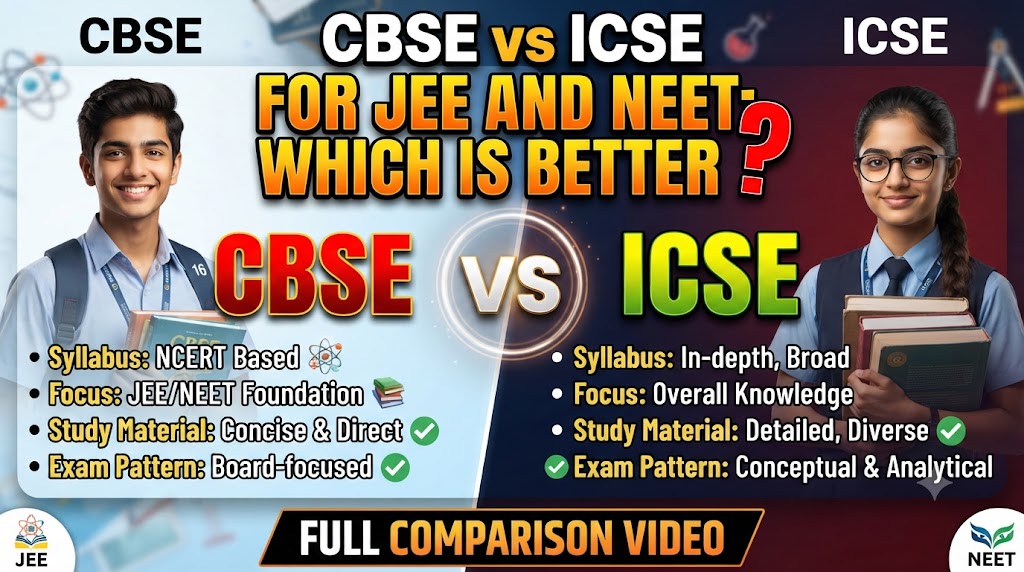
Choosing between CBSE and ICSE can be an important decision for students planning to pursue engineering or medical education in India. Both boards provide academic foundations in subjects such as Mathematics, Physics, Chemistry, and Biology, but they differ in curriculum structure, subject coverage, and learning approach. Students preparing for JEE or NEET must develop strong concepts, practise examination-level questions, and revise consistently. The board they choose can influence how easily they coordinate school studies with entrance-exam preparation, but it does not determine their final rank or admission outcome.
CBSE is generally a more convenient option for students targeting JEE and NEET because its curriculum is closely associated with NCERT textbooks, which are important resources for these examinations. ICSE, administered at the Class 10 level by CISCE, is known for its broad academic curriculum and emphasis on detailed learning. Students choosing the ICSE pathway typically continue through ISC for Classes 11 and 12. They can also prepare successfully for engineering and medical entrance examinations, provided they cover the required syllabus and practise suitable questions.
Quick Comparison Table
| Feature | CBSE | ICSE / ISC |
|---|---|---|
| School board pathway | CBSE | ICSE for Class 10; ISC for Classes 11–12 |
| JEE preparation | Generally convenient | May require more syllabus alignment |
| NEET preparation | Generally convenient | May require additional NCERT-focused preparation |
| NCERT alignment | Strong practical alignment | Depends on subject and level |
| English curriculum | English and other available mediums, depending on school | Strong emphasis on English |
| Curriculum approach | Structured national curriculum | Broad and detailed curriculum |
| Competitive-exam resources | Extensive NCERT-based resources | Extensive resources also available |
| School workload | Depends on school and subjects | Can be demanding due to curriculum breadth |
| Best suited for | Many students targeting national entrance exams | Students seeking a broad academic foundation and strong English education |
1. CBSE vs ICSE: Curriculum and Syllabus
CBSE
CBSE follows a national curriculum framework. NCERT textbooks are widely used for many subjects and are particularly relevant to the preparation of JEE and NEET.
This alignment can make it easier for students to coordinate school learning with entrance-exam preparation. However, the CBSE school syllabus alone does not provide all the practice required for competitive examinations.
ICSE and ISC
ICSE refers to the Class 10 examination conducted by CISCE, while ISC is the corresponding senior secondary examination for Classes 11 and 12.
The ICSE curriculum includes a broad range of subjects and places considerable emphasis on English. Students progressing to ISC can study the science subjects required for engineering or medical pathways.
Because the curriculum structure differs from CBSE, students may need to coordinate their ISC studies with NCERT resources and the current competitive-exam syllabus.
Verdict: CBSE generally offers a more direct route to NCERT-aligned preparation for JEE and NEET.
2. CBSE vs ICSE for JEE Preparation
JEE Main and JEE Advanced assess knowledge and application of Physics, Chemistry, and Mathematics. Admission requirements depend on the examination and institution.
CBSE
CBSE students often find it easier to coordinate their school syllabus with JEE preparation because of the close relationship between many CBSE topics and NCERT resources.
Nevertheless, JEE requires more than textbook reading. Students must practise numerical problems, advanced applications, previous-year questions, and mock examinations.
ICSE / ISC
Students following the ICSE-to-ISC pathway can also prepare successfully for JEE. They should check the current JEE syllabus against their ISC subjects and identify topics that need additional attention.
Extra practice is particularly important for developing speed, accuracy, and the ability to solve unfamiliar problems.
Verdict: CBSE is usually the more convenient option for JEE preparation, but success depends on preparation quality rather than board affiliation.
3. CBSE vs ICSE for NEET Preparation
NEET-UG is the principal entrance examination for undergraduate medical admissions in India, subject to applicable eligibility and admission rules.
CBSE
CBSE provides a convenient foundation for NEET preparation because NCERT textbooks are important study resources, especially for Biology and Chemistry.
Students still need to revise regularly, understand concepts thoroughly, and practise questions according to the current examination pattern.
ICSE / ISC
Students from the ICSE-to-ISC pathway can also qualify for NEET. They should use the prescribed science curriculum alongside NCERT textbooks and the official NEET syllabus.
A structured plan helps students cover the required topics without neglecting school examinations.
Verdict: CBSE generally provides a more convenient starting point for NEET, but ICSE/ISC students can also compete effectively with disciplined preparation.
4. CBSE vs ICSE: Teaching Style and Learning Approach
CBSE
CBSE schools follow a common national curriculum. Teaching methods vary by school, but students can find a wide range of NCERT-based resources and competitive-exam preparation materials.
This can be helpful for students who want to balance school examinations with entrance preparation.
ICSE / ISC
The ICSE curriculum is known for its broad subject coverage and substantial emphasis on English. Students may develop useful reading, writing, comprehension, and analytical skills through their coursework.
However, a broad curriculum may require careful time management when students also prepare for JEE or NEET.
Verdict: CBSE may offer a more focused route for entrance preparation, while ICSE/ISC can provide a broad academic experience. The actual teaching quality matters greatly.
5. CBSE vs ICSE: Study Materials and Coaching
CBSE
Students have access to NCERT textbooks, reference books, practice papers, online classes, and coaching resources designed around JEE and NEET preparation.
The familiarity of these materials can simplify study planning.
ICSE / ISC
ICSE/ISC students can also access competitive-exam coaching, online lessons, and reference materials. They may need to use NCERT resources more deliberately to ensure their preparation matches the examination syllabus.
Students do not necessarily need expensive coaching. Good teachers, a suitable study plan, and consistent practice can also support preparation.
Verdict: CBSE often makes it easier to align school learning with commonly used competitive-exam resources.
6. CBSE vs ICSE: English, Workload, and Overall Development
CBSE
CBSE offers a structured curriculum with options that vary by school. Students can use the time saved by a suitable school routine for additional entrance-exam practice, although actual workload differs considerably.
ICSE / ISC
The ICSE pathway is often attractive to families who value a detailed curriculum and strong English education. Its broad coursework can help students develop communication and academic skills.
The overall workload depends on subject choices, school expectations, and personal study habits. It is not accurate to assume that every ICSE school is harder or every CBSE school is easier.
Verdict: ICSE/ISC may suit students who value broader coursework and English development, while CBSE is often more convenient for students prioritising JEE or NEET.
7. Advantages and Disadvantages
CBSE
Advantages
- Convenient alignment with NCERT-based preparation.
- Extensive JEE and NEET learning resources.
- Nationally consistent curriculum and examination framework.
- Easier coordination between many school topics and entrance preparation.
Disadvantages
- Competitive examinations require additional practice beyond school studies.
- Teaching quality differs across schools.
- Private school fees may be high in some locations.
ICSE / ISC
Advantages
- Broad academic curriculum.
- Strong emphasis on English.
- Opportunities to develop detailed subject knowledge and analytical skills.
- Students can prepare for JEE and NEET alongside school studies.
Disadvantages
- Students may need extra effort to align their preparation with NCERT resources.
- A broad school curriculum can make time management challenging.
- Competitive-exam preparation still requires separate practice and revision.
Final Verdict: CBSE vs ICSE for JEE and NEET
CBSE is generally the more practical choice for students whose primary goal is JEE or NEET. Its close alignment with NCERT-based learning can make school and entrance-exam preparation easier to coordinate.
However, ICSE/ISC is not a disadvantage that prevents students from entering engineering or medical colleges. Students from either pathway can perform well if they understand the concepts, follow the current official syllabus, practise regularly, and manage their time effectively.
Before choosing, compare the actual schools, teachers, fees, subject options, and preparation support. A strong school with experienced teachers and a supportive learning environment may be more valuable than the board name alone.
Disclaimer
Curriculum details, entrance-exam syllabuses, eligibility requirements, and admission rules may change. Check the latest official CBSE, CISCE, NTA, JEE, and NEET information before making educational decisions.