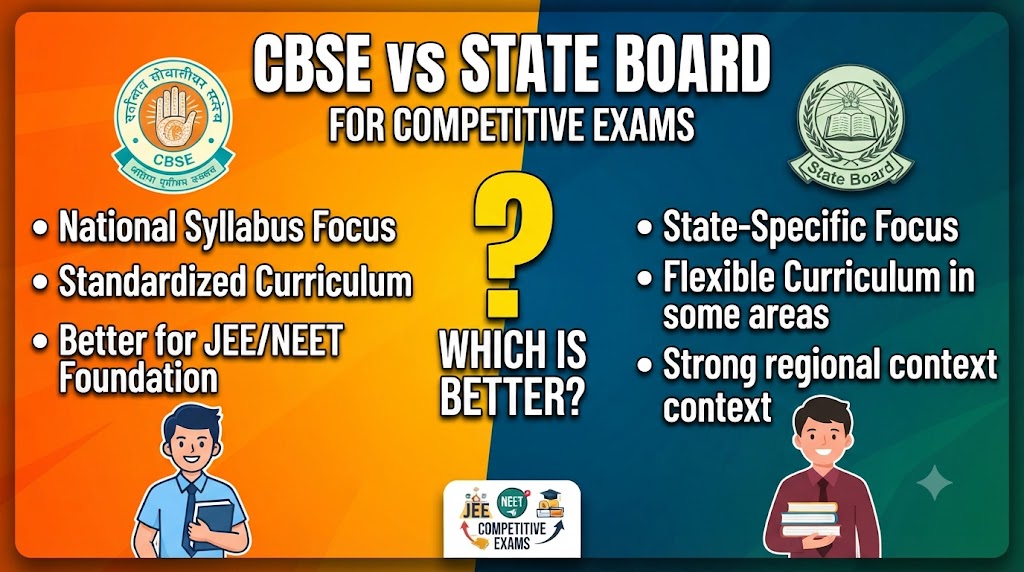
CBSE vs State Board for Competitive Exams
Introduction
Choosing between CBSE and a State Board is an important decision for students preparing for competitive examinations. Both boards provide school education, but their syllabuses, teaching approaches, examination patterns, and learning resources can differ. Students preparing for examinations such as JEE, NEET, CUET, and other entrance tests need a strong understanding of their school subjects. The right board can help students build this foundation, but success also depends on regular practice, conceptual clarity, and dedicated preparation outside the classroom.
CBSE is often a practical choice for students targeting national-level competitive examinations because its curriculum is broadly aligned with the NCERT textbooks commonly used for JEE and NEET preparation. State Boards can also provide an excellent academic foundation, particularly when students have access to good teachers and suitable study materials. However, State Board syllabuses and examination patterns vary by state. Therefore, the better option depends on the student’s target examination, preferred language of instruction, school quality, and ability to manage additional preparation.
Quick Comparison Table
| Feature | CBSE | State Board |
|---|---|---|
| Curriculum | National curriculum framework | Varies by state |
| JEE preparation | Often convenient due to NCERT alignment | May require additional syllabus alignment |
| NEET preparation | Often convenient due to NCERT alignment | NCERT-based preparation may be needed alongside board studies |
| CUET preparation | Depends on subjects and university requirements | Depends on subjects and university requirements |
| Study materials | Widely available NCERT-based resources | State textbooks plus supplementary resources |
| Language options | English, Hindi, and other available options, depending on the school | Often strong regional-language options |
| Board examination pattern | Generally consistent nationally | Varies by state |
| Local educational relevance | Nationally oriented curriculum | May align closely with state-level educational needs |
| Best suited for | Many students targeting national entrance exams | Students who prefer a state curriculum or regional-language education |
1. CBSE vs State Board: Syllabus and Curriculum
CBSE
CBSE follows a nationally administered curriculum. NCERT textbooks are central to many CBSE subjects, particularly at the secondary and senior secondary levels. This can make it easier for students to coordinate school studies with JEE and NEET preparation.
Students can also find many supplementary books, practice questions, online lessons, and coaching resources designed around NCERT-based learning.
State Board
Each State Board follows its own prescribed syllabus, textbooks, and examination system. Some state syllabuses overlap substantially with NCERT, while others differ in topic coverage, depth, or sequence.
Students can perform well in competitive examinations after studying under a State Board, but they may need to identify syllabus gaps and use additional NCERT textbooks or other suitable preparation materials.
Verdict: CBSE is generally more convenient for students targeting national engineering and medical entrance examinations.
2. CBSE vs State Board for JEE Preparation
The Joint Entrance Examination (JEE) is used for admission to various engineering institutions, including IITs through JEE Advanced and NITs through JEE Main.
CBSE
CBSE can provide a convenient starting point because NCERT textbooks support the development of concepts in Physics, Chemistry, and Mathematics. These concepts are important for JEE preparation.
However, studying only the school syllabus is usually insufficient for competitive-level questions. Students must also practise numerical problems, application-based questions, and mock tests.
State Board
State Board students can also prepare successfully for JEE. They should compare their prescribed syllabus with the current official JEE syllabus and cover any missing or differently emphasised topics.
Additional practice from suitable reference books, question banks, and mock tests can help them develop the problem-solving skills required for the examination.
Verdict: CBSE has a convenience advantage, but neither board guarantees a better JEE rank.
3. CBSE vs State Board for NEET Preparation
The National Eligibility cum Entrance Test (NEET-UG) is the principal entrance examination for undergraduate medical admissions in India, subject to applicable admission rules.
CBSE
CBSE students studying Biology, Physics, and Chemistry often find NCERT-based preparation straightforward because NCERT textbooks are an important resource for NEET.
A strong understanding of textbook concepts, regular revision, and practice with examination-style questions are essential.
State Board
State Board students can also prepare effectively for NEET. They should study the current official NEET syllabus and use NCERT Biology, Chemistry, and Physics resources where appropriate to cover the required content.
Students studying in a regional language should check the current examination’s available question-paper languages and select suitable learning resources.
Verdict: CBSE is often the more convenient option for NEET preparation, but State Board students can also compete successfully with structured preparation.
4. CBSE vs State Board: Teaching Methods and Exam Pattern
CBSE
CBSE schools generally follow a common national curriculum and examination framework. The extent of conceptual teaching, practical work, and examination preparation depends on the individual school and its teachers.
Students targeting competitive examinations still need to practise questions that go beyond routine school examinations.
State Board
State Board examination patterns vary. Some schools emphasise textbook-based learning and written examinations, while others provide strong conceptual teaching and competitive-exam support.
The quality of teaching matters more than the board’s name alone. A well-managed State Board school with experienced teachers may be a better learning environment than a poorly managed CBSE school.
Verdict: Neither board is automatically superior in teaching quality. Compare the actual schools before deciding.
5. CBSE vs State Board: Study Materials and Coaching
CBSE
CBSE students can access extensive NCERT-based learning resources, online lectures, practice papers, and competitive-exam coaching materials. This can simplify the process of coordinating school studies with entrance preparation.
State Board
State Board students have access to state-prescribed textbooks and competitive-exam resources. Depending on the state syllabus, they may need additional materials to match the entrance examination requirements.
Coaching is not compulsory for every student. A disciplined self-study routine, good teaching, and regular testing can also support effective preparation.
Verdict: CBSE often offers a more direct route to NCERT-aligned preparation, although resources are available to students from both boards.
6. CBSE vs State Board: Language and Affordability
CBSE
CBSE schools are available in many parts of India and offer different language options depending on the institution. School fees vary considerably between government, private, and other school categories.
State Board
State Board schools may provide more convenient access to regional-language education. Government schools can also be an affordable option, although facilities and teaching quality differ from school to school.
For students who understand concepts better in their mother tongue, a suitable regional-language school can be a meaningful advantage. They may need to learn the terminology used in their target competitive examination as well.
Verdict: State Board may be preferable for regional-language learning or affordability in some situations. Actual school facilities and costs should be compared.
7. Which Board Is Better for Different Competitive Exams?
| Examination | Practical choice | Reason |
|---|---|---|
| JEE Main and Advanced | CBSE often convenient | Strong alignment with NCERT-based learning, alongside advanced practice |
| NEET-UG | CBSE often convenient | NCERT-based study is an important part of preparation |
| CUET-UG | Depends on subjects | Students must meet the current subject and eligibility requirements |
| State-level entrance exams | Depends on the exam | Some examinations may reflect state-specific requirements |
| Government recruitment exams after school | Depends on the examination | The board is generally less important than the required qualification and exam preparation |
Students should always check the current official syllabus, eligibility rules, and admission requirements for their target examination.
Advantages and Disadvantages
CBSE
Advantages
- NCERT-aligned studies can simplify JEE and NEET preparation.
- Nationally consistent curriculum and board examination framework.
- Wide availability of supplementary learning resources.
- Convenient for many students who may relocate between states.
Disadvantages
- School fees can be high at some private institutions.
- Competitive-exam preparation still requires additional practice.
- The quality of teaching differs considerably between schools.
State Board
Advantages
- Often provides convenient regional-language learning options.
- Government schools may be more affordable.
- Curriculum can be closely connected to local educational requirements.
- Strong teachers and effective schools can provide excellent academic preparation.
Disadvantages
- Syllabus differences may require additional preparation for national entrance examinations.
- Access to particular coaching resources can vary by location.
- Students may need to supplement prescribed textbooks with NCERT materials.
Final Verdict: CBSE vs State Board for Competitive Exams
CBSE is generally the more convenient choice for students primarily targeting JEE or NEET, because NCERT-based learning can make it easier to coordinate school studies with competitive-exam preparation.
However, a State Board is not a barrier to success. Students who understand their concepts, follow the official entrance-exam syllabus, use appropriate study materials, and practise consistently can perform well regardless of their board.
Before making a decision, compare the quality of teaching, school fees, language options, travel distance, and available preparation support. A good school that matches a student’s needs is more valuable than choosing a board based on its name alone.
Disclaimer
Curriculum details, examination syllabuses, eligibility conditions, and admission rules may change. Students and parents should consult the latest official CBSE, relevant State Board, NTA, JEE, and NEET information before making educational decisions.