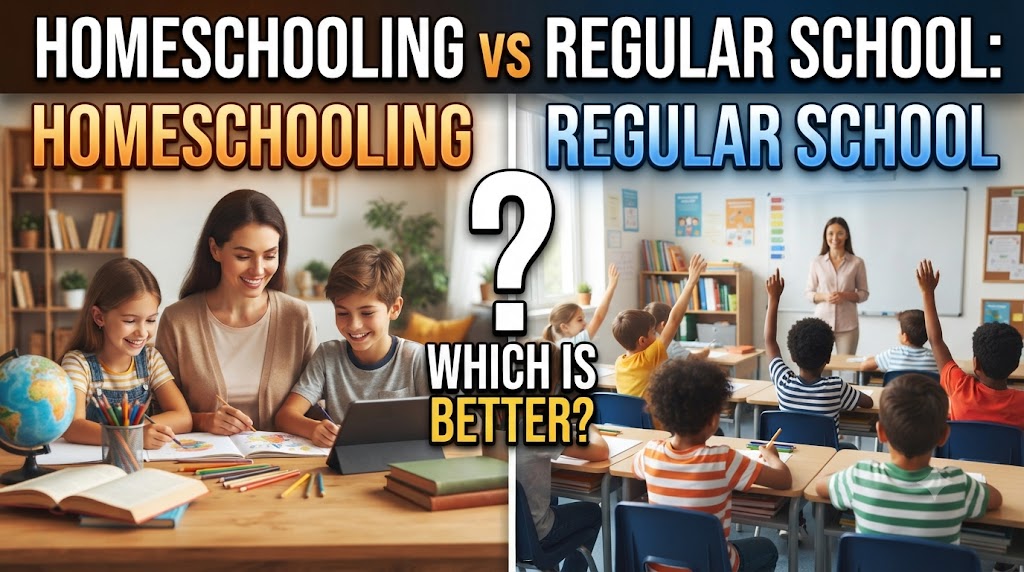
Homeschooling vs Regular School
Introduction
Choosing between homeschooling and regular school is an important decision that can affect a child’s education, daily routine, and social development. Homeschooling allows parents or guardians to take primary responsibility for a child’s learning, using textbooks, tutors, online courses, and other educational resources. Regular school provides a structured environment where students learn with teachers and classmates, follow an established timetable, and participate in classroom activities. Both approaches can support academic development, but their effectiveness depends on the child’s needs, the quality of instruction, family circumstances, and access to suitable learning resources.
Regular school can offer daily face-to-face interaction, trained teachers, organized assessments, and access to facilities such as laboratories, libraries, and sports grounds, depending on the school. Homeschooling can provide greater flexibility, individualized attention, and control over the pace of learning. However, it usually requires substantial parental involvement and deliberate planning for social interaction and recognized qualifications. Parents should consider their child’s age, personality, learning preferences, educational goals, and the time they can dedicate to learning. They should also verify applicable education regulations and qualification requirements before deciding which approach is appropriate.
Quick Comparison Table
| Feature | Homeschooling | Regular School |
|---|---|---|
| Teaching responsibility | Mainly parents or guardians, with tutors or other resources as needed | School teachers and educational staff |
| Learning environment | Usually at home or other selected learning locations | Physical classrooms and school facilities |
| Curriculum | Organized by the family, subject to applicable requirements | Set by the school and relevant education board |
| Learning pace | Can be adjusted to the child’s needs | Generally follows the class timetable and curriculum |
| Social interaction | Requires planned activities and community involvement | Regular interaction with classmates and teachers |
| Schedule | Usually more flexible | Usually follows fixed school hours |
| Parental involvement | Often substantial | Varies, with school staff managing daily instruction |
| Practical activities | Depend on resources and arrangements | May include laboratories, sports, and organized activities |
| Cost | Depends on materials, tutors, and examinations | Depends on school type, fees, transport, and other expenses |
| Best suited for | Families able to organize personalized education | Children who benefit from structured classroom learning |
1. Teaching Quality and Academic Learning
Homeschooling
Homeschooling allows parents to choose teaching methods that suit their child’s learning style. They can spend more time explaining difficult topics, use educational videos, arrange tutoring, and combine theoretical lessons with practical activities. However, effective homeschooling requires careful planning, subject knowledge or access to qualified tutors, and regular assessment of the child’s progress.
Regular School
Regular schools generally provide teachers responsible for different subjects, a planned curriculum, scheduled lessons, and established assessment methods. Students can ask questions during class and receive feedback on their work. The actual quality of teaching varies from school to school, so parents should evaluate the teachers and learning environment rather than relying only on the school’s reputation.
Verdict: Homeschooling can provide individualized instruction, while regular school offers organized teaching across subjects. The better option depends on the quality of instruction available in each setting.
2. Social Skills and Friendships
Homeschooling
Homeschooled children can develop friendships through sports, clubs, community activities, hobby classes, and groups involving other homeschooled students. Parents need to arrange these opportunities consistently so children can interact with different people and practise teamwork.
Regular School
Regular school provides routine opportunities to communicate and cooperate with classmates. Group projects, classroom discussions, games, and school events can help children develop social skills and learn to work with others.
Verdict: Regular school makes everyday peer interaction easier to access. Homeschooling can also support healthy social development when families deliberately create regular opportunities for children to socialize.
3. Flexibility and Learning Pace
Homeschooling
Parents can adjust the daily schedule, spend additional time on challenging subjects, and allow a child to progress more quickly through familiar material. They can also plan lessons around family circumstances and individual interests while ensuring that essential learning goals are met.
Regular School
Regular schools generally follow a fixed timetable and teach students according to a class-level curriculum. This structure helps establish routine, although teachers may have limited time to adapt every lesson to each student’s individual pace.
Verdict: Homeschooling usually offers more flexibility, while regular school provides a consistent timetable and shared learning structure.
4. Discipline and Daily Routine
Homeschooling
Families can design a routine around the child’s needs and preferred learning times. However, parents must establish clear expectations, monitor assignments, and ensure that flexible schedules do not lead to inconsistent study habits.
Regular School
Attendance rules, classroom routines, homework, and scheduled examinations provide an established structure. This can help students practise punctuality, follow instructions, and manage responsibilities, although the quality of discipline and support varies between schools.
Verdict: Regular school provides more built-in structure. Homeschooling can work well when families maintain consistent routines and monitor progress.
5. Cost and Financial Considerations
Homeschooling
Expenses may include textbooks, learning materials, educational software, tutors, extracurricular activities, and examination fees. Families may save on transport, uniforms, and certain school charges, but parents also need to consider the time required to organize and supervise education.
Regular School
Costs vary according to whether the school is government-run or private. Expenses can include tuition, uniforms, transport, books, meals, and activities. Government schools may offer a more affordable route in many areas, while private schools can have a wide range of fee structures.
Verdict: Neither option is automatically less expensive. Compare the total cost of instruction, materials, examinations, activities, and transport.
6. Practical Learning and Extracurricular Activities
Homeschooling
Parents can arrange science experiments, educational visits, sports, music lessons, art activities, and community projects. These experiences can be valuable, but access depends on the family’s time, budget, local facilities, and ability to organize suitable activities.
Regular School
Many schools provide access to laboratories, libraries, playgrounds, sports teams, assemblies, and extracurricular clubs. The availability and quality of these opportunities depend on the individual school.
Verdict: Regular school may make organized activities and facilities easier to access. Homeschooling can provide rich practical learning when parents arrange appropriate resources and experiences.
7. Individual Attention and Emotional Support
Homeschooling
Parents may be able to identify learning difficulties early and adapt lessons to a child’s pace, interests, and preferences. A familiar learning environment can be helpful for some children, but parents must also recognize when professional educational support is needed.
Regular School
Teachers can provide academic feedback, while school counsellors or other support staff may be available where provided by the school. Students can also learn alongside peers with different personalities and perspectives. However, the level of individual attention depends on class size and school resources.
Verdict: Homeschooling may offer more direct individual attention, while regular school can provide a wider network of teachers, peers, and support services.
8. Examinations, Recognition, and Future Education
Homeschooling
Families must plan how the child will demonstrate academic progress and obtain a qualification accepted for future education. Requirements depend on the country, relevant education rules, examination board, and intended pathway. In India, parents should verify current eligibility and examination requirements before choosing a homeschooling arrangement.
Regular School
Students generally follow an established school curriculum and assessment pathway. If the school is appropriately recognized and the student meets the required conditions, this can provide a more straightforward route to board examinations and subsequent education.
Verdict: Regular school often offers a more direct qualification pathway. Homeschooling can also support future studies, but families should confirm examination eligibility and qualification recognition early.
Which Option Is Better for Different Children?
| Child or family situation | Potentially suitable option |
|---|---|
| Child enjoys learning with classmates | Regular school |
| Child benefits from a highly individualized pace | Homeschooling may be suitable |
| Parents have limited time for daily teaching | Regular school may be more practical |
| Family can commit time to planning and supervising education | Homeschooling may work well |
| Child benefits from organized sports and school activities | Regular school, depending on facilities |
| Family needs a flexible daily schedule | Homeschooling |
| Parents want an established examination pathway | Regular school, after checking recognition |
| Family can arrange tutors, resources, and social activities | Homeschooling may be a viable option |
Advantages and Disadvantages
Homeschooling
Advantages
- Allows personalized learning and flexible scheduling.
- Gives parents greater control over educational materials and teaching methods.
- Can provide individual attention.
- Reduces the need for daily commuting.
Disadvantages
- Requires considerable parental time and planning.
- Access to specialist teachers and practical resources may be limited.
- Social activities need to be arranged deliberately.
- Examination eligibility and qualification recognition require careful planning.
Regular School
Advantages
- Provides structured lessons and established academic routines.
- Offers regular opportunities for peer interaction.
- May provide access to laboratories, sports, libraries, and other facilities.
- Usually follows a defined assessment and qualification pathway.
Disadvantages
- Offers less control over the timetable and curriculum pace.
- Individual attention varies by class size and teaching quality.
- Daily commuting can take time and add costs.
- School quality and facilities vary considerably.
Final Verdict: Homeschooling vs Regular School
Regular school is often the more practical choice for families who want structured teaching, everyday social interaction, organized activities, and a defined examination pathway. Homeschooling may be better for families who need greater flexibility and can provide consistent instruction, supervision, learning resources, and opportunities for social development.
Neither option is automatically better for every child. Parents should consider the child’s age, learning needs, personality, family schedule, budget, and future education plans. A strong learning environment matters more than choosing an approach simply because it is popular.
Before making a final decision, confirm the relevant education regulations, the availability of qualified instruction, and the pathway to a recognized qualification.
Disclaimer: Education regulations, examination eligibility, school recognition, and qualification requirements may change. Check the latest information from the relevant education authorities and examination boards before deciding.