Heat Pump Dryer vs Condenser Dryer
Introduction
Choosing between a heat pump dryer and a condenser dryer depends on your budget, laundry frequency, electricity costs, available space, and drying requirements. Both appliances dry clothes by removing moisture and collecting the resulting water, but they use different methods to manage heat. A heat pump dryer reuses much of the heat generated during drying, while a conventional condenser dryer generally uses an electric heating element to warm the air. This difference can affect electricity consumption, drying time, purchase price, and the overall cost of owning the appliance.
A heat pump dryer is often worth considering for households that dry clothes regularly and want to reduce electricity consumption over time. A condenser dryer may appeal to buyers who prefer a lower initial purchase price or want a simpler alternative to heat pump technology. However, drying performance and cycle duration vary by model, load size, and fabric type. Before purchasing, compare energy ratings, drying capacity, installation requirements, maintenance needs, and warranty coverage to determine which dryer suits your household best.
Quick Comparison Table
| Feature | Heat Pump Dryer | Condenser Dryer |
|---|---|---|
| Drying technology | Reuses heat through a heat pump | Usually uses an electric heating element |
| Electricity consumption | Generally lower | Generally higher |
| Initial purchase price | Usually higher | Often lower |
| Drying temperature | Generally lower | Generally higher |
| Drying time | Can be longer | Often shorter, depending on the model |
| Fabric care | Lower temperatures can help protect fabrics | Higher temperatures may be less suitable for some fabrics |
| Moisture collection | Collects condensed moisture | Collects condensed moisture |
| Installation | Usually does not require an external exhaust duct | Usually does not require an external exhaust duct |
| Maintenance | Filters and heat exchanger require care | Filters and condenser require care |
| Best suited for | Frequent drying and lower running costs | Buyers prioritising lower upfront cost |
1. How the Two Dryers Work

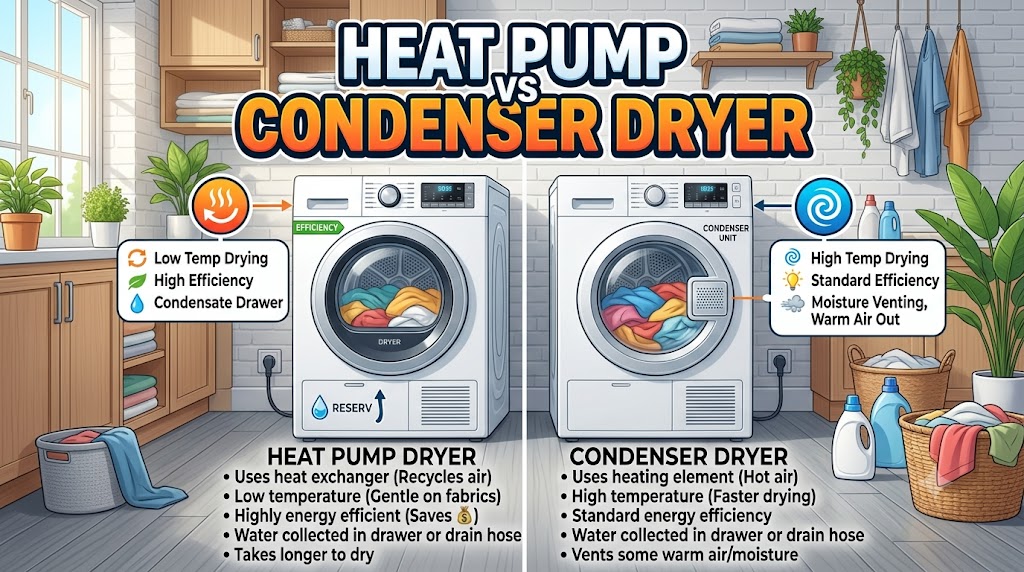
Heat Pump Dryer
Uses a heat pump to reuse heat and dry clothes at relatively low temperatures.

Condenser Dryer
Usually heats air electrically and condenses moisture into a collection tank or drain.
A heat pump dryer circulates air through the drum and uses a refrigeration-based heat pump system to remove moisture and recover heat. Reusing heat reduces the amount of electricity needed to generate new heat during the drying process.
A conventional condenser dryer also circulates warm air through the clothes. Moist air passes through a condenser, where moisture turns into water that is collected in a tank or directed to a drain. The air is then reheated to continue drying.
Both systems can dry clothes effectively. The primary difference is how heat is generated and reused.
Winner: Heat Pump Dryer for heat recovery and energy efficiency.
2. Electricity Consumption
Electricity consumption is one of the biggest differences between these dryer types.
Heat pump dryers generally use less electricity because they recover and reuse heat instead of relying mainly on an electric heating element to generate heat continuously. This can make them attractive for households that dry clothes several times a week.
Condenser dryers without heat pump technology generally consume more electricity per comparable drying load. If the dryer is used frequently, this difference can increase running costs over time.
Actual consumption varies by capacity, program, load size, moisture level, and model efficiency. Compare the manufacturer’s energy figures rather than assuming that every heat pump model has the same consumption.
Winner: Heat Pump Dryer.
3. Purchase Price
Heat pump dryers usually cost more initially because their heat pump systems are more complex.
Condenser dryers are often available at lower prices, making them attractive to people who need a dryer but do not want to spend as much upfront.
However, the cheapest machine may not be the cheapest to own over several years. Consider both the purchase price and expected electricity consumption.
Winner: Condenser Dryer for a lower initial purchase cost.
4. Drying Time
Drying time depends on the machine, the selected program, fabric type, and how wet the clothes are when the cycle begins.
Conventional condenser dryers can often complete comparable cycles more quickly because they generally use higher drying temperatures. Heat pump dryers may take longer because they operate at lower temperatures to improve efficiency and support gentler drying.
However, some heat pump models have fast programs, and certain condenser cycles can also take a long time. Compare the duration of the programs you are most likely to use.
Winner: Condenser Dryer in many comparable models when cycle speed is the priority.
5. Fabric Care and Clothing Protection
Heat pump dryers generally operate at lower temperatures than conventional condenser dryers. This can help reduce heat stress on suitable fabrics and may be beneficial for clothes that require gentler drying.
Condenser dryers typically use higher temperatures, which can increase the risk of shrinking or damaging heat-sensitive fabrics if the wrong program is selected.
Nevertheless, both types offer different temperature settings and fabric-specific programs. Always check the garment’s care label and select the appropriate drying cycle.
Winner: Heat Pump Dryer, generally, for lower-temperature drying.
6. Running Costs and Long-Term Value
A dryer’s total ownership cost includes the purchase price, electricity consumption, maintenance, and repairs.
A heat pump dryer may cost more initially but can save money on electricity when used regularly. The amount saved depends on local electricity prices, the difference in energy consumption, and the number of loads dried each year.
A condenser dryer may offer better value if you use it only occasionally or if the upfront price difference is large relative to your expected electricity savings.
To make a sensible decision, compare energy consumption per cycle and estimate how many loads you dry in a typical week.
Winner: Heat Pump Dryer for frequent use; a condenser dryer may offer better value for occasional use.
7. Maintenance and Cleaning
Both dryer types require regular maintenance.
For a heat pump dryer, you may need to clean the lint filters and maintain the heat exchanger or other components according to the manufacturer’s instructions. Some models provide easier-access cleaning systems than others.
A condenser dryer also requires lint-filter cleaning and periodic condenser maintenance. Water tanks need emptying unless the appliance is connected to a suitable drain.
Poor maintenance can reduce drying performance and increase cycle times in either type. Check how easily the filters and heat exchanger can be accessed before buying.
Winner: Depends on the model and how easy its components are to clean.
8. Installation and Space Requirements
Both heat pump and conventional condenser dryers generally collect moisture rather than exhausting all the moist air outside through a vent. This makes them useful for many indoor laundry areas.
However, both need adequate ventilation around the appliance as specified by the manufacturer, a suitable electrical connection, and enough clearance for safe operation and servicing.
Heat pump dryers can be sensitive to their permitted operating temperature range. Check the installation manual if you plan to place the appliance in a very cold or poorly ventilated utility room.
Winner: Neither universally. Compare the installation requirements of the specific models.
9. Which Dryer Is Better for Indian Homes?
Choose a heat pump dryer if:
- You dry clothes frequently throughout the year.
- You want to reduce electricity consumption.
- You prefer lower-temperature drying for suitable fabrics.
- You plan to keep the appliance for several years.
- Your budget allows for a higher initial purchase price.
Choose a condenser dryer if:
- You want a lower upfront cost.
- You use a dryer only occasionally.
- You prioritise faster drying cycles on suitable programs.
- The model’s energy consumption fits your budget.
- You prefer a straightforward option without paying extra for heat pump technology.
In India, natural sunlight may reduce the need for machine drying during dry weather. If you mostly dry clothes outdoors and use a dryer only during the monsoon or winter, calculate whether the extra purchase cost of a heat pump model is worthwhile.
Pros and Cons
| Heat Pump Dryer | Condenser Dryer |
|---|---|
| Generally uses less electricity | Often cheaper to purchase |
| Reuses heat during drying | Often offers shorter cycles |
| Lower drying temperatures can benefit fabrics | Can be useful for occasional drying |
| Higher initial cost | Generally higher electricity consumption |
| Some cycles may take longer | Higher temperatures need careful fabric selection |
| Heat exchanger maintenance may be required | Condenser and lint filters need cleaning |
Final Verdict: Heat Pump Dryer vs Condenser Dryer
A heat pump dryer is generally the better choice for households that dry clothes frequently and want lower electricity consumption over the long term. It can also be a good option if you prefer lower-temperature drying for suitable fabrics.
A condenser dryer may be the better purchase if you have a limited budget, dry clothes occasionally, or value faster cycles over long-term energy savings.
Before buying, compare the actual energy consumption, cycle duration, drying capacity, maintenance requirements, and warranty. The best choice depends on how often you use the dryer and how much you are willing to spend upfront.
Frequently Asked Questions
1. Which dryer uses less electricity?
Heat pump dryers generally use less electricity than conventional condenser dryers because they recover and reuse heat during drying.
2. Is a heat pump dryer worth the extra cost?
It can be worthwhile if you dry clothes frequently and expect the electricity savings to offset the higher purchase price over time.
3. Does a heat pump dryer take longer to dry clothes?
Some heat pump cycles take longer because they operate at lower temperatures. Actual cycle times vary by model, program, and load.
4. Which dryer is better for delicate clothes?
Heat pump dryers generally offer an advantage through lower-temperature drying, but you should always use a suitable fabric program and follow garment-care instructions.
5. Do condenser dryers need an exhaust vent?
Conventional condenser dryers generally collect water in a tank or drain rather than requiring an external exhaust duct. Always check the installation requirements for the particular model.
Disclaimer
Dryer prices, energy ratings, cycle times, capacities, warranty conditions, and maintenance requirements vary by model and may change over time. Check the manufacturer’s current specifications and installation instructions before purchasing.