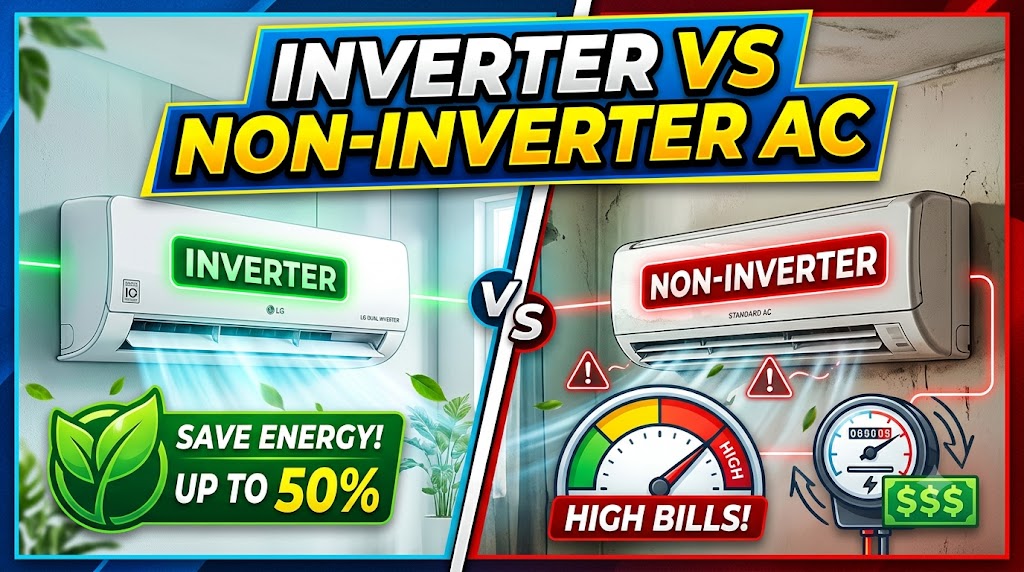
Inverter AC vs Non-Inverter AC
Introduction
Choosing between an inverter AC and a non-inverter AC depends on your cooling requirements, electricity budget, purchase budget, and daily usage. Both types are designed to cool indoor spaces, but they operate their compressors differently. An inverter AC adjusts compressor speed according to cooling demand, while a conventional non-inverter AC generally runs its compressor at a fixed speed and switches it on or off to maintain the selected temperature. Understanding this difference helps you compare electricity consumption, temperature control, noise, price, and long-term value before buying an air conditioner.
An inverter AC is often preferred for its potential energy savings, particularly when it operates for several hours a day. However, a non-inverter AC can still be suitable for buyers who want a lower initial purchase price or use air conditioning occasionally. Actual performance depends on the specific model, cooling capacity, room size, outdoor temperature, insulation, and energy rating. Instead of assuming that one type is always better, compare the annual electricity consumption, cooling capacity, warranty, and total purchase cost of the models that meet your requirements.
Quick Comparison Table
| Feature | Inverter AC | Non-Inverter AC |
|---|---|---|
| Compressor operation | Adjusts speed according to cooling demand | Generally operates at a fixed speed |
| Electricity consumption | Can use less electricity under suitable conditions | May use more electricity in comparable conditions |
| Temperature control | Can maintain temperature with fewer compressor cycles | Temperature fluctuates as the compressor switches on and off |
| Noise | Often quieter during reduced-speed operation | Compressor starting and stopping may be more noticeable |
| Purchase price | Often costs more | Often costs less |
| Cooling performance | Depends on capacity and model | Depends on capacity and model |
| Maintenance | Requires regular AC maintenance | Requires regular AC maintenance |
| Best suited for | Frequent or extended use when efficiency matters | Buyers prioritising upfront affordability or occasional use |
1. Compressor Technology
Inverter AC
An inverter AC uses electronic controls to adjust compressor speed according to the cooling demand. When the room is hot, the compressor can operate faster. As the room approaches the selected temperature, it can slow down instead of repeatedly switching off and restarting.
Non-Inverter AC
A non-inverter AC generally runs its compressor at a fixed speed. The compressor switches on when cooling is needed and switches off when the thermostat detects that the target temperature has been reached.
Winner: Inverter AC for its ability to vary compressor speed and respond more gradually to changing cooling demand.
2. Electricity Consumption
Inverter AC
An inverter AC can reduce electricity consumption by adjusting compressor output instead of relying on repeated full-speed operating cycles. This can be particularly useful when the AC runs for extended periods.
Non-Inverter AC
A non-inverter AC repeatedly starts and stops its compressor as cooling is needed. Depending on the model and operating conditions, this can result in higher electricity consumption.
Winner: Inverter AC, in many comparable situations. However, actual savings depend on the models’ efficiency ratings, cooling capacity, room conditions, and usage.
3. Temperature Control
Inverter AC
An inverter AC can maintain cooling by reducing compressor speed as the room approaches the selected temperature. This can help reduce temperature fluctuations.
Non-Inverter AC
A non-inverter AC cools at its operating speed until the thermostat switches the compressor off. When the temperature rises again, the compressor restarts, creating a more noticeable cooling cycle.
Winner: Inverter AC for generally more gradual temperature regulation.
4. Noise Levels
Inverter AC
An inverter AC can run at a lower compressor speed when less cooling is required. This often reduces operating noise, although the indoor fan and outdoor unit still contribute to overall sound levels.
Non-Inverter AC
A non-inverter AC’s compressor switches on and off during operation. These cycles can make starting sounds more noticeable, depending on the unit and installation.
Winner: Inverter AC in many cases, but compare the actual indoor and outdoor noise ratings before buying.
5. Purchase Price
Inverter AC
Inverter ACs often cost more initially because of their compressor technology and electronic controls. Prices vary according to capacity, brand, features, and energy rating.
Non-Inverter AC
Non-inverter ACs are often available at lower initial prices. They can be attractive when the purchase budget is limited.
Winner: Non-inverter AC for buyers who prioritise a lower upfront cost.
6. Cooling Performance
Inverter AC
An inverter AC can adjust its cooling output to changing conditions. Its performance still depends on correct sizing, the rated capacity, installation quality, and the room’s heat load.
Non-Inverter AC
A properly sized non-inverter AC can also cool a room effectively. Its fixed-speed compressor cycles on and off to maintain the selected temperature.
Winner: Depends. Neither type automatically cools every room better. Choose the correct capacity for your room and compare model-specific performance.
7. Maintenance and Repair Costs
Inverter AC
An inverter AC requires regular filter cleaning, outdoor-unit care, and periodic servicing. If electronic control components or the compressor fail, repairs may require specialised parts and technicians.
Non-Inverter AC
A non-inverter AC also requires routine cleaning and maintenance. Repair costs depend on the specific fault, parts availability, and local service charges.
Winner: Depends. Neither type is guaranteed to be cheaper to maintain. Compare warranty terms and local service support.
8. Long-Term Cost and Value
Inverter AC
An inverter AC may offer better long-term value when electricity savings over several years outweigh its higher purchase price. The result depends on how often the AC is used, the electricity tariff, and the efficiency of the particular model.
Non-Inverter AC
A non-inverter AC may provide good value when its initial price is substantially lower and usage is limited. However, frequent use can make electricity consumption an important part of its total cost.
Winner: Depends. Consider both the initial price and expected electricity costs over the period you plan to use the AC.
9. Which AC Should You Choose?
Choose an Inverter AC If:
- You use the AC for several hours most days.
- You want to prioritise potential electricity savings.
- You prefer more gradual temperature control.
- You find a model with a suitable energy rating and warranty.
Choose a Non-Inverter AC If:
- Your initial purchase budget is limited.
- You use the AC occasionally or for shorter periods.
- You find a model that meets your cooling needs at an attractive price.
- You are comfortable comparing its electricity consumption with other options.
Final Verdict: Inverter AC vs Non-Inverter AC
An inverter AC is generally a strong choice for frequent use because its variable-speed compressor can reduce electricity consumption under suitable conditions and provide more gradual temperature control. A non-inverter AC remains a reasonable option for buyers who prioritise a lower purchase price or have limited cooling requirements.
Before buying, compare cooling capacity, BEE energy ratings, annual electricity consumption, noise levels, warranty, and total price. The best AC is the one that meets your room’s cooling needs while providing suitable overall value.
Disclaimer
AC prices, cooling capacities, energy ratings, and features vary by manufacturer and model. Actual electricity consumption depends on usage, room conditions, outdoor temperature, installation, and maintenance. Check the latest product specifications and energy label before purchasing.