Single Inverter AC vs Dual Inverter AC
Introduction
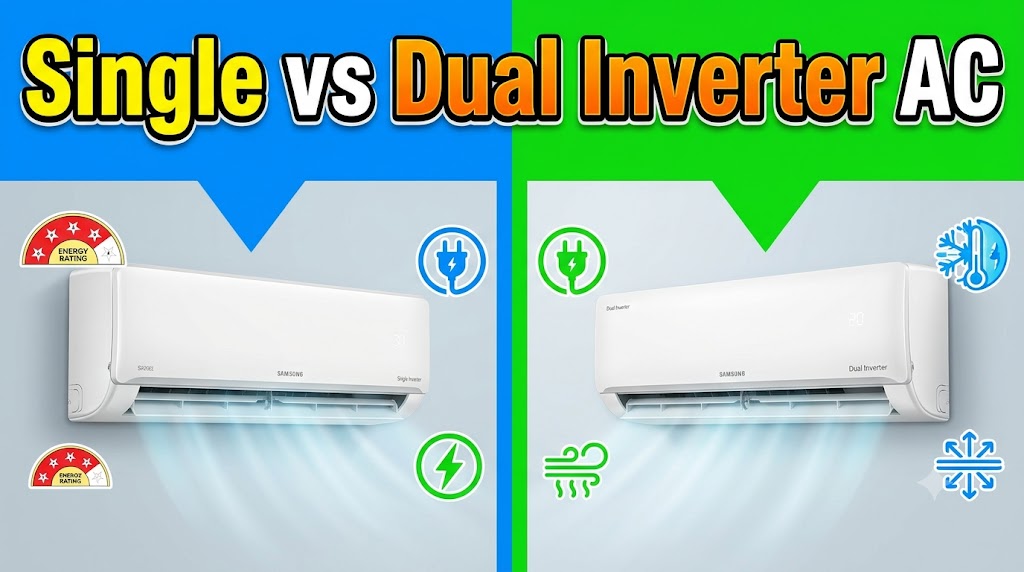
Choosing between a single inverter AC and a dual inverter AC can be confusing because both use inverter technology to adjust compressor operation according to cooling demand. The main difference is in the compressor design and how the manufacturer implements variable-speed operation. A single inverter AC typically uses a conventional inverter compressor design, while a dual inverter AC uses a different compressor mechanism designed to provide variable-speed operation with its own performance characteristics. The actual benefits depend on the brand, model, room size, outdoor temperature, and energy-efficiency rating.
A dual inverter AC is often marketed for efficient cooling, quieter operation, and reduced electricity consumption. However, these benefits are not identical across all models, and the term “dual inverter” does not mean that the AC has two separate compressors. A single inverter AC can also provide efficient cooling and good performance when correctly sized for the room. To make a sensible purchase, compare the rated power consumption, cooling capacity, energy label, noise levels, warranty, and price rather than relying on the compressor name alone.
Quick Comparison Table
| Feature | Single Inverter AC | Dual Inverter AC |
|---|---|---|
| Compressor design | Conventional inverter compressor design | Dual-rotary or other manufacturer-specific dual-inverter design |
| Speed adjustment | Adjusts compressor operation according to cooling demand | Also adjusts compressor operation according to cooling demand |
| Electricity consumption | Depends on model efficiency and usage | May be lower in comparable models, but not guaranteed |
| Cooling performance | Depends on capacity and compressor design | May offer efficient operation across a range of cooling demands |
| Noise levels | Vary by model and installation | May offer quieter operation, depending on design |
| Purchase price | Often more affordable | Often costs more |
| Maintenance | Requires normal AC maintenance | Requires normal AC maintenance |
| Repair costs | Depend on fault and parts availability | Depend on fault and parts availability |
| Best suited for | Buyers seeking inverter cooling at a suitable price | Buyers prioritising efficiency and features when supported by specifications |
1. Compressor Technology
Single Inverter AC
A single inverter AC generally uses an inverter-controlled compressor that adjusts its operating speed to meet the room’s cooling requirements. Instead of relying only on repeated full-speed starts and stops, it can vary its output as conditions change.
Dual Inverter AC
A dual inverter AC commonly uses a dual-rotary compressor design in which two compression chambers or rotary mechanisms work as part of the compressor system. Depending on the specific design, this can help improve operating stability and efficiency.
The exact meaning of “dual inverter” can vary by manufacturer, so checking the product’s technical specifications is important.
Winner: Depends. Dual inverter designs may offer particular efficiency or operating advantages, but the label alone does not establish that a model is better.
2. Electricity Consumption
Single Inverter AC
A single inverter AC can save electricity by reducing compressor output when the room approaches the target temperature. Its actual consumption depends on cooling capacity, energy rating, operating conditions, and usage.
Dual Inverter AC
A dual inverter AC may achieve lower electricity consumption through its compressor design and control system. However, a well-rated single inverter model can outperform a less efficient dual inverter model.
Winner: Depends. Compare the annual electricity consumption on the BEE energy label and the rated power consumption of the actual models.
3. Cooling Performance
Single Inverter AC
A properly sized single inverter AC can cool a room effectively and adjust its compressor operation as cooling demand changes. Its suitability depends on room dimensions, sunlight, insulation, occupancy, and outdoor temperature.
Dual Inverter AC
A dual inverter AC can also adjust cooling output to changing conditions. Some models may provide efficient operation across a broad range of cooling demands, but performance varies by design and capacity.
Winner: Depends. Cooling capacity, sizing, and verified performance specifications matter more than the single or dual inverter label.
4. Noise Levels
Single Inverter AC
Inverter operation can reduce repeated compressor start-up noise. However, indoor fan noise, outdoor-unit vibration, installation quality, and compressor design affect the overall sound level.
Dual Inverter AC
Some dual inverter ACs are designed for stable and quieter operation. Nevertheless, not every dual inverter model is quieter than every single inverter model.
Winner: Depends. Compare the published indoor and outdoor noise levels in decibels (dB) and consider installation quality.
5. Purchase Price
Single Inverter AC
Single inverter ACs are often available at lower prices than comparable dual inverter models. They can offer a good balance of cost and energy-efficient operation.
Dual Inverter AC
Dual inverter ACs may have higher purchase prices because of their compressor design, features, or product positioning. The price difference varies by manufacturer and model.
Winner: Single inverter AC for buyers prioritising a lower initial purchase price.
6. Temperature Control
Single Inverter AC
A single inverter AC adjusts compressor speed to maintain the selected temperature. Its ability to maintain comfortable conditions depends on the control system, cooling capacity, and room conditions.
Dual Inverter AC
A dual inverter AC also adjusts compressor output to meet cooling demand. Its particular control range and temperature stability depend on the model’s design.
Winner: Depends. Both types can maintain comfortable room temperatures when properly sized and installed.
7. Maintenance and Repair Costs
Single Inverter AC
Routine maintenance includes cleaning filters, keeping the outdoor unit clear, and arranging periodic servicing. Repair costs depend on the specific fault and the availability of parts.
Dual Inverter AC
A dual inverter AC requires similar routine maintenance. If its compressor or electronic control system develops a fault, the repair cost depends on the design, warranty coverage, and local service availability.
Winner: Depends. Neither compressor type guarantees cheaper maintenance or repairs. Check the warranty and service support before purchasing.
8. Long-Term Value
Single Inverter AC
A single inverter AC can provide good long-term value when its purchase price, energy efficiency, cooling capacity, and warranty suit your needs. A lower upfront cost may be particularly attractive if the model already offers good efficiency.
Dual Inverter AC
A dual inverter AC may justify a higher purchase price if its verified energy savings, noise performance, or other useful features provide sufficient value over time.
Winner: Depends. The better investment is the model that offers the strongest combination of purchase price, operating cost, and performance for your room.
9. Which AC Should You Choose?
Choose a Single Inverter AC If:
- You want inverter technology without paying extra unnecessarily.
- You find a model with a suitable BEE energy rating.
- Your room’s cooling requirements are straightforward.
- You want to balance initial cost with long-term running costs.
Choose a Dual Inverter AC If:
- You find a model with verified efficiency advantages.
- Its published noise levels and features suit your needs.
- You are comfortable paying more if the benefits justify the price.
- The model has appropriate cooling capacity and reliable after-sales service.
Final Verdict: Single Inverter AC vs Dual Inverter AC
A dual inverter AC may be a good choice if a particular model offers better verified efficiency, suitable noise levels, or other useful features for its price. However, a single inverter AC can be equally sensible when it has a strong energy rating, appropriate cooling capacity, and a lower purchase price.
Before deciding, compare the BEE energy label, annual electricity consumption, cooling capacity, noise ratings, warranty, and total price of specific models. Do not assume that every dual inverter AC automatically saves more electricity than every single inverter AC.
Disclaimer
AC prices, cooling capacities, energy ratings, compressor designs, and warranty conditions vary by manufacturer and model. Actual electricity consumption depends on room conditions, usage, maintenance, and outdoor temperature. Verify the latest specifications and energy label before purchasing.