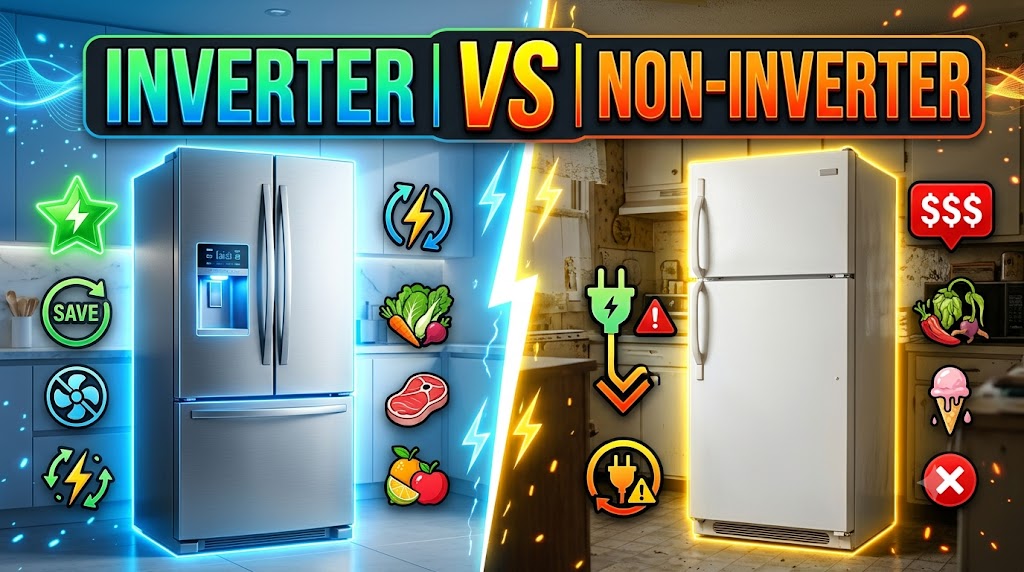
Inverter Refrigerator vs Non-Inverter Refrigerator
Introduction
Choosing between an inverter refrigerator and a non-inverter refrigerator depends on your electricity budget, household requirements, cooling preferences, and purchase budget. Both types keep food refrigerated, but they differ in how their compressors operate. An inverter refrigerator can adjust compressor speed according to cooling demand, while a conventional non-inverter refrigerator generally switches its compressor on and off to maintain the required temperature. Understanding this difference helps you compare electricity consumption, noise, temperature control, price, and long-term suitability before purchasing a refrigerator for your home.
Although inverter refrigerators are often associated with energy efficiency, the actual difference depends on the specific models being compared. Refrigerator capacity, insulation, energy rating, ambient temperature, door-opening frequency, and usage habits all influence electricity consumption. Similarly, a non-inverter refrigerator may be a practical choice when its purchase price is lower and its specifications meet your needs. Rather than choosing solely by compressor type, compare the annual energy consumption, available features, warranty, and price of individual models to make a more informed decision.
Quick Comparison Table
| Feature | Inverter Refrigerator | Non-Inverter Refrigerator |
|---|---|---|
| Compressor operation | Adjusts speed according to cooling demand | Generally switches on and off |
| Electricity consumption | Can use less electricity, depending on the model | May consume more in comparable conditions |
| Temperature control | Can provide more consistent cooling | Temperature fluctuates with compressor cycles |
| Noise | Often quieter during low-speed operation | Starting and stopping can be more noticeable |
| Purchase price | Often costs more | Often more affordable |
| Cooling performance | Depends on design and capacity | Depends on design and capacity |
| Maintenance | Requires normal refrigerator maintenance | Requires normal refrigerator maintenance |
| Repair costs | Depend on the specific fault and parts | Depend on the specific fault and parts |
| Best suited for | Buyers prioritising potential energy savings | Buyers prioritising initial affordability |
1. Compressor Technology
Inverter Refrigerator
An inverter refrigerator uses a compressor that can operate at different speeds. When the refrigerator needs more cooling, the compressor can increase its speed. Once the desired temperature is reached, it can slow down rather than repeatedly stopping and restarting.
Non-Inverter Refrigerator
A non-inverter refrigerator generally operates its compressor at a fixed speed. The compressor switches on when cooling is required and switches off when the temperature reaches the thermostat’s target range.
Winner: Depends. Inverter technology offers more flexible compressor operation, but both types can provide effective refrigeration when properly designed.
2. Electricity Consumption
Inverter Refrigerator
An inverter refrigerator can reduce electricity consumption by adjusting compressor speed to match cooling requirements. Potential savings depend on the model, energy rating, room temperature, and usage habits.
Non-Inverter Refrigerator
A non-inverter refrigerator cycles its compressor on and off. Depending on its efficiency and operating conditions, this can result in higher electricity consumption than a comparable inverter model.
Winner: Inverter refrigerator, when comparing models with similar capacities and suitable energy-efficiency specifications. Check the annual electricity consumption on the energy label before buying.
3. Temperature Control
Inverter Refrigerator
The compressor can run continuously at a lower speed when cooling demand is modest. This can help maintain a more stable temperature under suitable operating conditions.
Non-Inverter Refrigerator
The compressor switches between running and resting periods. As a result, the temperature naturally fluctuates within the thermostat’s operating range.
Winner: Inverter refrigerator for its potential to maintain more consistent temperatures, although performance varies by model.
4. Noise Levels
Inverter Refrigerator
An inverter compressor can run at lower speeds when less cooling is required. This often makes operation quieter, especially when the refrigerator is maintaining its temperature.
Non-Inverter Refrigerator
A non-inverter compressor starts and stops during normal operation. These cycles can produce more noticeable starting sounds, depending on the refrigerator’s construction and condition.
Winner: Inverter refrigerator for generally quieter operation, but actual noise levels should be checked for the individual model.
5. Purchase Price
Inverter Refrigerator
Inverter refrigerators may have a higher initial purchase price because of their compressor technology and associated electronics. However, prices vary by capacity, brand, features, and promotions.
Non-Inverter Refrigerator
Non-inverter refrigerators are often available at lower initial prices. They can be suitable for buyers who want basic refrigeration and need to keep upfront expenses down.
Winner: Non-inverter refrigerator for buyers prioritising the lowest initial purchase price.
6. Maintenance and Repair Costs
Inverter Refrigerator
An inverter refrigerator requires regular cleaning and normal maintenance. If the compressor control electronics or other specialised components fail, repairs may require model-specific parts and qualified technicians.
Non-Inverter Refrigerator
A non-inverter refrigerator also needs routine cleaning and maintenance. Its conventional compressor system may be simpler in some designs, but repair costs still depend on the fault, availability of parts, and labour charges.
Winner: Depends. Neither type is guaranteed to have lower repair costs. Check the compressor warranty, overall product warranty, and local service availability.
7. Cooling Performance and Food Storage
Inverter Refrigerator
Variable-speed compressor operation can help the refrigerator respond to changing cooling demand. However, food preservation also depends on airflow, insulation, temperature settings, and how food is stored.
Non-Inverter Refrigerator
A non-inverter refrigerator can also keep food fresh when it maintains the recommended storage temperature. Its performance depends on the same basic factors, including capacity and cooling-system design.
Winner: Depends. Compressor type alone does not determine which refrigerator preserves food better. Compare actual cooling performance and storage features.
8. Long-Term Value
Inverter Refrigerator
An inverter refrigerator may offer better long-term value if its electricity savings over several years outweigh any extra purchase cost. The outcome depends on the price difference, usage, electricity tariff, and the efficiency of the specific models.
Non-Inverter Refrigerator
A non-inverter refrigerator may offer good value when its lower purchase price is important and the model has acceptable electricity consumption. It may be a sensible choice for buyers who do not use a large refrigerator heavily.
Winner: Depends. Compare the total expected cost of purchase and electricity rather than judging by purchase price alone.
9. Which Refrigerator Should You Choose?
Choose an Inverter Refrigerator If:
- You want to reduce potential electricity costs.
- Your refrigerator operates throughout the day and you prioritise energy efficiency.
- You prefer potentially quieter compressor operation.
- You find a model with a good energy rating and a suitable warranty.
Choose a Non-Inverter Refrigerator If:
- Your main priority is a lower initial purchase price.
- You find a model with acceptable energy consumption.
- You want a straightforward option that meets your storage requirements.
- The price difference between the two models matters more to you than potential electricity savings.
Final Verdict: Inverter Refrigerator vs Non-Inverter Refrigerator
An inverter refrigerator is generally worth considering if you prioritise energy efficiency, quieter operation, and potentially more consistent temperature control. A non-inverter refrigerator can be a reasonable alternative if you want to spend less initially and find a model that meets your household’s cooling and electricity needs.
Before making a decision, compare the actual purchase price, annual electricity consumption, capacity, energy rating, warranty, and service availability. The best option is the one that delivers suitable performance and value for your household rather than simply the one with an inverter label.
Disclaimer
Refrigerator prices, energy ratings, compressor technology, warranty coverage, and features vary by manufacturer and model. Actual electricity consumption and savings depend on usage conditions and local electricity tariffs. Check the latest product specifications and energy label before purchasing.