On-Grid vs Hybrid Solar System
Introduction
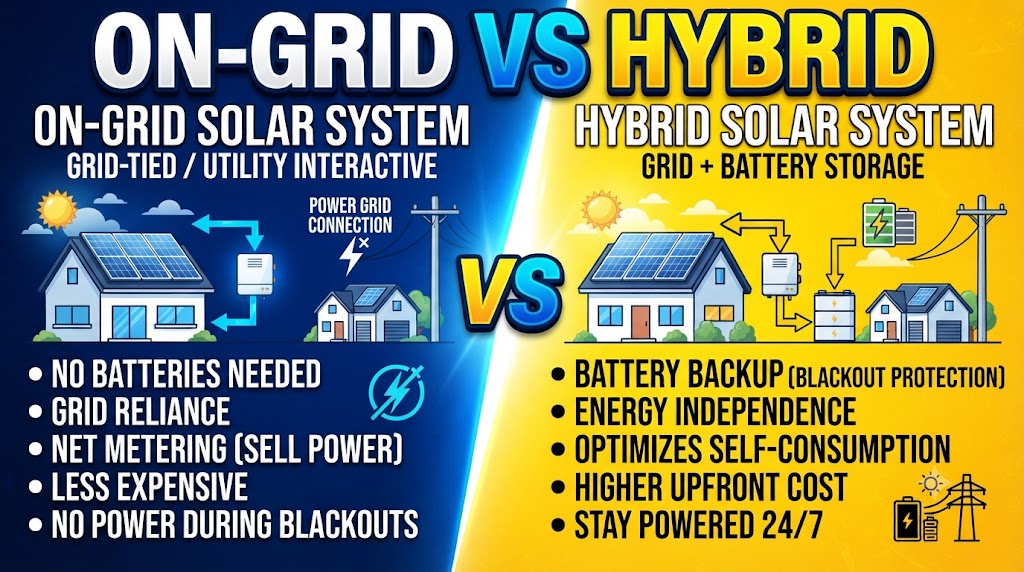
Choosing between an on-grid and a hybrid solar system depends on your electricity requirements, backup needs, available budget and reliability of the electricity supply. Both systems use solar panels to generate electricity, but they differ in how they manage excess energy and provide power during outages. An on-grid solar system connects directly to the electricity grid and generally operates without batteries. A hybrid solar system combines grid connectivity with battery storage, allowing users to store surplus solar electricity and use it when required.
On-grid solar systems are commonly preferred by homeowners and businesses that want to reduce electricity bills without investing in batteries. Hybrid solar systems are suitable for people who want the benefits of grid-connected solar power along with battery backup. They can store excess solar electricity for night-time use or power cuts, depending on the inverter and system configuration. Understanding their differences in cost, backup, energy efficiency, maintenance and performance can help you select the right solar system.
Quick Comparison Table
| Feature | On-Grid Solar System | Hybrid Solar System |
|---|---|---|
| Grid connection | Yes | Yes |
| Battery storage | Usually not included | Supported and generally included for backup |
| Power backup | No backup in standard systems | Yes, with suitable batteries and configuration |
| Excess solar electricity | Can be exported to the grid | Can be stored in batteries or exported |
| Night-time electricity | Draws electricity from the grid | Can use stored battery electricity |
| Initial cost | Generally lower | Generally higher |
| Installation | Comparatively simple | More complex |
| Energy independence | Depends on grid availability | Greater independence with battery storage |
| Electricity bill savings | Yes | Yes |
| Maintenance | Generally lower | Higher due to battery components |
| Best suited for | Reducing electricity bills | Bill savings with backup power |
1. Working Principle
On-Grid Solar System
An on-grid solar system connects solar panels to a grid-connected inverter. Solar panels generate DC electricity, which the inverter converts into AC electricity for household appliances.
The electricity generated by solar panels is first used by connected appliances. If production exceeds household consumption, surplus electricity can be exported to the utility grid through an approved metering arrangement.
When solar generation is insufficient, the system draws electricity from the grid.
Hybrid Solar System
A hybrid solar system combines solar panels, a hybrid inverter, battery storage and a grid connection.
Solar panels generate electricity to operate household appliances. Excess electricity can charge the batteries or be exported to the grid, depending on the system settings and applicable regulations.
When solar generation is insufficient or the grid fails, a suitably configured hybrid inverter can use stored battery electricity to supply selected household loads.
Winner: Hybrid Solar System – It offers more flexibility because it combines grid connectivity with battery storage.
2. Battery Backup
On-Grid Solar System
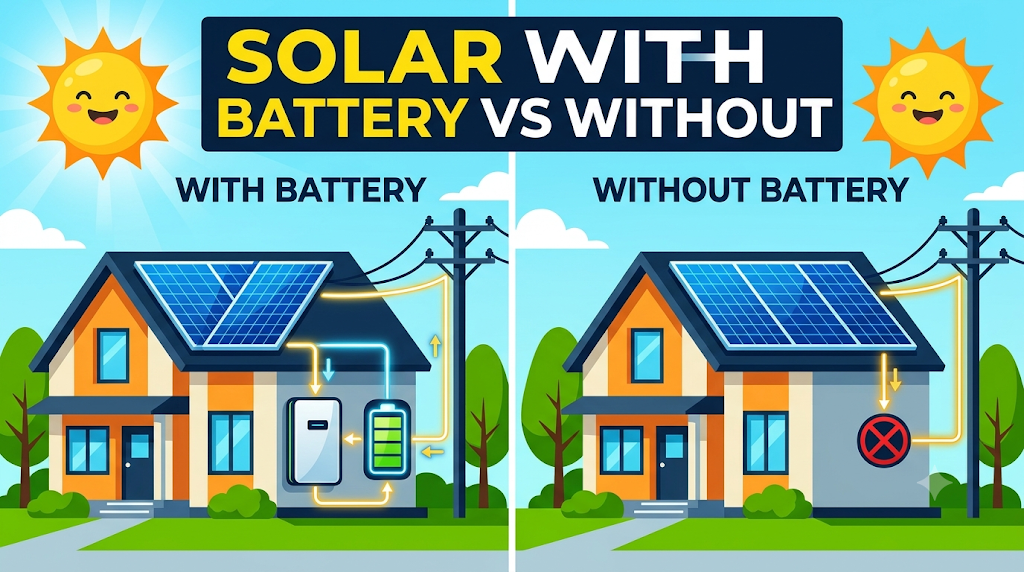
A standard on-grid solar system generally does not include batteries. It depends on the electricity grid whenever solar generation is insufficient.
During a power cut, a standard grid-tied inverter automatically disconnects from the grid for electrical safety. Therefore, solar panels alone cannot normally provide household backup during an outage.
Hybrid Solar System
A hybrid solar system can use batteries to store surplus electricity generated during the day.
During a power cut, a compatible hybrid inverter can supply electricity from the batteries to designated backup circuits. The backup duration depends on battery capacity and the connected electrical load.
Some hybrid systems can also use solar panels to recharge batteries while providing backup power during daylight.
Winner: Hybrid Solar System – It provides battery-based backup when correctly configured.
3. Initial Installation Cost
On-Grid Solar System
On-grid solar systems generally have a lower initial installation cost because they usually do not require batteries.
Their main components include solar panels, a grid-connected inverter, mounting structures, electrical protection equipment and an approved metering arrangement.
This makes them suitable for consumers who primarily want to reduce electricity bills.
Hybrid Solar System
Hybrid solar systems generally cost more because they require a compatible hybrid inverter and battery storage.
The total installation cost depends on battery technology, storage capacity, inverter specifications and backup requirements.
A larger battery bank increases the initial investment but can provide longer backup duration.
Winner: On-Grid Solar System – It is generally more affordable because it avoids the additional battery investment.
4. Electricity Bill Savings
On-Grid Solar System
An on-grid solar system can reduce electricity bills by supplying solar-generated electricity directly to household appliances.
Surplus electricity can be exported to the utility grid through an approved net-metering or other permitted arrangement. This can provide additional financial benefits depending on local electricity policies.
Hybrid Solar System
A hybrid solar system can also reduce electricity bills by using solar-generated electricity directly and storing excess energy in batteries.
Stored electricity can be used at night or during periods of low solar generation, reducing the need to purchase electricity from the grid.
However, battery investment and replacement costs must be considered when calculating long-term savings.
Winner: On-Grid Solar System – It generally offers better financial value when the main objective is reducing electricity bills without paying for battery storage.
5. Performance During Power Cuts
On-Grid Solar System
A standard on-grid solar system automatically shuts down when the electricity grid fails.
This safety feature prevents electricity from being exported into utility lines while maintenance workers may be repairing them.
As a result, the system generally cannot power household appliances during a power cut, even when sunlight is available.
Hybrid Solar System
A hybrid solar system can provide electricity during power cuts using its battery storage and backup output.
Depending on the inverter configuration, solar panels may also continue generating electricity to supply household loads and recharge batteries.
However, the available backup depends on battery capacity, inverter output and the appliances connected to the backup circuit.
Winner: Hybrid Solar System – It provides a practical backup solution during grid failures.
6. Energy Efficiency
On-Grid Solar System
On-grid solar systems generally use generated electricity directly without storing it in batteries.
This avoids the energy losses associated with battery charging and discharging. Surplus electricity can also be exported to the grid when permitted.
This arrangement can be efficient for homes that consume electricity during daylight hours.
Hybrid Solar System
Hybrid solar systems offer greater flexibility in managing electricity, but battery charging and discharging introduce additional energy losses.
The actual efficiency depends on battery technology, inverter performance, operating settings and electricity usage patterns.
Despite these losses, battery storage can provide valuable backup and allow solar electricity to be used after sunset.
Winner: On-Grid Solar System – It generally has an efficiency advantage when electricity is consumed directly without battery storage.
7. Installation and Maintenance
On-Grid Solar System
On-grid systems generally have a simpler installation because they do not normally require batteries or battery management equipment.
Maintenance mainly involves cleaning solar panels, checking electrical connections, inspecting the inverter and monitoring system performance.
Hybrid Solar System
Hybrid systems require additional installation work because they include batteries and a hybrid inverter.
Battery condition, charging performance, electrical connections and inverter operation need periodic inspection.
Maintenance requirements depend on battery technology. Lithium batteries generally require less routine maintenance than some traditional lead-acid battery systems.
Winner: On-Grid Solar System – Its simpler design generally results in lower maintenance requirements.
8. Energy Independence
On-Grid Solar System
An on-grid solar system depends on the utility grid whenever solar generation is insufficient.
It can reduce dependence on purchased electricity during daylight hours, but it cannot normally provide electricity during grid failures without additional backup equipment.
Hybrid Solar System
A hybrid solar system offers greater energy independence because it can store solar electricity for later use.
With adequate solar panel capacity and battery storage, a household can reduce its dependence on grid electricity during evenings and power cuts.
However, complete independence depends on solar generation, battery capacity, seasonal sunlight and household consumption.
Winner: Hybrid Solar System – Battery storage provides greater independence from the utility grid.
Advantages and Disadvantages
| Solar System | Advantages | Disadvantages |
|---|---|---|
| On-Grid | Lower initial cost; no regular battery replacement; can export surplus electricity; generally lower maintenance | No backup during grid failure in standard systems; depends on grid availability |
| Hybrid | Battery backup; grid connectivity; stores surplus solar electricity; greater energy independence | Higher installation cost; battery replacement expenses; more complex maintenance |
Which One Should You Choose?
Choose an On-Grid Solar System if:
- Your home has a reliable electricity connection.
- Your main objective is reducing monthly electricity bills.
- You want a lower initial installation cost.
- You do not need solar-powered backup during power cuts.
- You want to avoid battery replacement expenses.
Choose a Hybrid Solar System if:
- Your area experiences frequent power cuts.
- You need battery backup for essential appliances.
- You want to store excess solar electricity for night-time use.
- You want greater independence from grid electricity.
- Your budget allows for the additional battery investment.
Final Verdict: On-Grid vs Hybrid Solar System
Both on-grid and hybrid solar systems can reduce dependence on conventional electricity and help lower household electricity bills.
An on-grid solar system is generally more economical for homes with reliable electricity connections. It requires less initial investment and avoids battery-related maintenance and replacement costs.
A hybrid solar system is a better option for households that need electricity backup during power cuts and want to store excess solar energy for later use. Its additional battery investment provides greater flexibility and energy independence.
Overall Winner: Hybrid Solar System – It offers more features, battery backup and greater flexibility. However, an on-grid solar system is the better financial choice when electricity bill reduction is the main priority and power backup is not required.
Frequently Asked Questions (FAQs)
1. Which is better, an on-grid or hybrid solar system?
A hybrid solar system is better when battery backup and greater energy independence are important. An on-grid system is generally better for reducing electricity bills with a lower initial investment.
2. Does a hybrid solar system work during power cuts?
Yes. A properly configured hybrid solar system can supply electricity from its batteries during power cuts. Some systems can also use available solar generation to support loads and recharge batteries.
3. Does an on-grid solar system require batteries?
No. Standard on-grid solar systems generally operate without batteries because they use the utility grid to manage surplus and insufficient electricity.
4. Which solar system is cheaper?
An on-grid solar system is generally cheaper because it does not normally require battery storage or a hybrid inverter.
5. Can a hybrid solar system export excess electricity to the grid?
Yes. Compatible hybrid systems can export surplus electricity when configured and approved under applicable utility regulations.
6. Can a hybrid solar system run an entire house?
Yes, if the solar panels, inverter and batteries are appropriately sized for the household’s electricity consumption and peak load. The backup output and connected circuits must also support the required appliances.
7. Which solar system is better for areas with frequent power cuts?
A hybrid solar system is generally better because it can provide battery backup when the electricity grid fails.
8. Is a hybrid solar system worth the extra cost?
It can be worthwhile for households that experience frequent power cuts or need backup electricity. For households with reliable grid power, the additional battery investment may not provide sufficient financial benefit.
Disclaimer
Solar system performance, installation costs, electricity savings, battery capacity and maintenance requirements vary according to location, sunlight availability, equipment quality and household consumption. Government subsidies, net-metering permissions and electricity export rules depend on applicable schemes and DISCOM regulations. Always check current requirements and consult a qualified solar installer before purchasing.