Monocrystalline vs Polycrystalline Solar Panels
Introduction
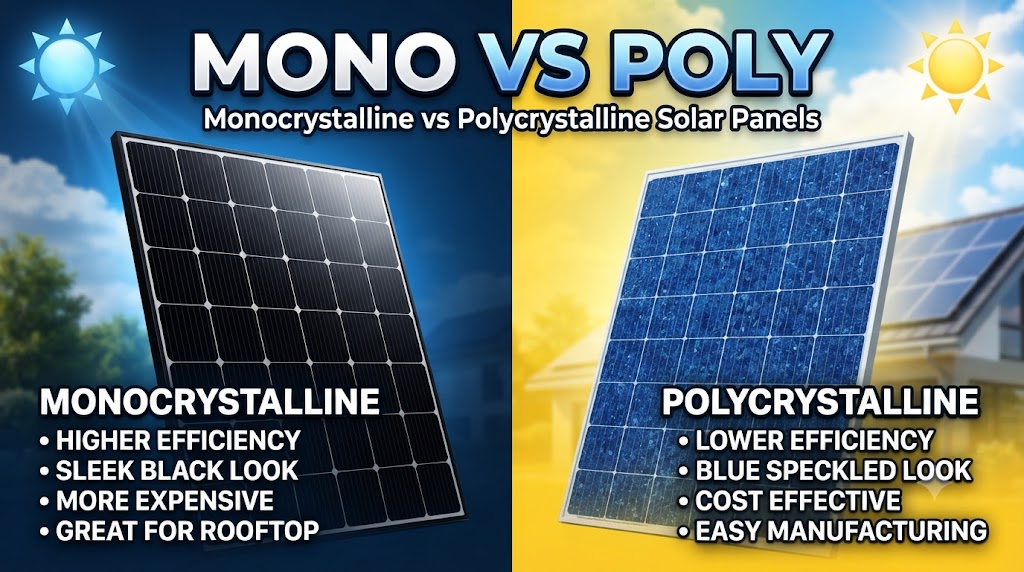
Solar panels are available in different technologies, and choosing the right type can affect electricity generation, installation costs and long-term performance. Monocrystalline and polycrystalline solar panels are two well-known types of photovoltaic panels. Both convert sunlight into electricity using silicon cells, but they differ in their manufacturing processes, appearance, efficiency and cost. Monocrystalline panels are made using single-crystal silicon, whereas polycrystalline panels are manufactured using multiple silicon crystal fragments melted together.
Choosing between these two solar panel types depends on your budget, available rooftop space and electricity requirements. Monocrystalline panels generally offer higher efficiency and better space utilisation, making them suitable for rooftops with limited installation areas. Polycrystalline panels are generally less expensive but require more space to produce a similar amount of electricity. Understanding their differences will help you make a suitable solar investment.
Quick Comparison Table
| Feature | Monocrystalline Panels | Polycrystalline Panels |
|---|---|---|
| Silicon Structure | Single-crystal silicon | Multiple silicon crystals |
| Appearance | Usually black or dark | Usually blue |
| Efficiency | Generally higher | Generally lower |
| Typical Efficiency | Around 20–23% | Around 15–18% |
| Space Requirement | Lower | Higher |
| Initial Price | Generally higher | Generally lower |
| Heat Performance | Depends on model; often favourable | Depends on model |
| Low-Light Performance | Generally good | Generally good |
| Manufacturing Process | Single-crystal growth | Silicon melting and casting |
| Installation Area | Smaller for similar output | Larger for similar output |
| Market Availability | Widely available | Less common in new installations |
| Best For | Limited roof space and higher output | Budget-focused installations with sufficient space |
Note: Efficiency ranges are indicative and vary by manufacturer, product generation and panel model.
1. What Are Monocrystalline Solar Panels?
Monocrystalline solar panels are made using silicon cells manufactured from a single continuous silicon crystal. This crystal structure allows electrons to move more efficiently through the material, helping the cells convert a greater proportion of sunlight into electricity.
These panels are commonly recognised by their dark black appearance and are widely used in modern residential, commercial and industrial solar installations. Their higher efficiency makes them useful for rooftops where installation space is limited and electricity generation needs to be maximised.
Advantages of Monocrystalline Solar Panels
- Higher Efficiency: They generally convert more sunlight into electricity per unit area.
- Space Saving: Fewer panels may be needed to achieve a particular system capacity.
- Modern Appearance: Their dark colour provides a clean and attractive rooftop appearance.
- Good Long-Term Performance: Quality monocrystalline panels can provide reliable electricity generation over many years.
- Wide Availability: Many manufacturers offer different capacities and advanced cell technologies.
- Suitable for Limited Roof Space: They are useful when the available installation area is restricted.
Disadvantages of Monocrystalline Solar Panels
- Higher Initial Cost: They generally cost more than comparable polycrystalline panels.
- Manufacturing Complexity: Producing single-crystal silicon requires a specialised manufacturing process.
- Performance Depends on Installation: Shading, high temperatures and incorrect orientation can reduce electricity generation.
- Potentially Higher Replacement Cost: Individual high-efficiency modules may cost more to replace, depending on the product.
2. What Are Polycrystalline Solar Panels?
Polycrystalline solar panels are manufactured using silicon that contains multiple crystal structures. During production, silicon is melted and poured into moulds, where it cools and forms solid blocks containing multiple crystals. These blocks are then cut into wafers and used to manufacture solar cells.
Polycrystalline panels are generally recognised by their blue, somewhat patterned appearance. They became popular because their manufacturing process was less expensive than traditional monocrystalline production. However, they generally offer lower efficiency and are less common in newer solar installations.
Advantages of Polycrystalline Solar Panels
- Lower Initial Price: They have traditionally been more affordable than monocrystalline panels.
- Simpler Crystal Manufacturing: Their production process does not require growing a single continuous crystal.
- Suitable for Larger Roofs: They can be used where sufficient installation space is available.
- Reliable Electricity Generation: Quality polycrystalline panels can provide dependable solar power.
- Established Technology: They have been used in residential and commercial solar installations for many years.
Disadvantages of Polycrystalline Solar Panels
- Lower Efficiency: They generally produce less electricity per square metre.
- Higher Space Requirement: More installation area may be needed to achieve the same system capacity.
- Less Common in Modern Markets: Many manufacturers have shifted towards newer monocrystalline technologies.
- Appearance: Their blue colour and crystal pattern may not suit every rooftop design.
- Limited New Product Choices: Availability of newer polycrystalline models may be more restricted in some markets.
3. Monocrystalline vs Polycrystalline Solar Panels: Key Differences
A. Efficiency
Monocrystalline panels generally have higher efficiency because their cells are made from single-crystal silicon. This structure allows better charge movement and reduces some energy losses.
Polycrystalline panels contain multiple crystal boundaries, which can reduce cell efficiency. As a result, they generally require more panel area to produce the same amount of electricity.
Winner: Monocrystalline Solar Panels for higher efficiency.
B. Initial Purchase Cost
Monocrystalline panels generally have a higher purchase price because their manufacturing process requires specialised single-crystal silicon production.
Polycrystalline panels have traditionally been less expensive due to their manufacturing process. However, market prices change, and the difference may vary depending on availability and manufacturer.
Winner: Polycrystalline Solar Panels for traditionally lower purchase cost.
C. Electricity Generation
Monocrystalline panels generally generate more electricity from the same installation area because of their higher efficiency.
Polycrystalline panels can also produce substantial electricity, but a larger number of panels may be required to achieve the same system capacity.
Winner: Monocrystalline Solar Panels for higher output from limited space.
D. Space Requirement
Monocrystalline panels are suitable for homes with limited rooftop space because they generally provide more power per square metre.
Polycrystalline panels generally need a larger installation area to generate an equivalent amount of electricity.
Winner: Monocrystalline Solar Panels for better rooftop space utilisation.
E. Appearance
Monocrystalline solar panels usually have a uniform black or dark appearance. Many homeowners prefer this look because it blends well with modern rooftop designs.
Polycrystalline panels generally have a blue colour with a visible crystal pattern. Their appearance may be less uniform than monocrystalline panels.
Winner: Monocrystalline Solar Panels for a darker, more uniform appearance.
F. Performance in Hot Weather
Both technologies experience a reduction in electricity output as their cell temperature increases.
Monocrystalline panels are not automatically better in every hot-weather situation. Temperature performance depends on the specific module’s temperature coefficient rather than simply whether it is monocrystalline or polycrystalline.
Compare the manufacturer’s temperature coefficient before purchasing either type.
Winner: Depends on the actual panel specifications.
G. Low-Light Performance
Both types can generate electricity under cloudy conditions and diffuse sunlight, although their output decreases when sunlight intensity is low.
Monocrystalline panels may provide an advantage because of their generally higher efficiency. However, low-light performance also depends on cell design, panel construction and electrical characteristics.
Winner: Monocrystalline Solar Panels in many comparable product selections, but the difference depends on the model.
H. Manufacturing Process
Monocrystalline panels use single-crystal silicon wafers, which require a controlled crystal-growing process.
Polycrystalline panels use silicon melted and cast into blocks containing multiple crystals. Their traditional manufacturing process was less demanding in some respects.
Winner: Polycrystalline Solar Panels for a simpler traditional crystal-forming process.
I. Availability and Technology
Monocrystalline panels are widely available and support several modern cell technologies, including PERC, TOPCon and HJT.
Polycrystalline panels are less common in many newer product ranges because manufacturers have increasingly focused on higher-efficiency monocrystalline technologies.
Winner: Monocrystalline Solar Panels for modern product availability and technology options.
J. Long-Term Performance
Both technologies can operate for many years when manufactured properly and installed correctly. Their actual degradation rates depend on cell design, materials, manufacturing quality and environmental conditions.
Monocrystalline panels often come with modern performance warranties and can provide higher electricity generation per installation area.
Winner: Monocrystalline Solar Panels in many current product comparisons, although individual warranty terms should always be checked.
4. Which Solar Panel Is Better for Different Users?
| User Requirement | Better Choice | Reason |
|---|---|---|
| Limited rooftop space | Monocrystalline | Higher efficiency |
| Lower initial budget | Polycrystalline | Traditionally lower price |
| Higher electricity generation per area | Monocrystalline | More power per square metre |
| Modern rooftop appearance | Monocrystalline | Uniform dark appearance |
| Large installation area | Both | Either may be suitable |
| New residential installation | Monocrystalline | Wider modern product selection |
| Commercial solar project | Monocrystalline | Higher efficiency and space utilisation |
| Lowest overall project cost | Depends | Compare complete installation quotations |
5. Which One Should You Choose?
Choose monocrystalline solar panels if you have limited rooftop space, want higher electricity generation per square metre and prefer modern solar technology. They are generally a practical choice for residential rooftops and installations where maximum power from a limited area is important.
Choose polycrystalline solar panels if you find a competitively priced product and have sufficient roof space for the required installation capacity. They can still generate useful electricity, but their availability in new markets may be limited.
Before purchasing, compare the panel’s rated wattage, efficiency, temperature coefficient, degradation warranty and price per watt. Do not select a panel based only on its technology name.
6. Final Verdict: Monocrystalline vs Polycrystalline Solar Panels
Both monocrystalline and polycrystalline solar panels convert sunlight into electricity, but monocrystalline technology generally offers better efficiency and space utilisation.
Overall Winner: Monocrystalline Solar Panels.
They are generally the better option for modern residential and commercial installations because they produce more electricity from a similar roof area and offer wider access to newer solar technologies.
Polycrystalline panels may still be suitable for budget-conscious projects where installation space is not a major concern and good-quality products are available.
For most new solar installations, monocrystalline panels are the more practical choice. Always compare actual product specifications, installation quotations and warranty conditions before making your final decision.
Frequently Asked Questions (FAQs)
1. Which is better, monocrystalline or polycrystalline solar panels?
Monocrystalline panels are generally better because they offer higher efficiency and require less rooftop space for similar electricity generation. Polycrystalline panels can be suitable for lower-budget projects.
2. What is the main difference between monocrystalline and polycrystalline panels?
The main difference is their silicon structure. Monocrystalline panels use single-crystal silicon, while polycrystalline panels contain multiple silicon crystals.
3. Why are monocrystalline solar panels more expensive?
Their traditional manufacturing process involves growing single-crystal silicon, which requires specialised production methods. However, actual prices depend on market conditions and manufacturers.
4. Which solar panel produces more electricity?
Monocrystalline panels generally produce more electricity per square metre because they have higher efficiency. Actual output depends on panel capacity, sunlight and installation conditions.
5. Which solar panel is better for home use?
Monocrystalline panels are generally a better option for homes because residential rooftops often have limited space. Their higher efficiency helps maximise electricity generation.
6. Are polycrystalline solar panels outdated?
They are an older and less commonly selected technology in many modern markets. Manufacturers have increasingly shifted towards monocrystalline products because of their higher efficiency.
7. Which solar panel is better in hot weather?
Neither technology is automatically better in every hot-weather condition. Compare the temperature coefficient of the actual panel models before making a decision.
8. How can I identify monocrystalline and polycrystalline solar panels?
Monocrystalline panels generally have dark black or uniform dark cells. Polycrystalline panels generally have a blue colour with a visible crystal pattern.
9. Do monocrystalline solar panels last longer?
Both types can have long operating lives. Lifespan and power retention depend on manufacturing quality, installation conditions, environmental exposure and warranty terms.
10. Are monocrystalline solar panels worth the extra cost?
They can be worth the additional investment when rooftop space is limited or higher electricity generation is important. Compare the total installation cost and expected electricity production before deciding.
Disclaimer
This comparison is intended for general educational purposes. Solar panel efficiency, prices, electricity generation, temperature performance, degradation rates and warranties vary by manufacturer and model. Actual performance depends on sunlight, weather, shading, installation angle and system configuration. Always check product specifications and warranty conditions and consult a qualified solar installer before purchasing or installing solar panels.